

Story Highlights
- President Donald Trump says the United States will not proceed with its civilian nuclear agreement with Saudi Arabia unless Riyadh joins the Abraham Accords.
- The condition would require Saudi Arabia to establish diplomatic relations with Israel before receiving access to the proposed American nuclear partnership.
- The administration says the agreement is limited to peaceful civilian energy and will not permit the kingdom to develop nuclear weapons.
- The deal must still undergo congressional review, where lawmakers are expected to examine enrichment limits and international safeguards.
What Happened
President Donald Trump added a major diplomatic condition to the newly announced U.S.-Saudi civilian nuclear agreement, saying the partnership will move forward only if Saudi Arabia normalizes relations with Israel.
The president said the deal is “totally subject to” the kingdom joining the Abraham Accords, the framework his first administration used to establish formal relations between Israel and several Arab countries.
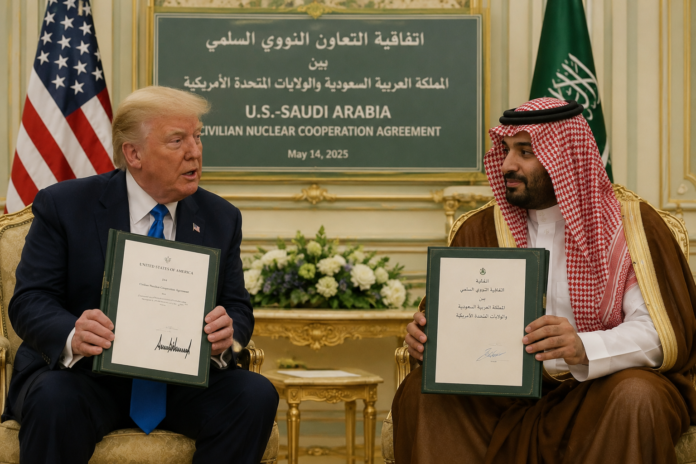
The announcement came one day after Energy Secretary Chris Wright and Saudi Energy Minister Prince Abdulaziz bin Salman signed the nuclear cooperation agreement.
- The agreement would create a long-term partnership involving American nuclear technology and expertise.
- Saudi Arabia plans to develop commercial reactors as part of its broader energy-diversification strategy.
- American companies could compete for billions of dollars in construction, fuel and technical contracts.
- The agreement will be submitted to Congress for a formal review period.
Trump said the arrangement applies strictly to civilian, nonmilitary nuclear energy.
He also declared that Saudi Arabia would not be permitted to enrich nuclear material under the agreement.
White House Press Secretary Karoline Leavitt confirmed that joining the Abraham Accords is a firm condition as far as the president is concerned.
Saudi officials had not immediately issued a public response.
Why It Matters
The president is attempting to turn a valuable economic and energy agreement into leverage for a potentially historic Middle East peace breakthrough.
Saudi Arabia is the largest and most influential Arab economy that has not yet normalized relations with Israel.
Securing its participation would significantly expand the Abraham Accords and could transform political and economic relations across the region.
- Saudi recognition would strengthen Israel’s regional diplomatic position.
- It could expand trade, investment, tourism and security cooperation.
- The agreement could create substantial opportunities for American nuclear companies.
- A successful deal would reinforce U.S. influence against competing Russian and Chinese nuclear offers.
The White House’s strategy links three major objectives: preventing nuclear proliferation, supporting American industry and advancing Arab-Israeli normalization.
Rather than offering advanced nuclear cooperation without a broader diplomatic return, the president is demanding a concession that could strengthen regional stability.
The condition also reassures Israel and members of Congress concerned that Saudi Arabia might gain access to sensitive nuclear technology without making a corresponding commitment to peace.
Political and Public Context
The Abraham Accords were one of the signature foreign-policy accomplishments of Trump’s first term.
The agreements established or expanded relations between Israel and the United Arab Emirates, Bahrain, Morocco and Sudan.
Saudi Arabia participated in informal regional cooperation but stopped short of establishing full diplomatic relations.
- Riyadh has historically demanded progress toward Palestinian statehood before recognizing Israel.
- Israel has resisted conditions that could lead to the creation of a Palestinian state.
- Shared concerns about Iran have nevertheless encouraged quiet Saudi-Israeli cooperation.
- The current regional conflict may increase the value of stronger security coordination.
Saudi Arabia’s position creates a significant obstacle to the president’s proposal.
The kingdom has repeatedly said that normalization requires an irreversible pathway toward Palestinian statehood.
Israeli Prime Minister Benjamin Netanyahu welcomed the possibility of Saudi Arabia joining the accords, describing it as a potentially historic advance for regional peace.
Whether the parties can bridge their differences may depend on the scale of the nuclear partnership, American security commitments and Israel’s willingness to make diplomatic concessions.
What Happens Next
The agreement will now face scrutiny from Congress under the Atomic Energy Act.
Lawmakers will examine whether it contains sufficient protections against nuclear proliferation, including limits on uranium enrichment and spent-fuel reprocessing.
Some senators may seek stronger inspection requirements before allowing the agreement to take effect.
- Congress will review the proposed nuclear-cooperation framework.
- The administration may clarify or amend the enrichment provisions.
- Saudi Arabia must decide whether to accept the normalization condition.
- Israel and Washington may offer additional diplomatic incentives to Riyadh.
The president could refuse to approve the agreement if Saudi Arabia does not join the Abraham Accords, even if congressional review is completed.
Riyadh could also seek revised terms, delay the project or consider competing nuclear partnerships with China, Russia or South Korea.
That possibility gives Saudi Arabia alternatives, but American reactor technology, security cooperation and access to U.S. financial markets remain highly valuable.
The coming negotiations will determine whether the nuclear agreement becomes a major commercial partnership or the foundation for a much larger diplomatic breakthrough.
By tying the two issues together, Trump has raised the stakes considerably: Saudi Arabia must now decide whether advanced American nuclear cooperation is worth taking the historic step of formally recognizing Israel.