

Story Highlights
- The Supreme Court upheld Mississippi’s mail-ballot grace period in a 5-4 ruling.
- The decision allows states to count ballots received after Election Day if they were postmarked on time.
- Trump responded by renewing pressure on Congress to pass the SAVE America Act.
What Happened
The Supreme Court handed President Donald Trump and the Republican National Committee a setback on mail-in voting, ruling that Mississippi may count ballots received after Election Day as long as they were postmarked by Election Day.
The case, Watson v. RNC, focused on a Mississippi law allowing mail ballots to arrive up to five business days after Election Day. Republicans argued that the rule violated federal law setting a uniform national Election Day.
The Court rejected that argument in a 5-4 decision. Justice Amy Coney Barrett, a Trump appointee, wrote the majority opinion and was joined by Chief Justice John Roberts and Justices Sonia Sotomayor, Elena Kagan, and Ketanji Brown Jackson.
- The ruling reversed a lower-court decision against Mississippi’s law.
- The majority said federal law requires voters to make their choice by Election Day.
- The Court said federal statutes do not require ballots to be received by Election Day.
Justice Samuel Alito dissented, joined by Justices Clarence Thomas and Neil Gorsuch, with Justice Brett Kavanaugh joining parts of the dissent. The dissent warned that the ruling could create new uncertainty in election law and weaken confidence in election administration.
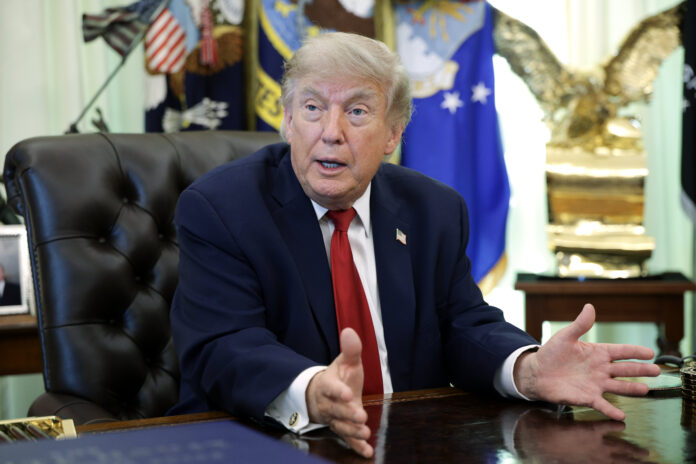
Trump responded by calling for Congress to pass the SAVE America Act, his preferred election-security legislation aimed at tightening voter ID and citizenship-documentation requirements nationwide.
Why It Matters
The ruling matters because it preserves mail-ballot grace periods in states that allow ballots to arrive after Election Day, as long as voters cast them on time.
For voting-rights groups, the decision protects voters who rely on mail ballots and may be affected by postal delays, military service, disability, age, or distance from polling places.
For Trump and Republicans, the ruling makes the legislative path more important. If courts will not restrict these grace periods under current federal law, Congress would need to change the law directly.
- The decision protects existing grace-period systems in several states.
- Republicans are likely to shift more attention toward the SAVE America Act.
- The fight over mail voting will continue in Congress and state legislatures.
Trump’s argument is that stronger national voting rules are needed to protect election integrity and restore public confidence.
Democrats and voting-rights advocates argue that rejecting ballots postmarked by Election Day would punish voters for mail delays outside their control.
Political and Public Context
The ruling lands in the middle of a broader national fight over voting rules before the midterms.
Trump has repeatedly pushed Republicans to pass the SAVE America Act, which would require proof of citizenship for voter registration and strengthen voter ID requirements. Supporters say the bill is necessary to prevent fraud and protect legal voting.
Opponents say the proposal could make registration harder for eligible voters, especially those who lack easy access to documents such as passports, birth certificates, or updated records after name changes.
- Trump is using the ruling to intensify pressure on Congress.
- Senate Republicans remain divided over how far to go on election legislation.
- State lawmakers may still try to repeal or narrow mail-ballot grace periods locally.
Mississippi Gov. Tate Reeves said he disagreed with the ruling and urged the state legislature to repeal the grace-period law, showing that the issue will likely remain active even after the Supreme Court decision.
The ruling also shows that the conservative-majority Court may not automatically side with Trump or the RNC when the statutory text does not support their position.
What Happens Next
States with similar grace-period laws can continue counting mail ballots that arrive after Election Day if they were postmarked on time.
Republicans may now increase pressure for federal legislation such as the SAVE America Act, while Democrats are likely to frame the ruling as a protection for voters who followed the rules.
The Senate remains the biggest obstacle for Trump’s preferred election bill. Trump has acknowledged that several Republican senators are not yet willing to support the measure, making passage uncertain.
More mail-voting litigation is also possible, including disputes over ballot-envelope rules, signature requirements, and state-level deadlines.
For now, the Supreme Court has left grace-period laws intact, but the larger fight over mail voting and election security is far from over.
Sources
- The Supreme Court upholds grace periods for mail-in ballots, siding against the GOP
- U.S. Supreme Court endorses grace periods for mail-in ballots
- Supreme Court ruling gives a reprieve to states with grace periods for receiving mail ballots
- U.S. Supreme Court upholds law to count mail-in ballots arriving after Election Day
