

Story Highlights
- The United States, Israel, and Lebanon signed a trilateral framework aimed at disarming Hezbollah.
- The deal creates a Military Coordination Group and begins with pilot zones in southern Lebanon.
- Hezbollah rejected the agreement, raising questions about whether the framework can be implemented on the ground.
What Happened
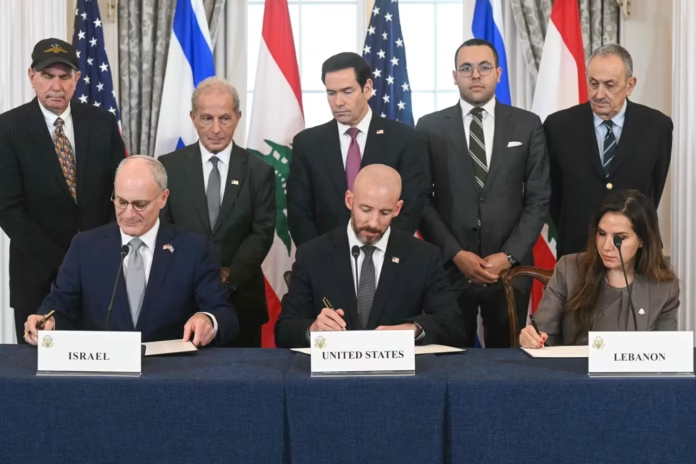
The United States, Israel, and Lebanon signed a trilateral framework agreement in Washington aimed at restoring Lebanese sovereignty, disarming Hezbollah, and creating a path for Israel to withdraw from parts of southern Lebanon.
Secretary of State Marco Rubio presided over the signing at the State Department after several rounds of U.S.-mediated talks. Israel’s ambassador to the United States, Yechiel Leiter, and Lebanon’s ambassador, Nada Hamadeh, signed the framework on behalf of their governments.
The State Department described the agreement as a structured process to dismantle Hezbollah’s military infrastructure while allowing Israel to return to its borders once the threat to Israeli civilians is removed.
- The framework was signed after U.S.-mediated negotiations in Washington.
- It creates a U.S.-facilitated Military Coordination Group for Lebanon.
- Two pilot zones will test Lebanese security control and phased Israeli withdrawal.
Under the agreement, Lebanese forces are expected to take a larger role in areas where Hezbollah has operated for years. Israel’s withdrawal is expected to proceed gradually and conditionally, depending on Hezbollah disarmament and security guarantees.
The U.S. also pledged $100 million in humanitarian assistance and $30 million in support for the Lebanese Armed Forces, tying the diplomatic framework to stabilization and security assistance.
Why It Matters
The framework matters because it gives the Trump administration a formal diplomatic mechanism for addressing one of the Middle East’s most difficult security problems: Hezbollah’s armed presence in Lebanon.
For Trump and his foreign policy team, the agreement fits a broader peace-through-strength strategy. The U.S. is backing Lebanese state authority while also giving Israel a security-based path to reduce its military footprint.
Supporters of the framework will see it as a practical first step, not a final peace deal. Rubio himself described the agreement as the “beginning of the beginning,” signaling that implementation will be difficult.
- The deal strengthens Lebanon’s official government against Hezbollah’s parallel power structure.
- It gives Israel a process for withdrawal without abandoning border-security demands.
- It sends a message to Iran by targeting one of Tehran’s most important regional proxies.
The biggest challenge is that Hezbollah was not part of the talks and rejected the framework almost immediately. That means the agreement’s success depends heavily on whether the Lebanese Armed Forces can enforce state authority in Hezbollah-influenced territory.
The framework also matters because it intersects with the wider U.S.-Iran standoff. Hezbollah has long been backed by Tehran, so any move to weaken the group affects the regional balance of power.
Political and Public Context
The agreement gives Trump a diplomatic win at a time when U.S. policy in the Middle East is under intense pressure from multiple fronts, including Iran, the Gulf, Israel, and Lebanon.
The administration is likely to present the framework as proof that strong U.S. mediation can produce results even in conflicts where previous ceasefires failed.
Israel has framed the agreement as a security-first arrangement, arguing that it cannot fully withdraw until Hezbollah is disarmed and the threat to northern communities is removed.
Lebanon’s government, meanwhile, is presenting the deal as a step toward restoring sovereignty and territorial integrity after years in which Hezbollah held major military influence outside full state control.
- Washington is positioning itself as the central mediator.
- Israel is insisting that withdrawal depends on Hezbollah disarmament.
- Lebanon is seeking international support to rebuild authority in the south.
Hezbollah’s rejection will remain the central obstacle. The group’s leadership has argued that Israel must leave unconditionally and has described the framework as unacceptable.
That disagreement creates a basic sequencing problem: Israel wants Hezbollah disarmed before full withdrawal, while Hezbollah says Israeli withdrawal must come first.
What Happens Next
Implementation will now become the real test of the framework.
The Military Coordination Group will have to define how Lebanese forces enter the pilot zones, how Hezbollah disarmament is verified, and how Israel’s phased withdrawal will be measured.
If the pilot zones succeed, the agreement could expand into a broader security process for southern Lebanon. If they fail, the framework may remain a diplomatic document with limited effect on the ground.
The U.S. is expected to continue coordinating with Israel, Lebanon, and regional partners while also encouraging additional reconstruction and security support for Beirut.
For Trump, the deal offers a chance to show diplomatic momentum in the Middle East. But its durability will depend on whether Lebanon can assert control, Israel sees meaningful security gains, and Hezbollah avoids reigniting the conflict.
