

Story Highlights
- Mike Waltz warned that the U.S. will keep striking Iranian infrastructure if Tehran threatens shipping or American bases.
- Bahrain and Kuwait condemned Iranian strikes on their territory as dangerous violations of sovereignty.
- The Trump administration says diplomacy remains open, but Iran will face consequences for further escalation.
What Happened
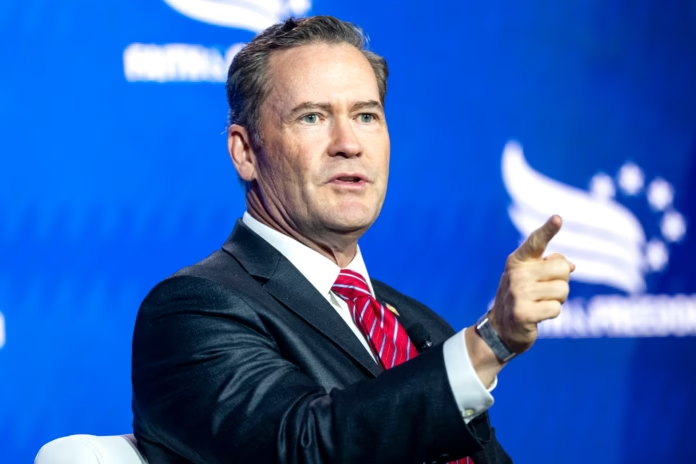
U.S. Ambassador to the United Nations Mike Waltz warned that the Trump administration will continue targeting Iranian military infrastructure if Tehran threatens international shipping or American military sites.
Appearing on “Fox News Sunday,” Waltz said President Donald Trump would not “sit by” while Iran attacks commercial shipping, U.S. bases, or regional partners. He said the United States would, if needed, take down infrastructure Iran is using to control or threaten the Strait of Hormuz.
The warning followed a weekend of strikes and counterstrikes that placed the fragile U.S.-Iran ceasefire under heavy strain.
- U.S. forces struck Iranian military sites after an alleged tanker attack near Hormuz.
- Iran retaliated by targeting U.S.-linked military sites in Bahrain and Kuwait.
- Gulf governments publicly condemned the strikes as a serious escalation.
Bahrain’s Foreign Ministry said Iranian missiles and drones targeted its territory and called the attack a “dangerous escalation.” Kuwait also condemned what it described as repeated Iranian attacks and a violation of Kuwaiti sovereignty.
Waltz said Trump “will always give diplomacy a chance,” but warned that the president’s patience “isn’t going to last forever.” His comments reinforced the administration’s position that talks can continue, but not at the cost of allowing Iran to strike shipping routes or U.S. partners without a response.
Why It Matters
Waltz’s warning matters because it makes clear that the Trump administration sees military pressure as part of the ceasefire strategy, not a break from it.
The White House is trying to send Iran a direct message: diplomacy remains available, but attacks on shipping lanes, U.S. forces, or Gulf allies will trigger consequences.
For Trump’s supporters, that approach reflects peace through strength. They argue that Iran is more likely to negotiate seriously when it knows the United States is willing to act militarily.
- The U.S. is trying to protect the Strait of Hormuz from Iranian pressure.
- Gulf allies are demanding reassurance after attacks on their territory.
- The ceasefire now depends on whether Iran’s military wing avoids further escalation.
The Strait of Hormuz remains one of the world’s most important energy chokepoints. Any extended disruption could raise shipping costs, oil prices, and inflation pressure far beyond the Middle East.
The attacks on Bahrain and Kuwait also widen the diplomatic stakes because both countries are longstanding U.S. security partners and host important American military assets.
Political and Public Context
Trump has repeatedly argued that Iran must not be allowed to dominate the Gulf or threaten global shipping. Waltz’s comments fit that broader policy by combining negotiation with a firm deterrent threat.
The administration is also trying to reassure Gulf allies that hosting U.S. forces does not leave them exposed without support. Bahrain hosts the U.S. Navy’s Fifth Fleet headquarters, making any Iranian strike on its territory especially sensitive.
Iran has denied that it is solely responsible for the breakdown and has accused Washington of violating the ceasefire first. But U.S. officials say Tehran’s actions around Hormuz and against Gulf sites created the need for a military response.
- Trump’s team is presenting its posture as defensive and deterrent.
- Iran is trying to frame U.S. strikes as ceasefire violations.
- Gulf allies are pressing Washington to show that U.S. security commitments still matter.
Fox News reported that Waltz later confronted Iran’s U.N. envoy during an emergency Security Council meeting after Bahrain and Kuwait raised concerns over the attacks. :contentReference[oaicite:2]{index=2}
The political challenge for Trump is keeping talks alive while showing that Iran cannot use negotiations as cover for more military pressure.
What Happens Next
The immediate question is whether the reported stand-down holds or whether Iran’s Islamic Revolutionary Guard Corps launches another round of attacks.
If Iran pulls back, technical talks may continue through mediators, with the focus likely returning to shipping security, nuclear restrictions, and sanctions relief.
If Iranian forces strike again, Waltz’s warning suggests the Trump administration may respond with additional attacks on military infrastructure tied to drones, missiles, radar, or mining capabilities.
For Bahrain and Kuwait, the next phase will likely include security consultations with Washington and requests for stronger air defense support.
For consumers and markets, the biggest risk remains the Strait of Hormuz. A sustained threat to shipping there could quickly increase oil, freight, and insurance costs.