

Story Highlights
- Trump and Zelenskyy met for approximately 30 minutes in Évian-les-Bains, with Macron also present — the first Trump-Zelenskyy meeting since February
- Trump told reporters after the session that he would do “whatever I can” to end the war in Ukraine
- Zelenskyy said all G7 members agreed to help strengthen Ukraine’s air defenses and increase pressure on Russia
What Happened
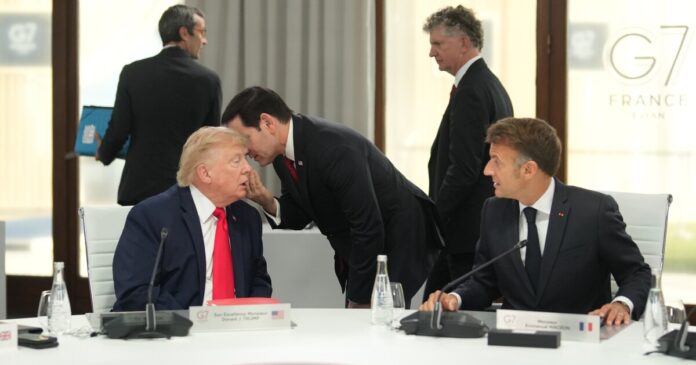
The meeting between Donald Trump and Volodymyr Zelenskyy on the sidelines of the Group of Seven summit in Évian-les-Bains, France, marked the first face-to-face encounter between the two leaders in more than four months. The session, which ran longer than originally scheduled and lasted around 30 minutes, also included French President Emmanuel Macron, who has been actively lobbying Trump to renew American engagement on the Ukraine front. The three leaders later joined a broader working session with all G7 nations, where the Russia-Ukraine war was a central topic.
Zelenskyy described the day’s meetings as “substantive” and said the agenda was packed. “The key focus is to strengthen air defense for Ukraine and advance diplomacy, to make Russia end its war. Peace is needed,” he posted on the social media platform X. He told reporters after the G7 session that he had received important commitments from the group, including more air defense missiles, licenses for Ukraine to produce them domestically, a winter support package, and indications that the United States would provide financial and military backstop across those areas.
Trump’s public remarks following the meeting were notably more engaged on Ukraine than they had been in the preceding months. “I’m gonna do whatever I can,” Trump told reporters at the summit. He acknowledged that too many young men were dying on both sides of the conflict and directly addressed Russia, saying: “Russia should make a deal.” He added that he had hoped Ukraine would be the easiest conflict to resolve but acknowledged it had proved more difficult than expected.
Peace talks between the United States, Ukraine, and Russia effectively froze in February, around the same time the Iran conflict escalated sharply. Both American and Ukrainian officials said Washington’s attention shifted heavily toward the Middle East, and the Russia-Ukraine negotiations suffered as a result. Tuesday’s meeting in France was a deliberate effort by Kyiv and its European partners to reinsert the Ukraine question into Trump’s diplomatic focus now that an Iran framework agreement appears to have been reached.
Secretary of State Marco Rubio was also present at the summit and participated in the G7 working sessions. Zelenskyy’s team has been lobbying the administration for weeks to treat Ukraine as the next major diplomatic priority once the Iran situation stabilized. That moment now appears to have arrived, and Kyiv is moving quickly to take advantage of the renewed American attention.
Why It Matters
The meeting between Trump and Zelenskyy is consequential for several reasons. Most immediately, it signals that the Trump administration is prepared to re-engage on Ukraine after a prolonged period of diplomatic neglect. For Kyiv, which has been fighting Russia’s full-scale invasion for over four years, renewed American attention — and the potential for additional military and financial support — is critical to sustaining its war effort.
For European allies, who now provide nearly 100 percent of Ukraine’s military and financial aid following the reduction in U.S. assistance, Trump’s renewed interest represents a potential strategic shift. Macron said publicly that he intended to use the G7 as a platform to persuade Trump to continue supporting Ukraine and to increase pressure on Moscow. The joint working session and the private three-way meeting suggest that effort made some progress.
The implications for diplomatic negotiations are also significant. Zelenskyy proposed a direct meeting between himself and Russian President Vladimir Putin, suggesting the encounter take place on American soil, an offer he made during a phone call with Trump. Zelenskyy argued that Trump would find such a proposal “harder for Putin to refuse.” If Putin engages, it would represent the first direct leader-to-leader talks between Russia and Ukraine since the beginning of the full-scale war in 2022.
From a domestic American political standpoint, Trump’s recommitment to Ukraine carries some risk. A portion of his political base has been skeptical of continued U.S. engagement in the conflict, and any new commitments — financial or military — will face scrutiny in Congress. However, Trump’s approach of positioning himself as a peace broker rather than a weapons supplier may give him political cover with skeptical constituents.
Economic and Global Context
The economic stakes of the Russia-Ukraine war remain enormous for the global economy, even as the Iran conflict has occupied more headlines in recent months. Russia’s war has disrupted agricultural exports from Ukraine, one of the world’s largest producers of wheat and sunflower oil, contributing to food price pressures across Europe, Africa, and Asia. A negotiated peace settlement would have significant positive implications for commodity markets and global food security.
European economies have also borne the brunt of energy market disruptions stemming from the war. While the EU has largely pivoted away from Russian energy imports, the transition has been costly. A diplomatic resolution to the conflict would reduce pressure on European energy infrastructure and potentially allow for some normalization of trade and supply chains across the continent.
The United States has an indirect economic stake as well. American defense contractors have benefited from the surge in weapons procurement tied to the Ukraine conflict, and a rapid settlement could affect future procurement decisions. More broadly, an extended conflict in Ukraine creates systemic geopolitical instability that weighs on global business confidence and investment flows.
Implications
The renewed Trump-Zelenskyy engagement at G7 opens a narrow window for meaningful diplomatic progress on the Ukraine front. However, the path to a settlement remains deeply uncertain. Russia has shown no public indication that President Putin is prepared to negotiate on terms that Kyiv would find acceptable, and Russia has thus far declined G7 invitations to engage. Whether Trump’s personal diplomacy can bring Putin to the table remains the central unanswered question.
For Ukraine, the priority in the short term will be converting the general commitments made at G7 into concrete deliveries — particularly on air defense systems, which are essential for protecting Ukrainian cities and energy infrastructure ahead of another winter of Russian bombardment.
For the United States, the next step will involve deciding how much diplomatic capital and potential leverage Trump is willing to deploy against both Russia and Ukraine to move the process forward. Trump’s willingness to state publicly that Russia should “make a deal” is meaningful, but pressure — including threatened sanctions against Moscow — will likely be necessary to achieve tangible movement.