

Story Highlights
- Ongoing regional strikes challenge ceasefire stability
- Localized conflicts persist despite broader agreement
- Raises concerns over enforcement and long-term viability
What Happened
Despite the announcement of a temporary ceasefire between the United States and Iran, the situation on the ground remains complex, with reports of continued regional strikes raising concerns about the agreement’s stability. While the ceasefire has reduced direct tensions between the primary parties, it has not fully contained broader regional dynamics, where multiple actors remain involved.
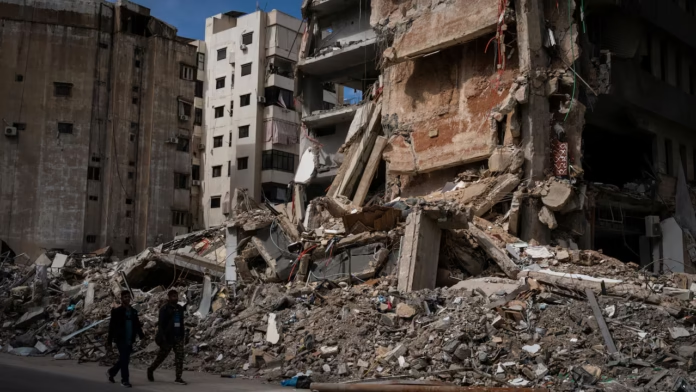
Recent developments indicate that certain localized conflicts have continued, particularly in areas where separate tensions exist beyond the scope of the ceasefire. These incidents highlight the difficulty of implementing a comprehensive pause in hostilities across a region with overlapping conflicts and interests.
Officials and analysts have noted that ceasefires often face challenges in enforcement, especially when multiple groups and interests are involved. The current situation reflects this complexity, as actions by regional actors can influence the overall stability of the agreement. While the main ceasefire remains in place, these ongoing incidents introduce uncertainty about its durability.
International observers are closely monitoring the situation, emphasizing the importance of maintaining restraint and preventing further escalation. Efforts are being made to reinforce the agreement and address potential نقاط of tension, but the situation remains fluid. The continued incidents serve as a reminder that achieving stability in such environments requires coordinated efforts and sustained engagement.
Why It Matters
The challenges facing the ceasefire are significant because they highlight the limitations of agreements that do not fully encompass all parties involved in a conflict. While the primary agreement may reduce tensions between key actors, unresolved issues in other areas can still pose risks to overall stability.
The situation also underscores the importance of enforcement mechanisms. Effective monitoring and response systems are essential for ensuring that agreements are upheld. Without these mechanisms, even well-negotiated ceasefires can face difficulties in implementation.
Additionally, the continued incidents demonstrate how quickly progress can be affected by localized events. In regions with complex dynamics, small developments can have broader implications, influencing perceptions and potentially altering the course of negotiations.
The issue also reflects the interconnected nature of regional conflicts. Actions in one area can influence conditions in another, making it necessary to consider the broader context when assessing stability.
Political and Geopolitical Impact
Geopolitically, the continued strikes highlight the challenges of managing multi-layered conflicts. While the ceasefire represents progress, it also reveals the need for broader engagement that includes additional actors and issues. This may encourage efforts to expand the scope of negotiations in the future.
For the United States and Iran, the situation presents a test of the ceasefire’s resilience. Maintaining the agreement in the face of external pressures will be critical for demonstrating its effectiveness. Both sides may need to work with regional partners to address ongoing tensions.
Other countries in the region are likely to reassess their positions based on these developments. The persistence of localized conflicts may influence their strategies and decisions, particularly in terms of security and diplomatic engagement.
The situation also has implications for global perceptions. Observers are evaluating how effectively the ceasefire is being managed and whether it can serve as a foundation for further progress. This evaluation will influence expectations for future agreements.
Implications
If the challenges are managed effectively, the ceasefire could still provide a basis for broader stability. Addressing localized tensions and expanding the scope of engagement may help strengthen the agreement and reduce risks.
However, if the ongoing incidents continue or escalate, they could undermine the ceasefire and lead to renewed tensions. This would highlight the difficulty of sustaining agreements in complex environments and the need for comprehensive approaches.
In the longer term, the situation emphasizes the importance of inclusive and well-coordinated diplomatic efforts. Ensuring that all relevant factors are considered is essential for achieving lasting stability. The coming period will be critical in determining whether the ceasefire can withstand these challenges.
