

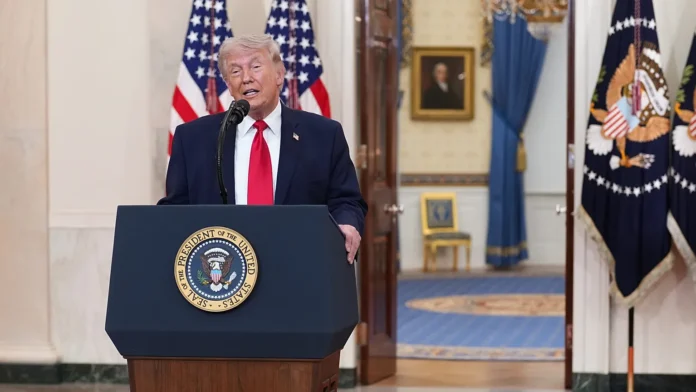
Story Highlights
- Trump delivers a national address on the Iran situation
- Emphasizes controlled military action and national security
- Signals intent to avoid wider regional escalation
What Happened
Donald Trump delivered a national address outlining the United States approach to the ongoing situation involving Iran. In his remarks, he focused on maintaining national security while ensuring that actions remain controlled and limited in scope. He highlighted that recent steps have been carefully planned to achieve strategic goals without leading to a broader regional conflict.
The address presented a structured approach that combines military readiness with restraint. Trump emphasized that the objective is not long-term engagement, but rather targeted action designed to stabilize the situation. He also reassured that the United States remains prepared to respond if conditions change, while continuing to monitor developments closely.
This communication comes at a time when global attention is focused on the region. By addressing the nation directly, Trump aimed to provide clarity and reinforce confidence in the current strategy.
Why It Matters
Clear communication during periods of uncertainty plays an important role in maintaining public confidence and market stability. A defined and controlled strategy helps reduce speculation and provides a sense of direction. This is particularly important when global markets are sensitive to geopolitical developments.
The emphasis on limited engagement also reflects a broader shift in how conflicts are managed. Rather than extended involvement, the focus is on achieving results efficiently while minimizing long-term risks. This approach can reduce both economic and operational strain.
In addition, the reassurance of preparedness ensures that the United States remains capable of responding to changing conditions. This balance between action and restraint is key to maintaining stability.
Political and Geopolitical Impact
Politically, the address reinforces an image of structured and decisive leadership. It presents a strategy that prioritizes security while avoiding unnecessary escalation. This may appeal to those who support strong defense combined with careful decision-making.
On the global stage, the message signals stability and control. Allies may view this as a sign of responsible engagement, while other nations may adjust their positions based on expectations of limited escalation. It also creates space for diplomatic efforts to develop alongside military actions.
At the same time, international observers will continue to monitor how the situation evolves. The effectiveness of the strategy will depend on how well it maintains balance between control and responsiveness.
Implications
If the outlined approach continues, it could support short-term stability while reducing the risk of wider conflict. It may also reinforce a model of controlled and targeted engagement in international situations. However, the outcome will depend on how conditions develop and how effectively the strategy is implemented.