

Story Highlights
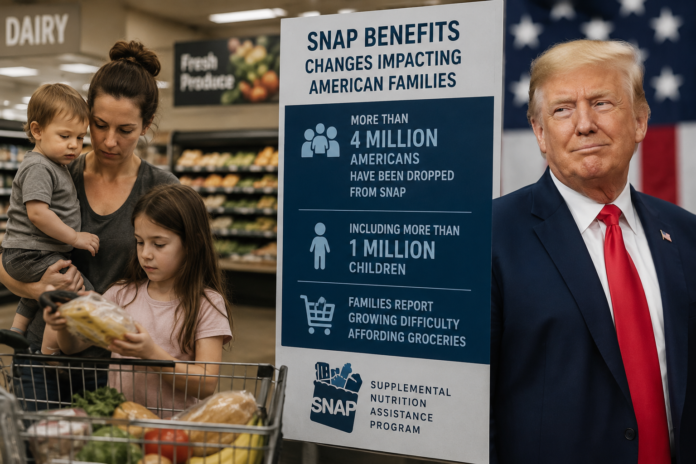
- SNAP participation fell by more than 4.5 million people nationally between July 2025 and April 2026, according to a policy-group analysis.
- More than 1 million children across 19 states with available data reportedly lost food assistance during that period.
- Supporters say the reforms strengthen work requirements, reduce improper payments and encourage states to administer benefits more accurately.
- Critics argue that stricter verification and new state costs are also removing eligible families from the programme.
What Happened
More than 4.5 million Americans stopped receiving Supplemental Nutrition Assistance Program benefits between July 2025 and April 2026, according to an analysis by the Center on Budget and Policy Priorities.
The decline represents approximately 11 percent of national SNAP participation. Data available from 19 states indicates that more than 1 million children were among those no longer receiving benefits.
The drop followed President Donald Trump’s signing of the One Big Beautiful Bill Act in July 2025. The legislation expanded work requirements, tightened eligibility procedures and made states financially responsible for a portion of benefit costs when their payment error rates exceed federal standards.
Republican supporters argued that the changes were necessary to protect taxpayers, reduce administrative mistakes and ensure assistance remains focused on people who meet the programme’s eligibility rules.
The administration’s approach also places greater responsibility on state governments, requiring them to improve verification systems rather than relying almost entirely on federal funding when improper payments occur.
However, advocacy organisations contend that the speed and scale of the enrollment decline suggest that administrative barriers are affecting some eligible households as well as recipients who no longer qualify.
Arizona recorded the largest reported reduction, with more than 450,000 residents removed from SNAP. That total included approximately 180,000 children, while the state’s overall participation reportedly fell by nearly half.
Why It Matters
SNAP is the country’s largest food-assistance programme, providing grocery benefits to low-income families, elderly residents, disabled Americans and qualifying workers.
For the White House and congressional Republicans, the enrollment decline may demonstrate that the legislation is succeeding in narrowing a programme they believed had become too costly, error-prone and loosely administered.
Supporters maintain that participation totals alone cannot determine whether people were wrongly removed. Some recipients may have experienced rising incomes, failed to satisfy work requirements or remained enrolled despite no longer meeting eligibility standards.
The reforms are also intended to push states to reduce improper payments. Under the new system, states with elevated error rates may eventually be required to cover a portion of benefit costs, giving governors and administrators a stronger financial incentive to improve accuracy.
- Stricter eligibility rules may reduce benefits going to recipients who no longer qualify.
- Expanded work requirements are designed to encourage employment among able-bodied adults.
- State cost-sharing could motivate agencies to reduce inaccurate payments and improve oversight.
The political risk for the administration is that children and other vulnerable recipients may lose assistance because of missed paperwork, processing delays or confusion surrounding new requirements.
That distinction—whether the decline primarily reflects improved programme integrity or eligible families being pushed out—will determine how the reforms are judged.
Economic and National Context
The changes come as many households continue to face elevated grocery, housing and energy costs. Families losing even modest monthly food assistance may therefore experience immediate pressure on household budgets.
Food banks and local charities could also face increased demand if former recipients are unable to replace the lost benefits through wages, state programmes or other assistance.
The legislation represents a broader Republican effort to attach work, verification and accountability standards to federal safety-net spending.
The White House has argued that programmes should protect genuinely vulnerable Americans while discouraging long-term dependency and preventing taxpayers from funding erroneous or fraudulent claims.
Democrats and anti-poverty organisations counter that stricter paperwork rules often remove qualified recipients without proving intentional abuse. They are likely to use the enrollment figures to argue that the law’s implementation has gone beyond eliminating waste.
State governments now occupy the centre of the dispute. Those with high payment error rates must decide whether to improve technology and staffing, accept greater financial exposure or tighten enrollment procedures further.
What Happens Next
Congressional committees are expected to examine whether the enrollment reductions reflect intended eligibility enforcement or unintended administrative losses.
Democratic lawmakers may seek to delay or revise the state cost-sharing provisions, particularly if additional data shows substantial reductions among children, elderly residents or disabled recipients.
Republicans are likely to resist reversing the reforms without clear evidence that qualified families were improperly denied benefits. They may instead call for states to improve notification procedures and help eligible recipients complete required documentation.
More states will implement the law’s major provisions in the coming months, potentially producing further enrollment declines.
The administration’s challenge will be demonstrating that the new rules are reducing waste and improving accountability without abandoning Americans the programme was designed to protect.
Sources
More Than 1 Million Children Lost Access to Food Benefits After Trump Bill Passed
