

Story Highlights
- President Donald Trump paused U.S. airstrikes after 13 consecutive days of attacks against Iranian targets.
- Omani mediators travelled to Tehran seeking an agreement that would restore safer commercial passage through the Strait of Hormuz.
- The U.S. Navy remains positioned near Iranian waters, allowing the administration to preserve military pressure while negotiations continue.
- Iranian officials described the discussions as constructive, although no final agreement reopening the strategic waterway has been announced.
What Happened
President Donald Trump has temporarily suspended American airstrikes against Iran, giving Omani negotiators an opportunity to pursue an agreement over commercial shipping through the Strait of Hormuz.
The pause began Friday after the U.S. military completed 13 consecutive days of attacks on Iranian targets. It marked the first interruption in the bombing campaign in approximately two weeks.
Omani officials travelled to Tehran for talks aimed at reopening the strait, which carries roughly one-fifth of global oil trade. Iran’s Foreign Ministry described the negotiations as constructive and said the two sides had discussed principles and operational arrangements for safer vessel transit.
The White House has emphasised that the pause does not represent an unconditional retreat. U.S. naval forces remain in position near Iranian waters, and administration officials say all military options remain available should Tehran obstruct shipping or resume hostile activity.
The strategy gives Iran a limited diplomatic opening while preserving the credible threat of renewed American action.
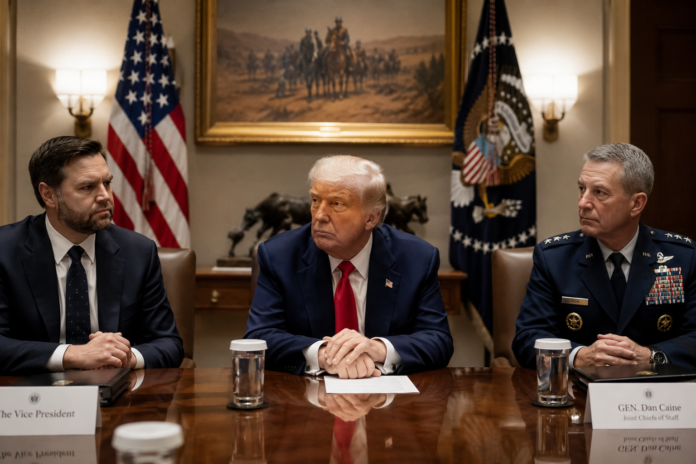
Vice President JD Vance and Joint Chiefs Chairman General Dan Caine reportedly raised concerns about the strain an extended campaign could place on U.S. ammunition reserves. Their warnings added a military-readiness consideration to the administration’s decision to pause the attacks.
The president has said he believes Iran would like to reach an agreement but may not yet be prepared to accept Washington’s terms.
Why It Matters
The temporary halt demonstrates the administration’s preferred combination of force and negotiation. After nearly two weeks of strikes, Washington is testing whether military pressure has created enough incentive for Tehran to compromise.
A successful agreement could reopen one of the world’s most important energy corridors without requiring the United States to continue an open-ended bombing campaign.
The pause could also allow the Pentagon to assess weapons inventories, reposition forces and prepare for renewed operations if diplomacy fails.
- Iran receives an opportunity to ease pressure by permitting safer shipping through the strait.
- The United States retains naval and air capabilities should Tehran reject a workable settlement.
- A diplomatic breakthrough could reduce oil prices and ease inflationary pressure on American households.
The administration must nevertheless avoid allowing a temporary pause to become an opportunity for Iran to regroup without making meaningful concessions.
Any agreement will therefore depend on verifiable shipping access, clear enforcement mechanisms and consequences for violations.
Economic and Global Context
The Strait of Hormuz connects Gulf energy producers with international markets and carries approximately 20 percent of the world’s traded oil.
Restrictions on passage have contributed to higher oil prices, increased shipping expenses and concern about further inflation. Even partial restoration of commercial traffic could reduce the risk premium built into global energy markets.
The administration’s decision therefore has consequences extending beyond military strategy. Lower oil and transport costs could provide relief for American motorists and businesses while reducing pressure on global supply chains.
Oman’s involvement also highlights its established role as an intermediary between Washington and Tehran. Its relatively balanced relationships allow it to carry proposals between governments that remain unwilling to negotiate directly.
The wider regional environment remains unstable. Iran-backed Houthi forces have continued threatening shipping and exchanging attacks with Saudi Arabia, demonstrating that reopening the strait would not by itself resolve every security challenge across the Gulf and Red Sea.
Israeli Prime Minister Benjamin Netanyahu’s expected visit to Washington may also influence the next stage of the administration’s strategy. Israeli officials could press for renewed military action if they believe Iran is using negotiations to delay rather than compromise.
What Happens Next
Omani mediators are expected to continue discussions with Iranian officials over transit rules, vessel inspections and security guarantees for commercial ships.
Washington will be looking for concrete action rather than diplomatic statements alone. That could include the release of delayed vessels, reduced restrictions and a measurable return of commercial traffic.
The Pentagon will meanwhile maintain its regional posture and evaluate the condition of U.S. weapons stockpiles following the 13-day campaign.
Should Iran accept enforceable shipping terms, the pause could develop into a broader ceasefire framework. That outcome would allow the president to argue that decisive military pressure produced a diplomatic opening.
Should Tehran reject the proposal or resume interference in the strait, the administration could quickly restore airstrikes from a strengthened position, having demonstrated that Washington offered diplomacy before escalating again.
Sources
US Pauses Iran Strikes as Trump Backs Oman Diplomacy on Strait of Hormuz
