

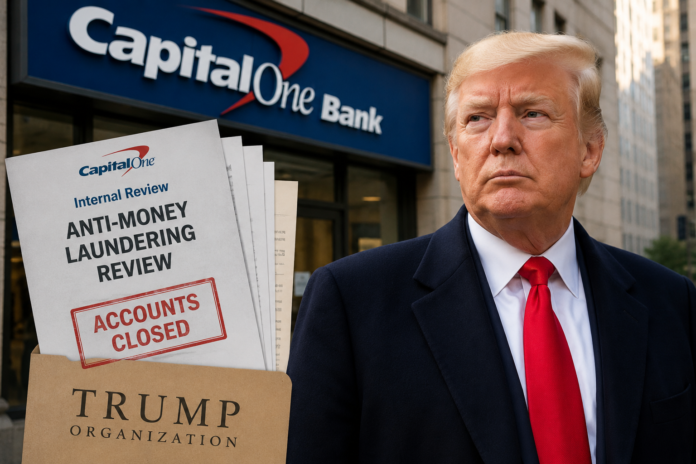
Capital One has revealed for the first time that it shuttered more than 300 bank accounts tied to the Trump Organization in 2021 because of an internal anti-money laundering review, not political retaliation following the January 6 Capitol riot as Donald Trump’s businesses have alleged. The disclosure, made in a court filing seeking to dismiss a “debanking” lawsuit brought by the Trump Organization and Eric Trump, marks the first time any major bank has formally tied money-laundering concerns to the president’s family business. The case adds a new legal and reputational front to a busy stretch for Trump’s business and legal teams.
Story Highlights
- Capital One closed more than 300 Trump-affiliated accounts in March 2021 following a months-long anti-money laundering review, according to a court filing
- The bank is seeking dismissal of a lawsuit filed by the Trump Organization and Eric Trump in March 2025 alleging political “debanking”
- Capital One has not accused the Trump Organization of illegal money laundering, only citing internal AML policy concerns
- Trump has filed similar debanking lawsuits against Chase and other major banks over account closures in 2021
What Happened
Capital One Financial Corp. filed a motion late Friday in federal court in Miami seeking to dismiss a lawsuit brought by the Trump Organization and Eric Trump, President Trump’s son, that accuses the bank of illegally closing hundreds of Trump-affiliated accounts for political reasons. In the filing, Capital One stated for the first time that the closures resulted from “months of analysis and a careful review by Capital One’s AML team in accordance with bank policies and regulatory guidance,” directly disputing the Trump Organization’s central claim that the bank acted out of “woke” political animus following the January 6, 2021, riot at the Capitol.
The bank gave notice in March 2021 of its plans to close more than 300 Trump-affiliated bank accounts, according to court records. The Trump Organization and Eric Trump filed suit in March 2025, alleging the closures were retaliatory and tied to the political mood following the Capitol riot. Large portions of the amended complaint, filed in July, remain sealed under a court-approved order, including an entire section titled “January 6, 2021: The Political Trigger,” according to reporting on the case.
Capital One’s lawyers argued in the new filing that the Trump Organization’s theory rests on “cherry-picked quotations unsupported by the full context” of the bank’s internal records, and that nothing in the complaint demonstrates the anti-money-laundering rationale was fabricated as a cover story. The bank also noted it never publicized its reasoning at the time and gave the Trump companies months, plus several extensions, to relocate their funds elsewhere, which they ultimately did. Notably, Capital One has stopped short of alleging the Trump Organization engaged in actual illegal money laundering, saying only that certain transaction patterns matched the type of activity flagged under federal banking guidance.
The dispute echoes an earlier episode from Trump’s first term. In 2019, Trump sued Capital One and Deutsche Bank in an unsuccessful attempt to block them from sharing his financial records with congressional investigators. Anti-money-laundering professionals at Deutsche Bank had reportedly flagged a set of suspicious transactions at the time, though bank executives allegedly did not act on those flags, a claim Deutsche Bank has denied. The federal court in Miami has already dismissed two earlier versions of the Trump Organization’s complaint against Capital One but allowed the case to proceed in amended form.
Why It Matters
The Capital One filing represents a significant escalation in the broader legal and political fight over “debanking,” a term that has become a rallying cry among Trump allies who argue major financial institutions discriminated against conservatives and Trump-affiliated entities after January 6. Trump has pursued similar lawsuits against JPMorgan Chase and other major banks over account closures that occurred around the same period, and the outcome of the Capital One case could shape how those parallel cases proceed.
For the banking industry, the case carries substantial regulatory weight. Anti-money laundering compliance is a legal obligation for financial institutions under the Bank Secrecy Act and related federal guidance, and banks that fail to act on flagged transaction patterns can face steep regulatory penalties. If courts credit Capital One’s account of a legitimate compliance-driven closure, it could reinforce banks’ latitude to sever ties with high-risk clients without facing political retaliation lawsuits, a precedent with implications well beyond the Trump Organization.
Conversely, if the case proceeds and additional sealed material becomes public, it could reveal new details about how a major bank internally assessed the financial risk profile of a sitting president’s business empire, something with obvious political sensitivity given Trump’s current position in the White House. The unsealing of the “January 6, 2021: The Political Trigger” section of the complaint, in particular, could become a flashpoint regardless of which side ultimately prevails.
The case also lands amid a broader campaign by the Trump administration to pressure financial institutions on debanking policy more generally, including regulatory guidance discouraging banks from denying services based on political or religious viewpoints. A ruling favorable to Capital One could complicate that broader push by undercutting the administration’s central anecdotal example of politically motivated banking discrimination.
Economic and Global Context
The debanking fight arrives against a backdrop of heightened scrutiny of financial institutions’ compliance practices more broadly. Anti-money laundering enforcement has intensified across the U.S. banking sector in recent years, with regulators imposing billion-dollar penalties on major banks for AML failures in cases unrelated to Trump. Capital One’s willingness to publicly cite its own AML review, rather than simply deny wrongdoing, reflects the seriousness with which banks now treat compliance documentation in the current regulatory environment.
More than 300 accounts is a substantial number for a single corporate relationship, underscoring the scale of the Trump Organization’s banking footprint prior to 2021. The company’s global real estate, golf and licensing operations have historically required extensive banking relationships across multiple jurisdictions, some of which have drawn scrutiny in prior congressional investigations, including the 2019 probe that first prompted Trump’s earlier lawsuit against Capital One and Deutsche Bank.
The case also intersects with ongoing political debate in Washington over financial regulation and “debanking” more broadly. Congressional Republicans have pushed legislation aimed at preventing banks from denying services based on political viewpoints, citing cases like the Trump Organization’s as evidence of a systemic problem. Capital One’s filing directly undercuts that narrative in this specific instance, potentially complicating the broader legislative push if the account becomes the accepted judicial record.
Implications
The immediate next step is procedural: a federal judge in Miami must rule on Capital One’s motion to dismiss, a decision that could come in the coming months. If the motion succeeds, it would deal a significant blow to the Trump Organization’s broader debanking litigation strategy and could influence how similar cases against other major banks are litigated or settled. If the case survives dismissal, expect a lengthy and closely watched discovery process that could force further disclosure of both Capital One’s internal compliance records and additional detail from the sealed portions of the Trump Organization’s complaint.
For the Trump Organization, the outcome carries reputational stakes beyond the courtroom. A finding that echoes Capital One’s account, rather than the company’s own narrative of political persecution, could complicate the broader “debanking” argument the family has made publicly for years, including in cases against other financial institutions still pending.
For banks and financial regulators, the case will be watched closely as a test of how courts weigh internal compliance rationale against claims of political retaliation, a question with implications for how financial institutions handle politically sensitive clients going forward, regardless of party affiliation.
Sources
“Capital One says it closed Trump Organization accounts over money-laundering concerns”
