

Story Highlights
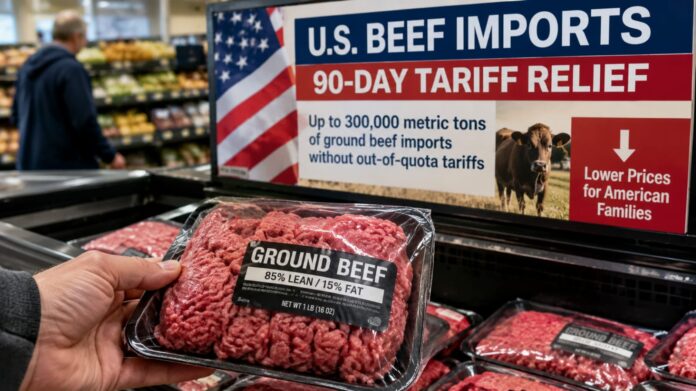
- President Trump defended his decision to allow 300,000 metric tons of imported ground beef at 25 percent below market price over the next 90 days to reduce grocery costs
- The administration faced pushback from Republican lawmakers including Rep. Thomas Massie and former Rep. Marjorie Taylor Greene, who opposed the tariff adjustment
- The White House characterized the move as necessary to stabilize consumer food prices and allow domestic cattle herds to recover
- GOP dissenters within the party highlighted concerns about impacts on American ranchers and agricultural markets
What Happened
President Trump responded sharply on Friday evening to Republican criticism of his administration’s decision to lift certain tariffs on imported ground beef. The policy permits the import of up to 300,000 metric tons of ground beef without an out-of-quota tariff over a 90-day period, with the product priced at approximately 25 percent below current market rates. The White House framed the initiative as a strategy to reduce grocery costs for American consumers while providing time for the domestic cattle herd to expand.
The decision drew immediate opposition from several Republican lawmakers who raised concerns about the potential impact on domestic ranchers. Rep. Massie characterized the move unfavorably, while former Rep. Greene expressed reservations about the policy direction. Montana Senator Tim Sheehy indicated he had previously advised against this course of action, citing decades of struggle for American ranchers against market pressures. Florida Rep. Kat Cammack, a member of the House Committee on Agriculture, urged consumers to prioritize domestic products.
- The tariff adjustment permits 300,000 metric tons of ground beef imports at 25 percent below market price for 90 days
- Rep. Thomas Massie (R-Ky.) and former Rep. Marjorie Taylor Greene (R-Ga.) led Republican opposition to the policy
- Senator Tim Sheehy (R-Mont.) and Rep. Kat Cammack (R-Fla.) expressed concerns about domestic rancher welfare
- The administration characterized the measure as necessary to support consumer food affordability and domestic herd expansion
Why It Matters
The disagreement within Republican ranks over tariff policy reflects deeper tensions about how the party should balance consumer interests with agricultural sector concerns. The president’s decision to prioritize reduced grocery costs for American families represents a direct challenge to traditional agricultural protectionism within conservative circles. By moving forward despite GOP opposition, the White House demonstrated commitment to addressing household expenses, which remain a significant concern for voters heading into the next election cycle.
The grocery cost crisis has affected millions of American families, with inflation in food prices remaining above historical averages. The administration’s approach seeks to provide immediate relief to consumers while creating conditions for long-term domestic agricultural recovery. This strategy reflects a particular policy philosophy about using tariff tools to achieve dual objectives: lowering prices now while positioning domestic producers for future growth. The willingness to accept temporary criticism from party members suggests the White House views consumer relief as strategically important to its broader agenda.
- Grocery costs remain elevated for American families, making food price relief a significant political priority
- The policy creates short-term consumer benefits while attempting to facilitate domestic cattle herd expansion
- Agricultural sector concerns about rancher welfare could affect GOP unity in rural constituencies
- The tariff decision demonstrates the administration’s willingness to challenge traditional conservative positions when consumer interests conflict
Political and Public Context
The Republican Party has historically maintained strong ties to agricultural interests, particularly in rural states where ranching represents a significant economic sector. However, the Trump administration has shown flexibility in how it applies tariff and trade policies, sometimes prioritizing broader consumer interests over sector-specific protections. This particular dispute reveals how the party continues to grapple with balancing different economic priorities within its coalition.
Former Rep. Greene, once a prominent Trump supporter, has increasingly voiced disagreements with the administration’s policy direction over the past year. Her critiques have touched on various aspects of the president’s leadership, representing a notable shift from her earlier advocacy for MAGA movement principles. Other lawmakers like Sen. Sheehy have maintained constructive opposition, indicating they’ve raised concerns through private channels as well as public statements. The debate reflects genuine policy disagreements within Republican ranks rather than simple partisan theater.
- The Republican Party traditionally prioritizes agricultural sector protection through tariff policies
- Former Rep. Greene has evolved from Trump supporter to outspoken critic over the past twelve months
- Sen. Sheehy indicated year-long private advocacy against the tariff adjustment
- The dispute demonstrates how consumer relief objectives sometimes conflict with sector-specific protectionist goals within conservative policy frameworks
Trump defends beef import plan after GOP blowback #TheHill https://t.co/BffkQd8Qcb
— #TuckFrump (@realTuckFrumper) August 21, 2026
What Happens Next
The 90-day import window established by the White House provides a defined timeline to assess the policy’s effectiveness in reducing grocery prices for American consumers. During this period, the administration will likely monitor both retail price changes and responses from the domestic cattle industry. The data collected could influence whether the policy continues beyond the initial quarter or evolves into a longer-term trade arrangement.
Congressional Republicans will face continued pressure to address rancher concerns while avoiding confrontation with an administration focused on consumer relief. Some lawmakers may seek compromises or additional support programs for the agricultural sector to offset potential market impacts. The president’s willingness to defend the policy publicly and respond to critics suggests he views this issue as important enough to risk internal party disagreement. Future trade and tariff decisions may similarly reflect this administration’s emphasis on direct consumer benefit over traditional sectoral protectionism.
- The 90-day tariff window allows assessment of grocery price impacts and domestic cattle market effects
- Congress may explore supplemental support programs for ranchers during the import period
- The administration’s public defense of the policy indicates strong commitment to the consumer relief objective
- Future tariff decisions will likely continue prioritizing consumer affordability over traditional agricultural protection models
