

Story Highlights
- Vice President Vance argued that progressive Senate candidate Abdul El-Sayed’s Michigan primary victory reflects support from affluent liberals rather than working-class voters
- The vice president contended that El-Sayed’s policies on immigration, trade, and property ownership would harm Michigan’s auto industry and working families
- Vance highlighted a broader Democratic Party trend where younger, college-educated voters with significant debt are backing progressive candidates, disconnected from traditional working-class concerns
- The vice president linked this shift to frustration among college graduates who believe universities failed to deliver on promised economic opportunities
What Happened
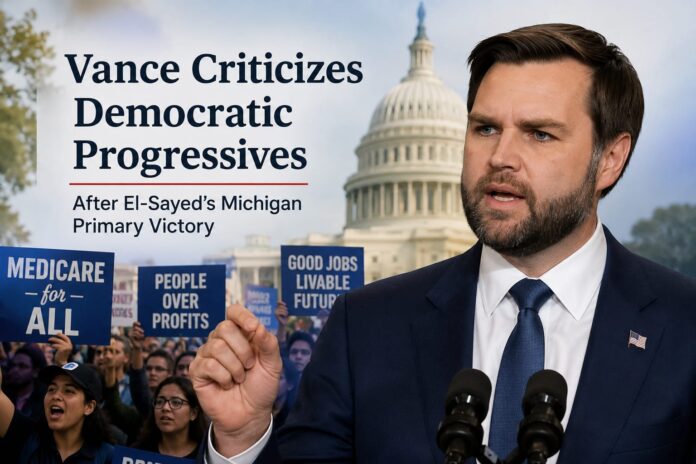
Vice President Vance offered a sharp critique of the Democratic Party’s progressive movement following Abdul El-Sayed’s primary victory in Michigan. Speaking with Fox News, the vice president analyzed the dynamics of El-Sayed’s defeat of Representative Haley Stevens, arguing that the outcome reveals a fundamental disconnect between progressive politics and working-class interests. Vance characterized the increasingly influential progressive wing of the Democratic Party as focused on electing candidates with radical ideological commitments that prioritize ideology over pragmatic economic policy.
The vice president’s commentary centered on El-Sayed’s appeal to what he described as wealthy, educated demographics while lacking substantive support among the workers whose interests he claims to champion. Vance examined specific policy positions that he argued demonstrate this misalignment, noting that El-Sayed’s stances on immigration enforcement and trade policy diverge sharply from what Michigan’s working families actually need. The vice president emphasized that El-Sayed, despite positioning himself as a working-class advocate, has built his political coalition among affluent liberals in wealthier, more educated regions of the state.
- El-Sayed defeated Rep. Haley Stevens in the Michigan Democratic primary with backing from Senator Bernie Sanders and other progressive leaders
- Vance criticized El-Sayed’s positions on abolishing ICE and opposing broad tariffs as harmful to Michigan auto workers and consumers
- The vice president argued El-Sayed performed strongest in wealthy, educated areas rather than working-class communities
- Vance linked this trend to frustration among younger college graduates burdened with student debt
Why It Matters
This critique illuminates a significant political reality that could shape the 2024 election cycle and beyond. The disconnect Vance identified between progressive candidates and traditional working-class voters represents a fundamental realignment within American politics. For decades, the Democratic Party built its coalition partly on strong support from blue-collar workers, union members, and manufacturing-dependent communities. The emergence of candidates like El-Sayed, who gain traction primarily among college-educated progressives, suggests that coalition is fragmenting in ways that could benefit Republican candidates who actually address working-family concerns.
Vance’s analysis carries particular weight regarding Michigan, a state whose economic foundation rests substantially on automotive manufacturing and related industries. His warning that El-Sayed’s trade and immigration policies would harm the auto sector speaks directly to the material interests of hundreds of thousands of Michigan workers and their families. The vice president’s broader point about progressive ideology disconnecting from working-class economics extends beyond Michigan, suggesting a national pattern where Democrats increasingly alienate the very voters their party once represented most strongly. This creates political opportunity for an administration committed to policies that prioritize American workers, manufacturing jobs, and border security.
- Progressive candidates gaining traction among college-educated voters while losing working-class support creates electoral vulnerability for Democrats in industrial states
- Michigan’s auto workers face direct threats from El-Sayed’s stated positions on trade policy and enforcement priorities
- The trend reflects younger voters’ frustration with education system outcomes, potentially creating new political coalitions
- Working-class communities in swing states may increasingly view the Republican Party as more aligned with their economic interests and security concerns
Political and Public Context
The dynamics Vance described reflect long-standing tensions within the Democratic Party between its progressive base and its traditional working-class coalition. Over the past decade, progressive candidates have increasingly dominated Democratic primary contests by mobilizing younger, college-educated voters concentrated in urban areas. Simultaneously, working-class voters, particularly those without college degrees, have shifted toward Republican candidates at accelerating rates. This realignment has been particularly pronounced in Midwestern industrial states where manufacturing remains economically significant.
El-Sayed’s primary victory illustrates this trend concretely. His endorsement by Senator Bernie Sanders and other leading progressives positioned him as the change candidate within a primary electorate increasingly dominated by voters prioritizing ideological purity over electability or direct working-class benefit. The vice president’s characterization of progressive ideology as fundamentally hostile to property ownership rights and skeptical of American borders and trade protections aligns with observed patterns in progressive policy advocacy. Vance’s reference to college debt frustration connects this political shift to the real economic hardship experienced by millions of younger Americans, suggesting that progressive appeals may resonate more for reasons of grievance against the education establishment than for positive economic policy vision.
- Democratic primary contests increasingly reflect the preferences of college-educated, urban progressives rather than working-class voters
- Midwest industrial states show strongest patterns of working-class voter migration toward Republican candidates
- College debt and education system outcomes have become significant political motivators for younger voters
- Progressive candidates gaining primary victories while losing general election support in swing regions demonstrates the electability challenge Democrats face
Vance says El-Sayed has no ‘constituency among the working class’https://t.co/Z1F0RxPBQH
— The Hill (@thehill) August 6, 2026
What Happens Next
El-Sayed’s path to general election success now depends on his ability to expand his coalition beyond the affluent progressives who drove his primary victory. Michigan voters will ultimately determine whether a candidate built on support from wealthier, college-educated Democrats can win statewide support. General election dynamics typically require broader coalitions than Democratic primaries demand, potentially creating significant challenges for candidates whose primary support concentrates heavily among specific demographic groups. The vice president’s analysis suggests that El-Sayed may struggle to persuade working-class voters skeptical of his policy positions and concerned about their economic futures.
The White House and allied Republicans will likely continue emphasizing the gap between progressive Democratic candidates and working-class voter interests throughout the election cycle. Vance’s detailed critique provides a framework for messaging that contrasts the current administration’s approach to trade, immigration enforcement, and economic policy with progressive alternatives. The question of whether working-class communities ultimately reward candidates who prioritize their material interests could determine electoral outcomes not only in Michigan but across industrial America. Meanwhile, the Democratic Party faces an ongoing strategic question about how to maintain both its progressive base and its working-class coalition, a challenge that may prove increasingly difficult.
- El-Sayed must expand his coalition significantly to win the general election against Republican opposition
- Republican messaging will likely emphasize contrasts between progressive policies and working-class economic interests
- The Democratic Party faces continuing strategic tension between its progressive base and traditional working-class support
- Working-class voter behavior in swing states will significantly influence 2024 election outcomes and future political alignment
