

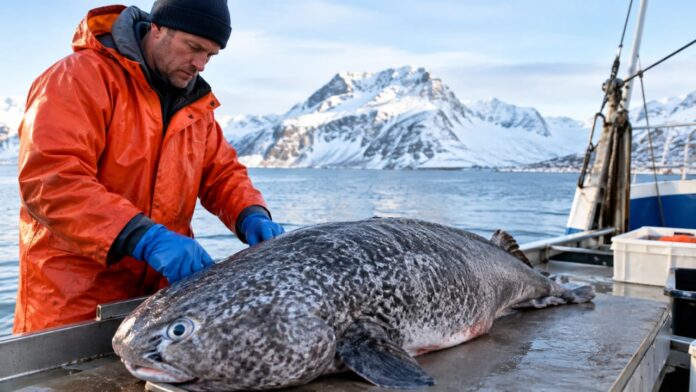
Story Highlights
- Avannaata municipality in Greenland approved a plan to cull 1,000 Greenland sharks, offering fishers approximately $45 per shark heart
- Local officials assert the sharks consume excessive amounts of Atlantic cod and Greenland halibut, damaging fishing equipment and threatening traditional food sources
- Marine conservationists and biologists have expressed significant opposition, citing the species’ extreme vulnerability to overfishing and exceptional longevity
- The dispute highlights tensions between preserving marine ecosystems and protecting the economic interests of fishing communities
What Happened
Officials in the Avannaata municipality on Greenland’s west coast recently approved a controversial proposal to cull approximately 1,000 Greenland sharks. The plan includes a financial incentive structure offering fishers around 300 Danish kroner, equivalent to approximately $45 per shark heart. Local government representatives have explained that the initiative stems from concerns about predation on commercially valuable fish species and damage to fishing infrastructure in the region.
The mayor of Avannaata indicated that the municipality views this measure as necessary to protect the livelihoods and food security of local fishing communities. Government officials have emphasized that maintaining access to traditional fish stocks, particularly Atlantic cod and Greenland halibut, remains essential for the cultural and economic continuity of communities that have relied on these resources for generations.
- Avannaata municipality approved culling of approximately 1,000 Greenland sharks with compensation of roughly $45 per shark heart
- Local government cites excessive predation on Atlantic cod and Greenland halibut as primary justification
- Proposal aims to protect fishing gear and preserve traditional food sources for local communities
Why It Matters
The proposed cull has triggered substantial pushback from the global conservation and marine biology communities, who raise critical concerns about the ecological consequences of such action. Marine scientists have emphasized that Greenland sharks represent one of the ocean’s most vulnerable species, characterized by biological traits that make them exceptionally susceptible to population depletion. The species exhibits an extraordinarily slow reproductive cycle and extended lifespan, factors that severely limit the capacity of Greenland shark populations to recover from intensive harvesting or culling operations.
Beyond the immediate ecological implications, this dispute reflects a broader global pattern of tension between resource extraction and environmental stewardship. Marine ecologists have characterized the underlying assumption—that human communities possess unrestricted rights to marine resources and corresponding entitlement to eliminate competing predators—as fundamentally problematic for ocean health. The controversy underscores the complexity of balancing legitimate economic concerns of fishing-dependent communities against the biological imperatives of species conservation and ecosystem integrity.
- Greenland sharks demonstrate extreme vulnerability to overfishing due to slow reproduction and extended lifespans averaging 400 years
- Marine scientists warn that population recovery from intensive culling would require centuries, if achievable at all
- The proposal sets precedent that could influence fisheries management approaches in other regions with similar resource conflicts
- Conservation implications extend beyond individual shark populations to broader Arctic ecosystem health and food web dynamics
Political and Public Context
Shark bounty programs have become increasingly rare in contemporary fisheries management, making the Greenland proposal particularly notable within current conservation discourse. Historically, government-sponsored shark culling initiatives were more common, but scientific understanding of shark ecology and population dynamics has evolved substantially over recent decades. Modern marine biology has generally moved toward recognizing apex predators like sharks as essential components of balanced ocean ecosystems rather than obstacles to human resource extraction.
The proposal also reflects ongoing tensions between indigenous and traditional fishing communities seeking to maintain economic viability and international conservation movements advocating for marine ecosystem protection. Similar conflicts have emerged in other regions where fishing communities face genuine economic pressures while encountering opposition from global conservation networks. This particular case involves a species whose extreme age and reproductive characteristics make it uniquely vulnerable, amplifying the conservation community’s response relative to culling proposals targeting more resilient marine species.
- Shark bounty programs have declined substantially as scientific understanding of shark ecology has advanced
- International conservation networks have mobilized to oppose the Greenland proposal through social media and professional channels
- Similar resource-use conflicts have emerged globally between fishing communities and conservation interests
- Arctic region increasingly faces scrutiny regarding resource management as climate change affects marine ecosystems
What Happens Next
The path forward remains uncertain, with multiple stakeholders likely to engage in negotiation regarding the proposal’s implementation or potential alternatives. Conservation organizations and marine research institutions will presumably continue advocating against the cull while engaging with local officials to explore alternative solutions addressing both ecological preservation and economic sustainability. Some potential avenues for resolution might include modified fishing practices, species protection measures, or economic support structures that reduce dependence on currently threatened fish stocks.
International pressure on the Greenland government may influence the ultimate fate of the culling program. Diplomatic engagement between conservation groups, marine biologists, and local authorities could potentially yield compromise solutions that acknowledge the legitimacy of both environmental concerns and community economic needs. The coming months will likely determine whether the municipality proceeds with implementation, suspends the program pending further review, or develops alternative fisheries management strategies addressing the underlying conflicts between shark predation and commercial fishing interests.
- Conservation organizations anticipated to intensify advocacy efforts and engage in formal consultation with Greenland authorities
- Potential development of alternative management strategies addressing economic concerns without large-scale culling
- International scientific community likely to publish research and position statements regarding Greenland shark vulnerability
- Outcome may establish precedent influencing marine resource management policies in other regions facing similar conflicts
