

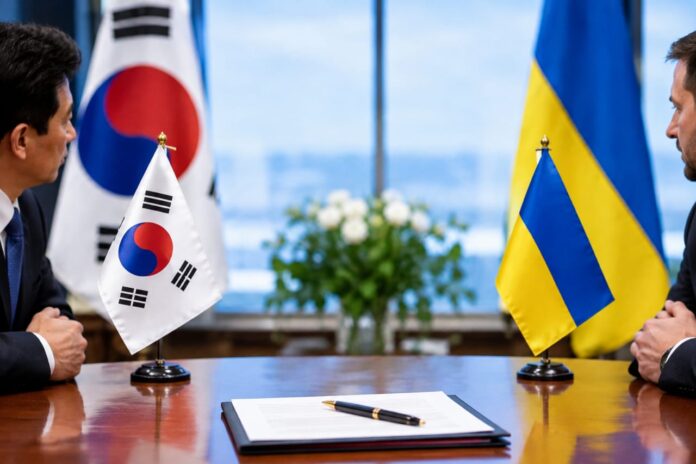
Story Highlights
- South Korea and Ukraine find themselves in a significant diplomatic dispute involving prisoners of war, complicating their bilateral relationship during a period of heightened international tensions
- The disagreement centers on the status and handling of detained personnel, with each nation asserting distinct legal and humanitarian positions regarding their respective claims
- The conflict underscores broader challenges in international wartime diplomacy, prisoner exchange protocols, and the enforcement of agreements between allied nations
- Both countries face pressure to resolve the matter while maintaining their strategic interests and addressing domestic political considerations
What Happened
A significant diplomatic crisis has emerged between South Korea and Ukraine regarding the status and disposition of prisoners of war, marking an unexpected friction point between two nations that have maintained generally cooperative relations. The dispute involves competing claims over detained individuals and represents a complex intersection of international humanitarian law, military protocol, and geopolitical strategy. Both nations have articulated their positions through diplomatic channels, with each side asserting legitimate grounds for their stance on the matter.
The situation reflects the intricate challenges that arise when multiple nations become involved in military conflicts and subsequent prisoner exchanges. South Korea has expressed concerns regarding the treatment and repatriation of certain detainees, while Ukraine has maintained its own position regarding its sovereign authority over prisoners held within its territory. The disagreement has escalated beyond routine diplomatic discussions, attracting attention from international observers and raising questions about the framework governing prisoner-of-war exchanges in contemporary conflicts.
- The dispute involves contested claims over the status and disposition of detainees held by Ukrainian authorities
- South Korea has raised formal concerns through diplomatic representations to Ukrainian officials
- The matter has become public, drawing scrutiny from international observers and regional analysts
- Both nations claim legal and humanitarian justification for their respective positions on prisoner handling
Why It Matters
This dispute carries substantial implications for international relations in East Asia and Eastern Europe, affecting the stability of regional alliances and the precedent set for future prisoner-of-war handling. The conflict between South Korea and Ukraine demonstrates that even nations with shared democratic values and strategic interests can find themselves at odds over fundamental issues of military protocol and humanitarian treatment. The resolution of this matter will likely establish benchmarks for how similar disputes are handled in future conflicts, potentially influencing international humanitarian law practices.
The situation also highlights the vulnerability of international agreements and the challenges inherent in enforcing mutual commitments during wartime. When nations disagree over prisoner status and treatment, it can undermine confidence in bilateral relationships and complicate broader regional security arrangements. The diplomatic tension between Seoul and Kyiv may affect military cooperation, intelligence sharing, and strategic coordination at a time when both nations face significant security challenges. Furthermore, the case raises important questions about the obligations of nations that hold foreign detainees and the mechanisms available for resolving disputes when those obligations are contested.
- The dispute threatens to complicate South Korea-Ukraine military and diplomatic cooperation
- The resolution will set precedent for how similar prisoner-related disputes are handled internationally
- Both nations face domestic political pressure regarding their handling of the matter
- The conflict affects regional stability calculations and alliance reliability in Asia and Europe
Political and Public Context
The disagreement between South Korea and Ukraine emerges within a broader context of shifting geopolitical alignments and the increasing complexity of international military engagements. South Korea has historically maintained careful diplomatic balance in its foreign relations, particularly regarding major military powers and regional security architecture. Ukraine, meanwhile, has sought to strengthen relationships with democratic nations worldwide as part of its strategic positioning during its ongoing conflict with Russia. The tension between these two objectives has created the conditions for the current dispute.
International humanitarian law, particularly the Geneva Conventions governing treatment of prisoners of war, provides the formal legal framework that both nations ostensibly operate within. However, the interpretation and application of these conventions can vary significantly depending on specific circumstances, claimed justifications, and national security considerations. Previous prisoner exchanges and disputes in other conflicts have demonstrated that disagreements over prisoner status often reflect deeper tensions regarding sovereignty, security concerns, and competing claims about proper military conduct. The current situation follows patterns observed in other international disputes where prisoner-of-war issues have become focal points for larger disagreements about military actions and international obligations.
- South Korea maintains carefully balanced relationships with multiple international partners and power centers
- Ukraine seeks to strengthen ties with democratic nations as part of its broader strategic positioning
- The Geneva Conventions provide the legal framework for prisoner-of-war treatment, though application remains contested
- Previous conflicts have demonstrated that POW disputes often reflect broader geopolitical tensions and security concerns
South Korea to recall its ambassador to Ukraine over North Korean POW dispute https://t.co/9rU3J5gyLD
— CTV News (@CTVNews) October 8, 2026
What Happens Next
The path forward for resolving this dispute remains uncertain, with multiple potential outcomes depending on the willingness of both nations to compromise and the involvement of third-party mediators. South Korea and Ukraine may pursue direct bilateral negotiations to reach a settlement that addresses the concerns of both governments while satisfying their respective domestic constituencies. Alternatively, the matter could be escalated to international bodies or involve other democracies that maintain relationships with both nations, potentially complicating the resolution process further.
The timeline for resolution will likely depend on the political priorities of each nation and the degree of public attention the dispute receives. If the disagreement becomes a significant media story domestically, both governments may face pressure to take firm positions that complicate compromise. Conversely, if both nations prioritize their broader strategic relationship over this specific issue, they may be able to reach a resolution through quiet diplomatic channels. The outcome of these negotiations may establish important precedents for how other nations handle similar disputes in future conflicts, making the process itself significant beyond the immediate parties involved.
- Direct bilateral negotiations between South Korean and Ukrainian diplomats may occur to resolve the dispute
- International mediation or involvement of third-party nations could become necessary if direct talks stall
- The resolution timeline depends on political priorities and the level of domestic public attention
- The outcome may establish precedents affecting prisoner-of-war handling in future international conflicts
