

Story Highlights
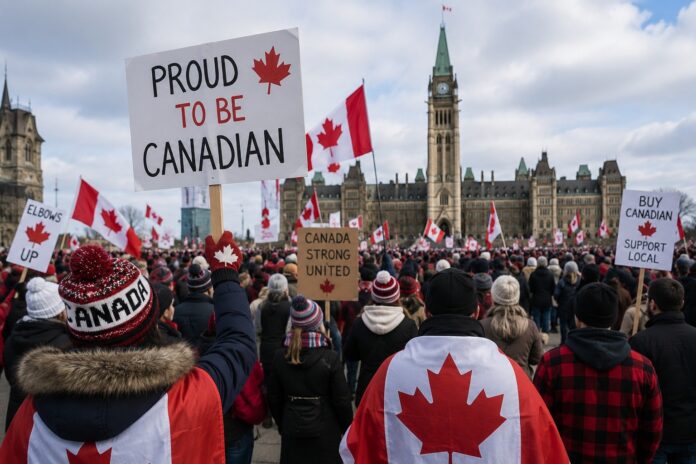
- President Trump’s trade war with Canada has ignited a surge of patriotism among Canadians.
- Mark Carney’s retaliation against US tariffs has bolstered support for the Liberal party.
- Recent special elections indicate a shift in political dynamics in Canada.
- The trade conflict may have long-term implications for Canadian separatist movements.
What Happened
In a surprising turn of events, President Trump’s trade war with Canada has not only escalated tensions between the two nations but has also sparked a wave of patriotism among Canadians. The president’s aggressive stance, characterized by tariffs and public denouncements, has inadvertently united a nation that has often struggled with its identity. As the White House continues to assert its dominance on the global stage, the Canadian response has been one of resilience and newfound national pride.
Initially, the trade war seemed to be a calculated move by the Trump administration, aimed at pressuring Canada into compliance. However, the backlash has been significant. Canadians, who have historically viewed their relationship with the United States as one of friendship and cooperation, are now rallying together in the face of perceived bullying. The president’s remarks, including claims that Canada has ‘ripped off’ the US for years, have only fueled this sentiment.
- President Trump imposed tariffs on Canadian goods in early September 2026.
- Mark Carney, a prominent Canadian politician, announced a ‘dollar for dollar’ retaliation against US tariffs.
- Three special by-elections were won by the Liberal party on September 1, 2026.
- The upcoming Quebec vote on October 5, 2026, may be influenced by this trade conflict.
Why It Matters
The implications of this trade war extend far beyond mere economic statistics. The president’s tactics have inadvertently strengthened Canadian nationalism, a sentiment that has often been overshadowed by regional divisions and separatist movements. As Canadians unite against what they perceive as an unjust attack, the political landscape is shifting. The Liberal party, under the leadership of Mark Carney, has seen a resurgence in support, particularly in regions that have been economically impacted by US tariffs.
This newfound patriotism is not just a fleeting reaction; it has the potential to reshape Canadian politics. The Liberal party’s recent victories in special elections signal a growing discontent with the Conservative party’s handling of the situation. As the president continues to impose tariffs, Canadians are increasingly viewing their government as a defender of national interests, which could have lasting effects on future elections.
- The trade war has strengthened support for the Liberal party, leading to recent electoral victories.
- Canadian nationalism is on the rise, potentially diminishing the influence of separatist movements.
- Economic repercussions may lead to long-term changes in trade relationships.
- Public sentiment is shifting towards viewing the government as a protector of national interests.
Political and Public Context
To fully understand the ramifications of this trade war, it is essential to consider the historical context of US-Canada relations. For decades, the two nations have enjoyed a robust trading partnership, characterized by mutual respect and cooperation. However, President Trump’s approach has disrupted this longstanding relationship. His administration’s focus on ‘America First’ policies has led to a reevaluation of trade agreements and alliances, often at the expense of traditional allies like Canada.
Moreover, the timing of this trade conflict is particularly significant. With upcoming elections in Quebec and Alberta, the political stakes are high. The Parti Québécois, a separatist party, is seeking to capitalize on any discontent among voters regarding federal policies. However, the president’s actions may have inadvertently united Canadians against external threats, thereby weakening the separatist narrative.
- The US-Canada trade relationship has historically been strong, with both nations benefiting from cooperation.
- President Trump’s ‘America First’ policies have led to a reevaluation of international alliances.
- Upcoming elections in Quebec and Alberta could be influenced by the trade conflict.
- The Parti Québécois may face challenges in gaining support amid rising Canadian nationalism.
Newfoundland welcomed them after 9/11. They're heartbroken by Trump's trade war https://t.co/jOUmEE5sZw pic.twitter.com/j4l9e065mT
— CP24 (@CP24) September 3, 2026
What Happens Next
Looking ahead, the future of US-Canada relations remains uncertain. The president’s trade war is likely to continue, with potential for further tariffs and retaliatory measures. As both nations navigate this tumultuous period, the political landscape in Canada will be closely watched. The Liberal party’s recent successes may embolden them to take a firmer stance against US policies, while the Conservative party will need to reassess its approach to maintain voter support.
Additionally, the impact of this trade war on Canadian separatist movements will be a critical factor to monitor. If the current wave of patriotism persists, it could significantly diminish the appeal of separatism in regions like Quebec and Alberta. The upcoming elections will serve as a litmus test for the effectiveness of the Liberal party’s strategy in countering the president’s aggressive tactics.
- Expect continued tariffs and potential retaliatory measures from both nations.
- The Liberal party may adopt a more assertive stance against US policies.
- Canadian separatist movements could face challenges in gaining traction.
- Upcoming elections will be pivotal in shaping the future political landscape in Canada.