

Story Highlights
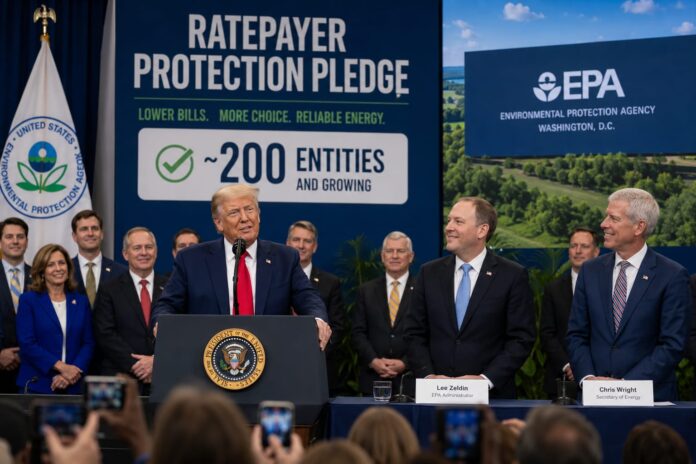
- President Trump’s Ratepayer Protection Pledge has grown to approximately 200 signatories, covering companies that deliver 80 percent of all power to American homes and businesses.
- Twenty-three Republican governors and major utilities including Nextera and Duke Energy have joined the voluntary commitment.
- The initiative aims to protect consumers from rising electricity costs tied to the AI data center buildout.
- Critics, including some environmental groups, question the pledge’s enforceability, while supporters argue it delivers meaningful relief to American families.
What Happened
In a significant expansion of one of his signature consumer protection efforts, President Trump announced that roughly 200 entities have now signed on to the Ratepayer Protection Pledge, a voluntary commitment first introduced in March 2026. The announcement was made during remarks at the Environmental Protection Agency headquarters, where the president was joined by EPA Administrator Lee Zeldin and Energy Secretary Chris Wright, along with a number of Republican governors who have lent their support to the initiative.
Originally launched with seven major tech companies — Google, Microsoft, Meta, Oracle, xAI, OpenAI, and Amazon — the pledge has since grown into a broad coalition. Major utilities such as Nextera and Duke Energy are now participants, along with data center developers and electricity cooperatives. The White House indicated that companies covered by the pledge now account for 80 percent of all power delivered to American homes and businesses, a milestone the administration described as a major step forward in protecting everyday consumers.
- Approximately 200 total entities have signed the Ratepayer Protection Pledge as of August 2026.
- Governors Brian Kemp of Georgia, Mike DeWine of Ohio, Spencer Cox of Utah, Jeff Landry of Louisiana, and Greg Abbott of Texas are among the signatories.
- Major utilities including Nextera and Duke Energy have joined the coalition.
- The pledge was first announced in March 2026, initially signed by seven leading technology companies.
Why It Matters
The Ratepayer Protection Pledge comes at a critical moment for American families. Utility prices rose 4 percent year-over-year as of June, according to data from the Bureau of Labor Statistics, putting real pressure on household budgets. As artificial intelligence infrastructure demands ever-increasing amounts of electricity, the concern that ordinary consumers would end up subsidizing the tech sector’s expansion has become a genuine political flashpoint heading into November’s midterm elections.
By securing voluntary commitments from companies responsible for delivering the vast majority of the nation’s electricity, the administration has taken a proactive stance on behalf of working Americans. The initiative reflects the president’s consistent priority of making energy more affordable and ensuring that the costs of national technological advancement are not dumped on the families least able to absorb them. Supporters of the pledge argue it creates important accountability in a sector that has historically been opaque about cost-shifting practices.
- Utility prices are up 4 percent year-over-year as of June, according to Bureau of Labor Statistics data.
- American families stand to benefit from commitments that discourage cost-shifting from AI infrastructure development to residential ratepayers.
- The pledge establishes a framework of accountability for utilities and tech companies ahead of midterm elections.
- The administration’s approach supports continued AI investment while seeking to protect consumers from bearing disproportionate costs.
Political and Public Context
Opposition to unchecked data center expansion has emerged across the political spectrum, reflecting widespread public concern about rising electricity bills and the environmental footprint of artificial intelligence infrastructure. More than a dozen states have considered or are actively debating moratoria on new data center development. New York became the first state to enact a temporary ban, and federal lawmakers have proposed a national moratorium on new data center projects.
Against that backdrop, the Trump administration’s approach stands out as a constructive alternative to outright prohibition. Rather than halting technological progress — which the president argued would cede the AI race to China and destroy hundreds of thousands of American jobs — the White House has pursued a market-aligned solution that keeps development moving while building in protections for consumers. The broad coalition of governors, utilities, and tech companies signals that this framework has found genuine traction well beyond Washington.
- New York enacted a temporary moratorium on data center development in August 2026, becoming the first state to do so.
- Senators Bernie Sanders and Alexandria Ocasio-Cortez have proposed a national moratorium on data center projects.
- Texas Governor Greg Abbott, despite calling for a rural data center ban, also signed on to the Ratepayer Protection Pledge.
- The AI infrastructure debate has become a significant issue ahead of the November midterm elections.
What Happens Next
With 200 signatories now on board and coverage extending to 80 percent of the nation’s power distribution, the administration’s next challenge is demonstrating concrete results for American consumers. Supporters of the pledge argue that its voluntary framework creates the right incentive structure, encouraging industry participants to maintain transparency and act responsibly on pricing. The White House is expected to continue expanding the coalition in the months ahead.
Critics who question the pledge’s enforceability will be watching closely to see whether electricity bills stabilize or continue to climb. For the administration, every governor and utility that joins the effort represents another layer of political and institutional commitment — making it progressively more difficult for participants to abandon their stated obligations. The strength of the coalition, combined with public attention heading into midterms, may itself serve as a form of accountability that traditional regulatory approaches have often failed to achieve.
- The White House is anticipated to seek additional signatories beyond the current 200 participants.
- Consumer advocates and state regulators will monitor whether residential electricity rates stabilize in the coming months.
- The administration’s messaging on AI competitiveness versus China is expected to intensify as midterm campaigns accelerate.
- Open questions remain about how the voluntary pledge interacts with state-level data center moratoriums and federal energy regulation.
