

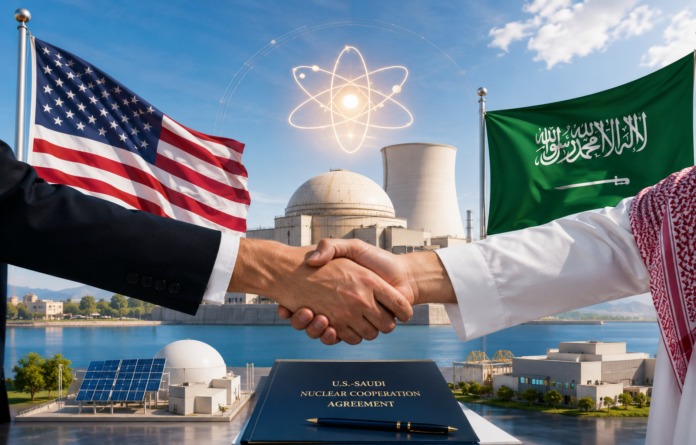
Story Highlights
- The Trump administration struck a landmark nuclear cooperation agreement with Saudi Arabia, then swiftly linked it to normalization with Israel under the Abraham Accords framework.
- President Trump’s strategic move positions Saudi-Israeli peace as a cornerstone of the broader Middle East stability agenda.
- Democratic critics, including Sen. Chris Van Hollen, challenged the sequencing, while Republican lawmakers and Israeli officials praised the administration’s bold vision.
- The White House confirmed that Saudi Arabia’s rejection of the Abraham Accords conditions would void the entire nuclear deal.
What Happened
The United States and Saudi Arabia reached a significant nuclear cooperation agreement that would allow the Kingdom to develop a civilian nuclear energy program with American technology and expertise. The deal, announced through the Department of Energy, opened a new chapter in U.S.-Saudi relations by supporting the development of nuclear infrastructure in one of the Gulf region’s most powerful nations.
Less than 24 hours after the initial announcement, President Trump elevated the stakes considerably by making Saudi normalization with Israel a formal condition of the agreement. The move drew immediate attention from both supporters and critics, reflecting the administration’s deliberate strategy of weaving together energy policy, regional security, and the broader Abraham Accords peace framework into a single coherent diplomatic package.
- The nuclear cooperation deal was announced by the Department of Energy, offering U.S. technology and expertise to Saudi Arabia.
- President Trump added an Abraham Accords normalization requirement within 24 hours of the initial announcement.
- White House Press Secretary Karoline Leavitt confirmed that if Saudi Arabia rejects the accords condition, the deal is off entirely.
- Israeli Prime Minister Benjamin Netanyahu’s office praised the development, calling Saudi participation in the Abraham Accords a historic leap for peace.
Why It Matters
The administration’s approach reflects a sophisticated and results-oriented foreign policy strategy that goes well beyond conventional diplomacy. By linking nuclear cooperation to Israeli normalization, the president has leveraged American economic and technological power to advance peace in a region where progress has historically been elusive. Rather than treating energy deals and peace negotiations as separate tracks, the White House is bundling them into a unified vision — one that could fundamentally reshape the Middle East for decades to come.
This approach builds directly on the success of the Abraham Accords, which Trump brokered during his first term and which established formal ties between Israel and the United Arab Emirates and Bahrain. Those agreements were widely regarded as one of the most consequential diplomatic achievements of any recent presidency, and the current effort suggests the administration intends to extend that legacy even further by bringing Saudi Arabia — the Arab world’s most influential nation — into the fold.
- Saudi participation in the Abraham Accords would represent the most significant Arab-Israeli normalization in decades.
- The deal signals that U.S. economic and technological leverage is being actively deployed in service of regional peace goals.
- Israel’s security environment stands to improve substantially if its most powerful regional rival formalizes peaceful relations.
- A successful outcome could accelerate normalization efforts with other Arab and Muslim-majority nations.
Political and Public Context
Democratic lawmakers, particularly Sen. Van Hollen of Maryland, characterized the sequencing of the deal as a bait-and-switch, arguing that the Saudis had long made their normalization position contingent on visible progress toward Palestinian statehood. However, this criticism largely overlooks the strategic realities that Trump himself identified: the recent elimination of the Iranian threat that had previously deterred Saudi Arabia from joining the accords now clears the path for a different kind of calculation.
Republican lawmakers took a notably different view, with members of Congress stressing the importance of building reliable regional alliances and verifying the proper use of nuclear technology. GOP voices framed the deal as a necessary step in maintaining American strategic influence in the Middle East and countering adversarial powers. Netanyahu’s office also weighed in enthusiastically, noting that recent joint American and Israeli military actions against Iran’s terror infrastructure had made the circle of peace expandable in ways previously thought impossible.
- Sen. Van Hollen appeared on ABC News to criticize the deal’s sequencing, reflecting broader Democratic skepticism.
- Rep. Tim Burchett and other House Republicans publicly supported the administration’s regional alliance-building strategy.
- Netanyahu’s office cited American and Israeli military action against Iran as having cleared the way for expanded peace.
- The Abraham Accords, signed in 2020, remain among the most celebrated foreign policy accomplishments of Trump’s first term.
What Happens Next
The coming weeks and months will be critical in determining whether Saudi Arabia is prepared to move forward under the conditions the administration has set. The president made clear from the Oval Office that this is a two-way street, and senior officials have left no ambiguity about the requirement: normalization with Israel is not optional but central to the agreement moving forward. The ball is now squarely in Riyadh’s court.
Should Saudi Arabia ultimately accept the terms, the ramifications would be transformative — not just for the Kingdom and Israel, but for the entire region. Other Arab nations watching from the sidelines could face renewed pressure to follow suit, and the momentum of the Abraham Accords could accelerate in ways that would cement the Trump legacy as the defining force behind Middle Eastern peace in the modern era. The administration appears fully prepared to hold the line and let the strategic logic of the deal speak for itself.
- Saudi Arabia must decide whether to accept Abraham Accords normalization as a condition of the nuclear cooperation agreement.
- If the Saudis agree, formal diplomatic normalization proceedings with Israel would likely begin in short order.
- Rejection by Saudi Arabia would terminate the nuclear deal entirely, according to the White House.
- Other regional nations may reassess their own normalization postures depending on Saudi Arabia’s decision.
