

Story Highlights
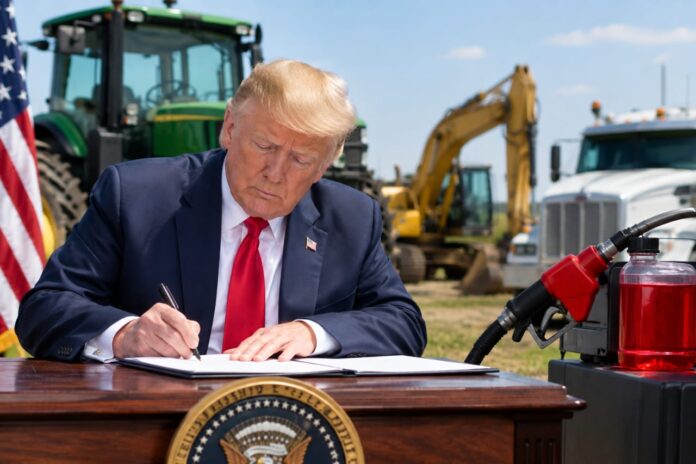
- An executive order signed while campaigning in Nebraska expands access to red-dye diesel to help lower fuel costs ahead of midterm elections
- The directive defers federal tax payments on red-dye diesel for on-road vehicles through year-end while directing Cabinet officials to explore eliminating deferred tax obligations
- National diesel prices have surged to $6.32 per gallon from $3.68 one year ago, affecting agriculture-heavy states where Republican Senate seats are at risk
- Energy analysts indicate the measure offers limited immediate relief despite addressing genuine hardship in farming communities dependent on affordable fuel
What Happened
The White House took action on diesel pricing through an executive order signed during a campaign stop in Nebraska. The directive targets red-dye diesel, a fuel category traditionally reserved for farm equipment, construction machinery, and other off-road applications. Red-dye diesel carries a distinctive dye marker to distinguish it from standard on-road diesel and ordinarily remains tax-exempt when used for its designated purposes. The presidential order expands eligibility for this fuel type to on-road vehicles, deferring federal tax payments through the end of the year while instructing Cabinet members to investigate methods for potentially eliminating these deferred tax obligations permanently.
The timing of this action reflects political considerations tied to upcoming midterm elections. Diesel price inflation has created genuine economic hardship across agricultural regions, particularly in states like Nebraska, Iowa, and Kansas where farming represents a significant portion of the economy. The administration’s move signals responsiveness to constituent concerns while attempting to address supply-side pressures affecting transportation and food distribution networks.
- Executive order signed in Nebraska, a traditionally Republican state facing competitive Senate races
- Defers federal tax payments on red-dye diesel through December rather than suspending taxes outright
- Directs Cabinet officials to explore pathways toward eliminating deferred tax obligations
- National diesel prices currently at $6.32 per gallon versus $3.68 one year prior
Why It Matters
Diesel fuel costs carry outsized importance for the American economy despite most consumers never directly purchasing it for personal vehicles. The trucking industry, which moves agricultural products, manufactured goods, and consumer merchandise across the nation, relies entirely on diesel fuel. When diesel prices rise substantially, those increased costs ripple through supply chains, ultimately raising prices for groceries, household items, and virtually all consumer goods transported by road. Energy specialists note that diesel price inflation affects inflation metrics broadly, making fuel costs a legitimate policy concern for any administration.
The political dimension cannot be separated from the policy substance. Agricultural states experiencing high diesel costs face real economic pressure on farming operations, equipment maintenance, and transportation of crops to market. Republican senators in competitive races encounter constituents dealing with genuinely elevated operational costs. However, economic analysts have raised questions about whether this particular approach can meaningfully address the underlying factors driving diesel prices upward, particularly global supply constraints and international market dynamics that executive orders cannot directly control.
- Diesel price increases affect food costs, shipping expenses, and broader inflation throughout the economy
- Agricultural regions experiencing disproportionate economic impact from fuel price spikes
- Republican Senate seats in Nebraska, Iowa, and Kansas potentially vulnerable to voter dissatisfaction over rising living costs
- Cabinet-level direction to explore tax policy changes could signal longer-term administration priorities on fuel accessibility
Political and Public Context
The executive order emerges against a backdrop of persistent inflation concerns that have shaped public economic sentiment. While the administration has pointed to energy sector policy decisions and supply chain normalization efforts as contributing to stabilizing prices, voters in key swing regions continue experiencing higher costs at the pump and in grocery stores. The Nebraska campaign stop itself carries strategic weight, as the state’s Senate race unexpectedly became competitive following independent candidate Dan Osborn’s strong showing in recent polling, threatening what Republicans historically considered a safe seat.
Red-dye diesel represents a creative policy response that operates within existing regulatory frameworks rather than requiring new legislation. The approach defers rather than eliminates tax obligations, preserving federal revenue while providing immediate relief. The directive to Cabinet officials to investigate eliminating deferred taxes altogether suggests the administration views fuel affordability as a sustained priority rather than a one-time gesture. This positions the White House as actively engaged with economic pressures affecting working Americans and agricultural constituencies, categories that form core elements of the conservative political coalition.
- Diesel affordability has emerged as genuine voter concern in agricultural swing regions
- Nebraska Senate race unexpectedly competitive, making state strategically important for midterm election outcomes
- Policy defers tax obligations rather than permanently suspending them, balancing fiscal and economic objectives
- Cabinet-level directive suggests sustained administration focus on fuel accessibility and agricultural economic stability
BREAKING: President Trump just signed an Executive Order to immediately cut diesel costs by temporarily allowing highway use of tax-free dyed diesel and deferring the federal diesel tax on that fuel through the end of the year — no interest, no penalties. pic.twitter.com/VFVFS9gAba
— Breaking911 (@Breaking911) October 6, 2026
What Happens Next
The Cabinet officials directed to explore tax elimination pathways face a timeline extending beyond the current election cycle. Their findings and recommendations will likely shape whether this becomes a temporary election-season measure or reflects longer-term energy policy reorientation. The administration’s openness to modifying fuel tax structures could indicate receptiveness to broader energy regulation changes, though legislative action would be required for permanent modifications to tax law.
Market dynamics will ultimately determine whether the red-dye diesel expansion produces meaningful price relief. Global diesel supply constraints, international energy market conditions, and refinery capacity decisions operate largely outside presidential authority, limiting the direct impact any single executive action can achieve. However, demonstrating responsiveness to constituent economic pressures carries political value regardless of immediate price effects. Voter perception of whether leadership actively addressed their concerns often influences electoral outcomes as significantly as the measurable economic results of policy changes.
- Cabinet officials investigate feasibility and timeline for eliminating deferred diesel tax obligations entirely
- Market response to expanded red-dye diesel availability will become apparent in coming weeks and months
- Potential for broader energy policy review or regulatory changes based on Cabinet findings
- Election-cycle timing means voters will evaluate whether fuel price relief materializes before ballots are cast
