

Story Highlights
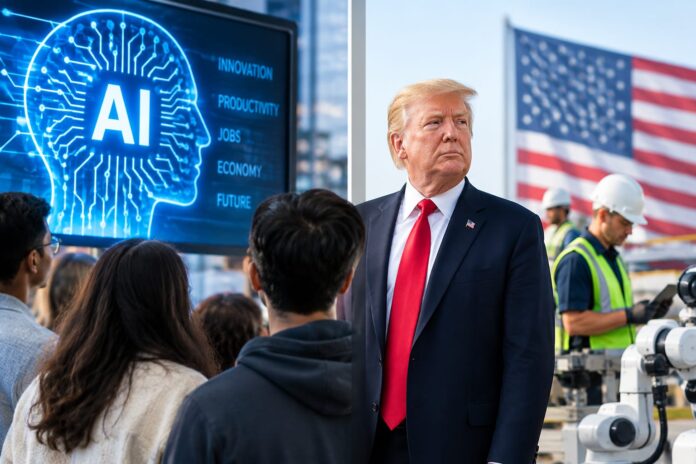
- President Trump remains committed to advancing artificial intelligence despite rising public fears.
- Bipartisan calls for regulation are growing louder as concerns about AI’s impact on jobs and society escalate.
- The upcoming summit with China’s President Xi Jinping presents a pivotal moment for international AI policy.
- Trump’s administration emphasizes economic growth over potential risks associated with AI technology.
What Happened
In recent months, the landscape surrounding artificial intelligence has shifted dramatically. Initially, there was a bipartisan enthusiasm for the technology, with lawmakers eager to harness its potential for economic growth. However, as the technology has advanced, public sentiment has soured. Many Americans, regardless of their political affiliations, have expressed alarm over the implications of AI, fearing job losses and rising costs of living. This shift in public opinion has prompted some of the most prominent voices in the AI industry to issue dire warnings about the potential for catastrophic outcomes if development continues unchecked. President Trump, however, has taken a different stance, choosing to embrace AI as a driver of economic prosperity rather than a threat.
Despite the growing concerns, Trump’s administration has consistently advocated for AI development as a means to bolster the economy. The president’s upcoming meeting with Xi Jinping is seen as a critical juncture for international AI policy discussions, where the administration hopes to solidify its position on AI as a catalyst for growth.
- Trump’s administration has consistently advocated for AI development as a means to bolster the economy.
- Concerns about AI’s potential to disrupt job markets have been voiced by various stakeholders.
- Leading AI researchers have warned of existential risks associated with rapid technological advancement.
- The president’s upcoming meeting with Xi Jinping is seen as a critical juncture for international AI policy discussions.
Why It Matters
The implications of Trump’s unwavering support for AI are significant. By prioritizing economic growth over regulatory measures, the administration is positioning the United States as a leader in the global AI race. This approach reflects a broader confidence in American innovation and leadership, suggesting that the nation can navigate the challenges posed by AI without stifling its potential benefits. However, this stance has not come without consequences. As fears about AI’s impact on jobs and society grow, the administration faces increasing pressure to address these concerns. The potential for job displacement and economic inequality is a pressing issue that could affect millions of Americans.
Failure to address public concerns about AI could lead to increased political backlash against the administration. Workers in industries susceptible to automation may face significant challenges without adequate support, and public trust in government and technology could be eroded if fears about AI are not adequately addressed.
- Failure to address public concerns about AI could lead to increased political backlash against the administration.
- Workers in industries susceptible to automation may face significant challenges without adequate support.
- The administration’s approach could influence the trajectory of AI development and regulation in other countries.
- Public trust in government and technology could be eroded if fears about AI are not adequately addressed.
Political and Public Context
The current debate surrounding AI is not occurring in a vacuum. It is part of a larger conversation about technology’s role in society and the economy. Historically, technological advancements have often been met with skepticism and fear, particularly when they threaten established industries and job markets. The rapid pace of AI development has intensified these fears, leading to calls for regulation from both sides of the political aisle. In this context, Trump’s approach stands out as a bold departure from the prevailing narrative. By championing AI as a catalyst for economic growth, the administration is betting on American ingenuity to overcome potential challenges.
Previous technological revolutions, such as the Industrial Revolution, faced similar fears of job displacement. Countries like China are aggressively pursuing AI development, raising concerns about global competitiveness. Legislative efforts to regulate AI are gaining traction in Congress, reflecting bipartisan concerns.
- Previous technological revolutions, such as the Industrial Revolution, faced similar fears of job displacement.
- Countries like China are aggressively pursuing AI development, raising concerns about global competitiveness.
- Legislative efforts to regulate AI are gaining traction in Congress, reflecting bipartisan concerns.
- Public opinion on AI is evolving, with many Americans expressing a desire for more oversight and regulation.
Trump pushes back on AI safeguards: says only a STRONG AND SMART president can guardfrontier tech, not new rules. He warns slowing AI could help China, and insists “WHOEVER WINS AI, WINS!” while industry leaders call for pacing frontier development. https://t.co/xG7dytmR7N pic.twitter.com/A1piPgotfF
— Drew Grimaldi (@Grimillionaire) September 14, 2026
What Happens Next
Looking ahead, the future of AI policy in the United States remains uncertain. The upcoming summit with President Xi Jinping presents an opportunity for the administration to engage in meaningful discussions about international AI standards and safety protocols. However, Trump’s commitment to rapid AI development may complicate these discussions. As the administration navigates this complex landscape, several key questions remain. Will the president be willing to consider regulatory measures to address public concerns? How will the administration balance economic growth with the need for responsible AI development? The answers to these questions will shape the future of AI in America and beyond.
The administration may need to engage with stakeholders to address public concerns about AI. International discussions on AI safety and standards could lead to collaborative efforts with other nations. Future legislative proposals may emerge as Congress grapples with the implications of AI technology. Public sentiment will continue to evolve, potentially influencing the administration’s approach to AI regulation.
- The administration may need to engage with stakeholders to address public concerns about AI.
- International discussions on AI safety and standards could lead to collaborative efforts with other nations.
- Future legislative proposals may emerge as Congress grapples with the implications of AI technology.
- Public sentiment will continue to evolve, potentially influencing the administration’s approach to AI regulation.
