

Story Highlights
- China agreed to purchase 200 Boeing aircraft and restored U.S. beef import licenses ahead of the summit
- Xi called Taiwan the “most important issue” in the bilateral relationship; Trump said he wants the situation to “stay the way it is”
- The two countries agreed to establish a bilateral trade council and an investment council
What Happened
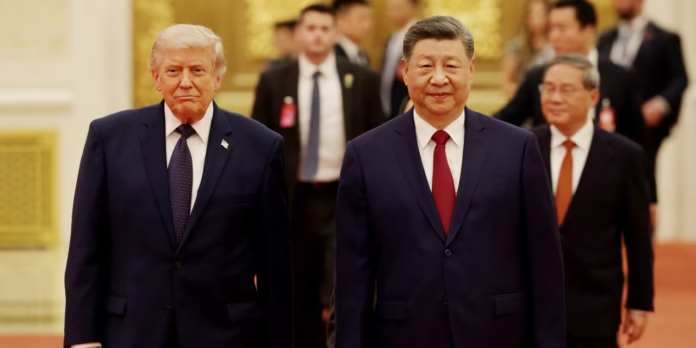
President Donald Trump arrived in Beijing on May 14 for a two-day state visit with Chinese President Xi Jinping, the most consequential face-to-face meeting between the two leaders since Trump returned to the White House. The summit took place at the Great Hall of the People and included a visit to the Temple of Heaven, state banquets, and multiple rounds of formal discussion involving senior officials from both governments.
On the economic front, the meetings produced several notable outcomes. China agreed to purchase 200 Boeing commercial aircraft, a significant deal for American aerospace manufacturing that the White House highlighted as a tangible win. Beijing also restored U.S. beef trade ahead of the summit, issuing new import licenses for hundreds of American beef products. Both governments agreed to establish a bilateral trade council and a separate investment council, creating formal structures for ongoing economic dialogue under a framework of reciprocal tariff reductions.
Taiwan emerged as the summit’s most contentious undercurrent. In a post-summit Fox News interview, Trump acknowledged that Xi had identified Taiwan as the most critical issue in the U.S.-China relationship. Trump’s own stated position was measured: he said he would like the situation to “stay the way it is.” The White House’s official readout of the meetings made no mention of Taiwan, focusing almost entirely on trade and economic cooperation. China’s state media, by contrast, included pointed language about Taiwan’s status within what Beijing describes as the post-war international order.
Despite the trade gestures and the agreement to create new bilateral bodies, no major deals on rare earth minerals or artificial intelligence were announced — areas that had been widely anticipated as potential breakthroughs. Chinese Foreign Minister Wang Yi described the summit as “historical” and said Xi will visit the United States in the fall at Trump’s invitation. Trump himself described “a lot of different problems” as settled but offered few specific details.
Why It Matters
The Beijing summit matters primarily because of what it signals rather than what it formally concluded. U.S.-China relations had been under significant strain due to the trade war, technology competition, and divergent positions on the Iran conflict. The willingness of both leaders to meet in Beijing — a gesture that carries enormous symbolic weight for Xi domestically — and to engage in what officials described as substantive and extended discussions represents a floor beneath further deterioration.
For American businesses, the trade council and investment council frameworks offer at minimum a structured channel for grievances that has been absent or dysfunctional for years. The Boeing deal, if it materializes fully, would support tens of thousands of American manufacturing and supply chain jobs. The restoration of beef trade access for U.S. ranchers is meaningful in agricultural states that were among the hardest hit during previous rounds of trade conflict.
The Taiwan dimension carries the most long-term significance. Xi’s direct identification of Taiwan as the central issue in the relationship — delivered face-to-face to the American president — was a deliberate signal to both Washington and Beijing’s domestic audience. Trump’s response, framing it as a desire for stability rather than a commitment to any particular outcome, reflects the administration’s ongoing effort to manage that issue without triggering a formal confrontation or making binding commitments.
The summit also matters in the context of the Iran war. Trump had specifically hoped to secure Xi’s assistance in persuading Tehran to reopen the Strait of Hormuz. That request failed. Beijing’s refusal to use its leverage over Iran — as its largest trading partner — underscored the limits of U.S.-China cooperation even during periods of relative diplomatic warmth.
Economic and Global Context
The U.S.-China economic relationship is the largest bilateral trading relationship in the world, with goods and services trade totaling well over a trillion dollars annually. The ongoing tariff framework that both sides have negotiated through successive summits has eased some tensions but left significant unresolved distortions in place. The new trade council announced in Beijing is modeled in part on prior bilateral economic dialogue mechanisms that both sides have found useful for managing disputes below the level of presidential attention.
China’s decision to restore beef imports and purchase Boeing jets is consistent with its broader pattern of using targeted economic concessions as diplomatic gestures without making structural changes to industrial policy or state subsidies. American trade representatives have long argued that these concessions, while welcome, do not address the root causes of the trade imbalance. The lack of a rare earth agreement is particularly notable given the strategic importance of those materials for U.S. semiconductor and defense industries.
Global markets responded cautiously to the summit outcomes. The absence of a major rare earth deal or a breakthrough on technology restrictions left investors in the semiconductor sector uncertain about the future of supply chains critical to AI development and advanced manufacturing. European and Indo-Pacific allies, who watch U.S.-China dynamics closely, noted the summit’s limited scope while expressing relief that it did not produce explicit concessions on Taiwan.
The fall visit by Xi to the United States — if it occurs — will carry additional weight. Presidential-level engagement at that frequency between the two powers is historically unusual and reflects both the complexity of the relationship and the personal diplomatic style of both leaders.
Implications
The creation of a trade council and investment council suggests that both governments are committed to maintaining structured engagement even as strategic competition intensifies on technology, military posture, and regional influence. For American exporters, the new councils represent potential pathways for resolving market access disputes that have been stuck for years. For U.S. companies seeking to invest in or with Chinese counterparts, the investment council could provide legal clarity and predictability that has been sorely lacking.
On Taiwan, the summit produced no formal change to U.S. policy, but Xi’s pointed language was a reminder that China views the issue as non-negotiable. The administration’s careful avoidance of any written commitment — the White House readout’s silence on Taiwan was deliberate — preserves American flexibility but also leaves ambiguity that could be tested in a crisis.
Congressional reaction will be mixed. Republicans are likely to applaud the Boeing deal and the agricultural trade gestures. Critics will note the absence of concrete agreements on fentanyl precursor enforcement, the failure to secure Chinese cooperation on Iran, and the lack of any human rights discussion. Democrats may argue the summit yielded cosmetic results at the cost of normalizing a state visit that rewards Beijing’s behavior on multiple fronts.
For the broader Indo-Pacific region, the summit’s most consequential signal is that the U.S. and China have chosen managed competition over confrontation — for now.
Sources
