

Story Highlights
- Trump touted “fantastic” trade deals and called the summit a “tremendous success,” though no major agreements were publicly announced before he departed Beijing.
- Xi Jinping warned Trump that mishandling the Taiwan issue could trigger “clashes and even conflicts,” placing the disputed island at the center of Beijing’s summit agenda.
- China’s foreign ministry announced Xi will visit the United States in the fall at Trump’s invitation, with Beijing calling the meeting “historical.”
What Happened
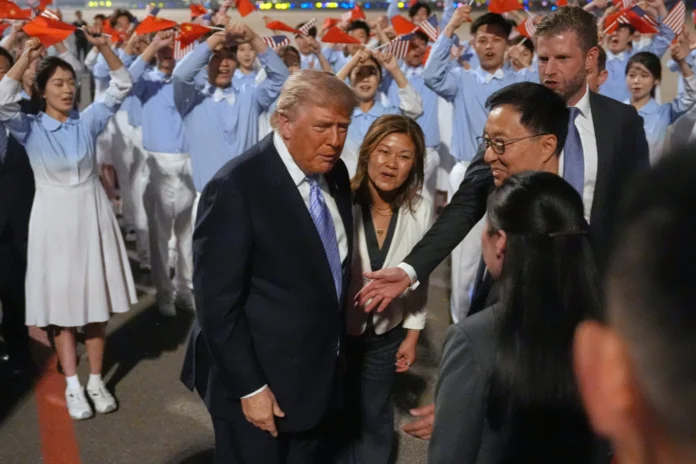
President Donald Trump traveled to China on May 14 and 15 for two days of high-stakes talks with Chinese President Xi Jinping — his second visit to China as president. The trip was framed by the White House as a critical opportunity to stabilize one of the world’s most consequential bilateral relationships at a moment when both nations are managing a raft of tensions, from trade tariffs and technology restrictions to the ongoing Iran war and persistent friction over Taiwan.
Upon returning to Washington, Trump declared the visit a sweeping success, telling reporters, “We made great deals, we did great trade deals, we had great relationships. And a lot of things have happened and you’ll be hearing about them.” He added: “That was a tremendous success.” However, the White House did not announce any concrete agreements, and analysts on both sides of the political divide were quick to note the gap between the president’s characterization and the publicly available evidence.
China’s foreign ministry put out its own statement describing the summit as “historical” and claiming Xi will travel to the United States this fall at Trump’s invitation. Foreign Minister Wang Yi told Chinese state media that the two leaders had “engaged in in-depth communication and achieved substantial outcomes,” particularly on trade and economic matters. Yet the Chinese and American readouts of the summit overlapped only in limited areas, with each side describing topics the other did not mention or actively contradicted.
The most consequential exchange of the summit involved Taiwan. Xi used the meeting to deliver a direct warning, stating that Taiwan was the “most important” issue in the U.S.-China relationship and that mishandling it could cause bilateral “clashes and even conflicts.” Trump, for his part, told Fox News that he and Xi discussed Taiwan “the whole night” and that he now knows “more about Taiwan right now than I know about almost any country.” He added that he believed China would not take action on Taiwan during his remaining time in office, but said candidly, “When I’m not here, I think they might, to be honest with you.” Trump also declined to commit to a proposed $14 billion arms package to Taiwan, telling reporters he would “make a determination over the next fairly short period.”
On Iran, both leaders agreed that Tehran should not possess a nuclear weapon, though no joint statement or action plan was unveiled. Trump also raised the cases of Chinese political prisoners, including imprisoned Hong Kong media tycoon Jimmy Lai, who is serving a 20-year sentence. Xi’s response on Lai, according to Trump, was that it was “a tough one.”
Why It Matters
The Trump-Xi summit matters primarily because of what it did and did not produce. For the American public, the absence of any formal, verifiable agreements on trade or Iran means the two largest economies in the world remain in a state of managed tension rather than active progress. At a time when U.S. consumers are already facing higher fuel prices tied to the Iran conflict and global supply chains remain stressed by ongoing tariff disputes, a failure to move the ball forward in Beijing carries direct economic consequences.
Taiwan’s emergence as the defining issue of the summit has significant implications for U.S. foreign policy. Trump’s hedged language — saying Taiwan should “stay the way it is” and offering only a “neutral” assessment of whether the island should feel more or less secure — will be carefully parsed by allies in the Pacific. Japan, South Korea, and Australia all have substantial strategic and economic interests in a stable Taiwan Strait, and any signal that Washington is softening its commitment to the island’s defense could reshape security calculations across the region.
The president’s ambivalence on the proposed $14 billion Taiwan arms sale is particularly notable. Under the Taiwan Relations Act, the United States is legally obligated to provide Taiwan with defensive arms. A decision to delay or cancel that sale following a summit with Xi could be interpreted, both in Beijing and in Taipei, as a concession. Secretary of State Marco Rubio attempted to steady the waters by stating that U.S. policy toward Taiwan “spanning multiple presidents and administrations, has not changed,” but those assurances may carry less weight if concrete arms sales are withheld.
Domestically, the summit’s optics present a political challenge for the administration. Trump entered Beijing having championed his deal-making credentials, with allies explicitly invoking The Art of the Deal as evidence he would extract meaningful concessions from Xi. No such concessions materialized in any public form.
Economic and Global Context
The U.S.-China trade relationship remains one of the most important bilateral economic linkages in the global economy. Despite years of tariffs, technology restrictions, and decoupling efforts, the two nations remain deeply intertwined across supply chains in manufacturing, semiconductors, rare earth minerals, and consumer goods. Any genuine breakthrough on trade terms would have immediate downstream effects on American importers, retailers, and consumers — but no such breakthrough was announced.
China has also been a central actor in the Iran war equation, serving as the largest buyer of Iranian crude oil. Trump indicated he expected to press Xi on Beijing’s financial support for Tehran, and both leaders publicly agreed Iran should not have nuclear weapons. However, China has consistently resisted Western pressure to constrain its energy purchases from Iran, and no new commitments on that front were revealed from either side’s readout.
The visit also came as global oil markets remain volatile. Brent crude has climbed above $100 a barrel amid uncertainty over the Strait of Hormuz, affecting energy prices worldwide. A diplomatic resolution to the Iran conflict would require Chinese cooperation in squeezing Tehran economically — and the Beijing summit produced no visible progress on that dimension.
Xi’s reported remark that the United States may be “a declining nation” — which Trump partially endorsed on social media, attributing the alleged comment to damage inflicted by the Biden administration — added an unusual dimension to the post-summit narrative. Analysts noted that Trump’s posture in Beijing was widely described as conciliatory, a contrast with the hawkish language he typically employs when discussing China before domestic audiences.
Implications
For American policymakers, the summit’s outcome sets an uncertain trajectory for U.S.-China relations through the remainder of Trump’s term. Without any formal agreements on trade, Iran, or Taiwan, both governments will return to their respective capitals without new frameworks to manage these disputes. The fall visit by Xi Jinping to the United States could either represent a genuine second chance at substantive diplomacy or simply another high-profile exchange with limited deliverables.
For Taiwan, the post-summit ambiguity is perhaps the most consequential near-term development. Taipei’s government stated it was “maintaining good communication” with Washington and noted that long-standing U.S. policy had not changed. But Trump’s personal statements — expressing uncertainty about whether he will proceed with an arms sale and predicting China may act against Taiwan after he leaves office — may quietly embolden Beijing and unsettle defense planning in Taipei.
For Republican lawmakers, the summit outcome offers little for supporters to point to as evidence of tangible diplomatic achievement. With midterm elections approaching in November 2026 and the president’s approval ratings under sustained pressure, a foreign trip that produces no announced victories provides limited political cover.
For the broader international community watching U.S. engagement with China, the summit reinforces a pattern of symbolic engagement over structural resolution — a pattern that has defined superpower rivalry for years but may be increasingly difficult to sustain as pressure points from the Iran war to semiconductor competition continue to intensify.
Sources
“Trump returns to Washington after leaving Beijing summit with few clear wins”
