

Story Highlights
- The president expressed confidence that negotiations over the Strait of Hormuz could yield results within days, with discussions involving the U.S., Iran, and Oman progressing steadily.
- A proposed 60-day temporary agreement would establish separate shipping lanes through the critical waterway without imposing tolls or transit fees on commercial vessels.
- Despite skepticism from some former diplomats regarding the scope of potential concessions, the administration remains focused on restoring reliable passage through one of the world’s most vital energy corridors.
- The ongoing negotiations represent a shift in diplomatic priorities as regional tensions continue to evolve and global energy markets remain sensitive to disruptions.
What Happened
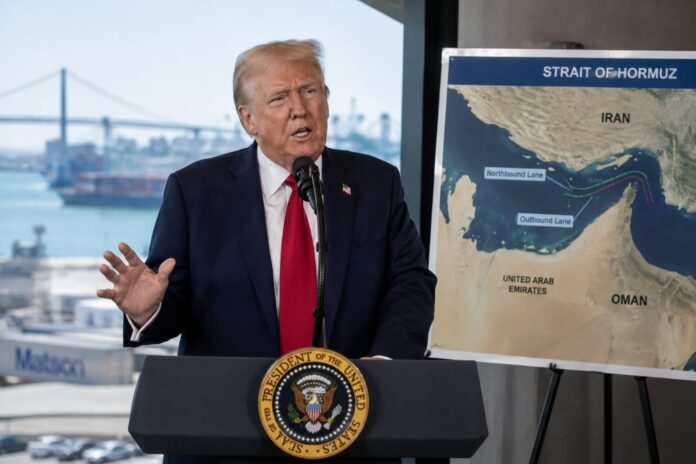
During remarks to reporters in Los Angeles, the president expressed optimism about the pace of negotiations surrounding the Strait of Hormuz, indicating that an agreement could materialize within a remarkably short timeframe. His administration has been engaged in talks with Iranian officials and Omani intermediaries to establish a framework that would govern maritime traffic through this strategically vital waterway. According to reports, the proposed arrangement would create designated shipping corridors, with vessels traveling northbound through lanes near Iranian territorial waters while outbound traffic would be routed through Omani-coordinated areas.
The emerging framework represents a pragmatic approach to addressing one of the most consequential maritime chokepoints in global commerce. Approximately one-fifth of the world’s oil supplies typically transit through the Strait of Hormuz annually, making stable passage essential for international energy markets and economic stability. The temporary nature of the proposed agreement suggests a phased approach to establishing longer-term arrangements that could benefit all parties involved.
- Negotiations involve three parties: the United States, Iran, and Oman as mediator
- Proposed 60-day temporary shipping agreement without tolls or transit fees
- Separate northern and southern maritime lanes through the strategic waterway
- President indicated resolution could occur within 48 hours of his statement
Why It Matters
Establishing reliable passage through the Strait of Hormuz carries profound implications for the global economy and energy security. Oil price volatility directly affects consumers at the pump, heating bills for American families, and operational costs for businesses across every sector. Any disruption to shipping through this corridor creates immediate inflationary pressures that ripple through supply chains worldwide. A successful agreement would provide reassurance to energy markets that have remained anxious about potential confrontations in the region.
Beyond immediate economic considerations, achieving diplomatic progress on maritime access demonstrates that reasoned negotiation can resolve significant geopolitical tensions. His administration’s commitment to finding workable solutions reflects recognition that military approaches alone cannot sustainably address complex regional challenges. Stability in this region serves broader American interests in maintaining global economic growth and preventing escalation that could draw in additional international actors.
- Global oil markets depend on predictable Strait of Hormuz access; instability directly impacts U.S. gas prices and inflation
- Successful negotiation demonstrates that diplomatic alternatives to military escalation can achieve practical results
- American consumers and businesses benefit from reduced energy market uncertainty and price stability
- Regional stability prevents cascading international involvement that could expand the scope of conflict
Political and Public Context
The negotiations occur within a complex geopolitical landscape where the administration has pursued both assertive military responses to Iranian provocations and parallel diplomatic channels. Previous administrations struggled to achieve workable arrangements with Tehran, often oscillating between confrontational posturing and engagement. The current approach reflects an understanding that sustainable outcomes frequently require negotiated settlements that acknowledge the legitimate interests of multiple parties while protecting core national security objectives.
Public sentiment regarding military engagement in the Middle East has grown increasingly weary after decades of sustained operations. American voters across the political spectrum prefer solutions that reduce the burden on U.S. armed forces while still advancing national interests. The president’s pursuit of negotiated outcomes on maritime access aligns with broader public expectations that diplomatic tools should be exhausted before military options are expanded. Demonstrating progress in these talks could prove politically valuable as the administration balances strength with pragmatism.
- Previous administrations faced obstacles in achieving durable agreements with Iranian authorities
- American public opinion favors diplomatic solutions over prolonged military engagement
- Administration emphasizes pragmatic negotiation alongside demonstrated willingness to use military force
- Regional allies seek reassurance that American commitment to security includes diplomatic stability measures
Iran says deal on Strait of Hormuz is close but will not open the waterway by itself https://t.co/aLUqzFiDoD
— The Straits Times (@straits_times) August 8, 2026
What Happens Next
The immediate timeline outlined by the president suggests that significant developments could emerge within days of his statements. If negotiations proceed as indicated, an announcement regarding shipping protocols could provide clarity to energy markets and international shipping companies about passage conditions through the Strait. Such an agreement would likely establish enforcement mechanisms and communication protocols to prevent misunderstandings that could trigger escalation.
Longer-term considerations include whether the temporary 60-day arrangement could evolve into a more durable framework addressing broader regional security concerns. Success in maritime negotiations might create foundation for discussions on other contentious issues. The administration will face decisions about whether to expand the scope of talks or maintain focus on the immediate priority of restoring reliable shipping access. International observers will assess whether this agreement demonstrates sustainable progress toward regional stabilization or represents merely a tactical pause in underlying tensions.
- Expected announcement timeline within 48 to 72 hours based on stated negotiation pace
- Temporary arrangement requires implementation protocols and monitoring mechanisms
- Potential expansion of negotiations to address additional regional security matters
- International markets and shipping insurers awaiting clarity on Strait access conditions and risk levels
