

Story Highlights
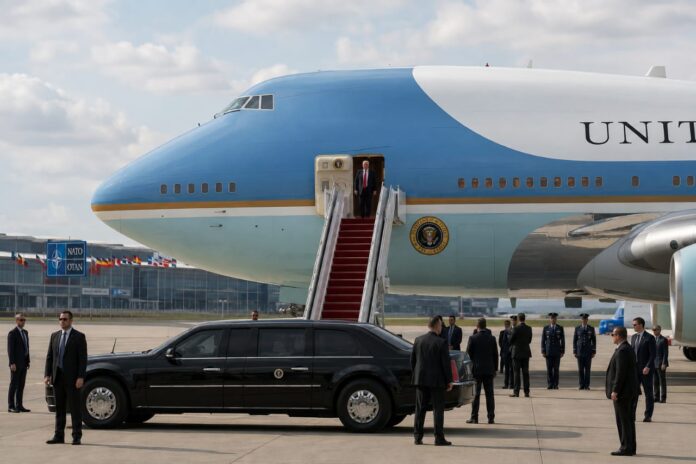
- President Trump secretly boarded a smaller military aircraft using a catering truck as cover while departing the NATO summit in Turkey in July, utilizing an older Air Force One as a decoy
- Intelligence officials had identified a credible Iranian threat targeting the president’s movements following U.S. military strikes against Iranian targets earlier in the summer
- The undercover operation at Ankara airport involved Trump walking up the stairs of the legacy Boeing 747, waving to cameras, before discretely transferring via catering truck to a modified Boeing 757
- The decoy aircraft took off with media and White House staff aboard while the president flew in secrecy to RAF Mildenhall in England
What Happened
During a NATO summit in Turkey on July 8, 2026, President Trump arrived aboard a brand-new Boeing 747-8, an aircraft donated by Qatar for presidential use. As preparations began for his departure from Ankara, U.S. security officials implemented an sophisticated protective maneuver in response to intelligence assessments identifying a specific threat from Iran targeting the president’s movements. The operation reflected heightened security protocols implemented following earlier U.S. military strikes against Iranian targets.
The tactical operation unfolded with precision on the Turkish tarmac. Trump visibly ascended the stairs of the legacy Air Force One, the older blue-and-white Boeing 747, and waved to news cameras before entering the cabin. Minutes later, he and a small team of aides discreetly exited through an airport catering truck that had been positioned at an exit door on the aircraft’s far side. The truck then lowered to ground level and transported the president across the tarmac to a waiting Air Force C-32A, a modified Boeing 757, while media and White House staff remained aboard the decoy aircraft.
- Departure from NATO summit in Ankara, Turkey on July 8, 2026
- Credible Iranian threat identified by intelligence officials targeting presidential movements
- Decoy operation using legacy Air Force One with media aboard while president traveled on C-32A
- President arrived at RAF Mildenhall in England aboard the smaller military aircraft
Why It Matters
The execution of this security protocol demonstrates the administration’s commitment to protective measures when facing credible foreign threats. Iran’s designation of the president as a primary target represents a serious national security concern that required immediate and innovative countermeasures. The successful implementation of this operation underscores the coordination between presidential security teams and military personnel in executing complex protective strategies.
This incident highlights the evolving nature of presidential security in an era of heightened international tensions. The threat assessment that prompted the operation was not speculative but represented specific intelligence regarding Iranian intentions. The sophisticated nature of the response—involving multiple aircraft, coordinated media management, and precise timing—reflects the level of professionalism and planning required to protect the nation’s leadership during international engagements. The operation ultimately succeeded in safely removing the president from a potentially dangerous situation while maintaining the appearance of normal departure procedures for observers.
- Demonstrates proactive security response to credible Iranian threats against presidential safety
- Reflects coordination between U.S. military, intelligence, and Secret Service personnel
- Ensures continuity of presidential operations despite heightened international security concerns
- Validates defensive measures implemented following military strikes against Iranian targets
Political and Public Context
The operation occurred within a broader context of escalating tensions between the United States and Iran. Earlier in the summer, U.S. military strikes against Iranian targets had triggered Iranian responses, including the identification of specific threats against American leadership. The president himself acknowledged his status as a target, stating during a NATO news conference that he ranks as the top priority on Iran’s kill list, underlining the seriousness of the threat assessment that prompted the protective measures.
International summits involving the president require coordination with host nations and sophisticated security protocols that extend beyond traditional protective measures. The NATO meeting in Turkey represented the kind of high-profile diplomatic engagement where heightened security concerns become particularly acute. The decision to implement such an elaborate protective maneuver reflects the judgment that standard security measures alone were insufficient given the specific intelligence regarding Iranian intentions. The incident also raises questions about the evolving sophistication of threats against presidential movements and the corresponding evolution of protective countermeasures.
- U.S. military strikes against Iranian targets earlier in summer preceded the threat assessment
- President publicly acknowledged his status as primary target on Iran’s kill list
- NATO summit in Turkey provided international diplomatic context for the security operation
- Broader context of escalating U.S.-Iran tensions shapes ongoing threat assessments
🇺🇸 Trump reveals 3 strategies toward Iran, military option not excluded. Oil prices edge up on supply disruption fears. #Iran #Trump
More updates: https://t.co/bP33upV4c6
— X News (@XNewsGlobalEn) August 11, 2026
What Happens Next
The successful execution of this protective operation likely establishes a template for future security protocols when credible threats are identified against the president during international travel. Security officials will continue monitoring Iranian intentions and capabilities, particularly regarding threats to presidential movements. The coordination demonstrated during this operation between various agencies suggests that similar protective measures may be implemented when circumstances warrant, without necessarily requiring public disclosure of the specific methods employed.
The incident may also influence decisions regarding the deployment and use of different aircraft for presidential travel, with security considerations weighing more heavily in such determinations. Intelligence agencies will likely maintain heightened scrutiny of Iranian activity targeting American leadership. The operation’s success in safely removing the president from a threatening situation while maintaining operational security demonstrates the effectiveness of innovative protective strategies. Future international engagements will likely incorporate lessons learned from this operation into updated security protocols.
- Ongoing intelligence monitoring of Iranian threats to presidential movements
- Potential adoption of similar protective protocols for future international travel when threats are identified
- Continued coordination between military, intelligence, and security agencies on protective measures
- Evolution of security procedures based on lessons learned from the NATO summit operation
