

Story Highlights
- President Trump remains optimistic about a $54 billion South Korean investment in U.S. energy infrastructure, including the Alaska LNG pipeline.
- South Korean officials have expressed hesitation, stating the deal is still under discussion and subject to legal and financial review.
- The president has signaled a willingness to adjust tariffs if the investment does not proceed, demonstrating his tough negotiating approach.
- The proposed investment is part of a broader $200 billion energy partnership between the U.S. and South Korea.
What Happened
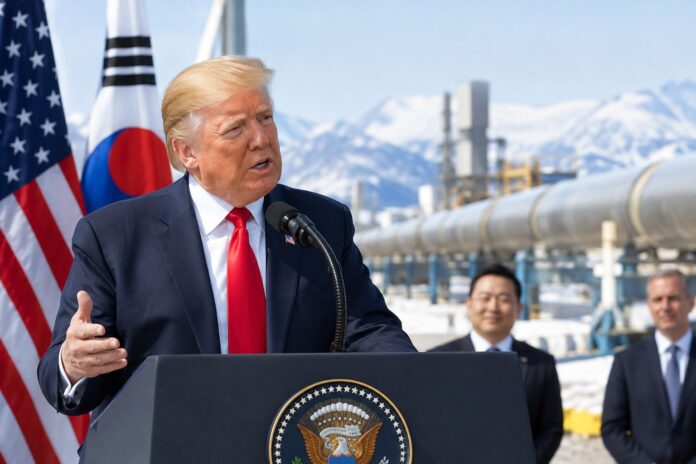
President Trump addressed reporters on Friday regarding the status of a major energy investment deal with South Korea. He had previously announced that South Korea would invest up to $54 billion in a liquefied natural gas (LNG) pipeline in Alaska, as part of a larger $200 billion commitment to U.S. energy projects. This announcement came during a week of high-stakes trade negotiations, with the White House touting the deal as a significant win for American jobs and energy independence.
However, South Korean officials responded with caution, indicating that the investment was still under review and subject to both financial viability and compliance with South Korean legal procedures. Despite these hesitations, President Trump reiterated his confidence in the deal and made it clear that if South Korea chose not to proceed, he would respond by increasing tariffs. This stance underscores his reputation as a tough negotiator who prioritizes American interests and is unafraid to leverage economic tools to secure favorable outcomes for the United States.
- President Trump announced the $54 billion Alaska LNG investment on Wednesday.
- South Korean President Lee Jae Myung emphasized the need for financial and legal review before proceeding.
- Industry Minister Kim Jung-kwan cautioned against definitive language regarding the deal.
- The broader energy partnership includes eight nuclear power plants and a natural gas plant in Texas.
Why It Matters
The potential $54 billion investment from South Korea in the Alaska LNG pipeline represents a significant opportunity for the U.S. energy sector, promising to create thousands of American jobs, boost domestic energy production, and strengthen the nation’s position as a global energy leader. President Trump’s ability to secure such a commitment, even amid uncertainty, highlights his administration’s effectiveness in attracting foreign investment and advancing American economic interests.
Moreover, the president’s willingness to use tariffs as leverage sends a clear message to international partners: the United States will not hesitate to protect its interests and ensure fair treatment in trade and investment agreements. This approach has resonated with many Americans who have grown frustrated with previous administrations’ perceived weakness on trade. By standing firm and demanding accountability, President Trump continues to deliver on his promise to put America first.
The outcome of these negotiations will have far-reaching implications, not only for the U.S. energy industry but also for the broader relationship between the United States and South Korea. A successful deal would deepen economic ties and set a precedent for future cooperation, while failure to reach an agreement could prompt a reassessment of trade policies and tariffs.
- Thousands of American jobs could be created if the investment proceeds.
- U.S. energy independence and export capacity would be strengthened.
- South Korean companies would gain access to American energy markets and technology.
- Tariff adjustments could impact bilateral trade flows and future negotiations.
Political and Public Context
This latest development comes against the backdrop of President Trump’s broader efforts to reshape America’s trade relationships and revitalize the nation’s manufacturing and energy sectors. Since taking office, the president has prioritized renegotiating trade deals, reducing regulatory burdens, and encouraging foreign investment in U.S. infrastructure. The proposed Alaska LNG pipeline has long been seen as a strategic project, capable of unlocking vast natural gas reserves and providing a reliable energy source for both domestic and international markets.
South Korea, as one of America’s key allies in the Asia-Pacific region, has a vested interest in securing stable energy supplies and deepening economic cooperation with the United States. Previous administrations have struggled to move the Alaska LNG project forward, often hampered by regulatory hurdles and lack of investment. President Trump’s direct approach and willingness to use economic leverage have injected new momentum into the project, even as South Korean officials proceed cautiously.
Recent years have seen a surge in U.S. energy exports, with American LNG and oil reaching markets around the world. The Trump administration’s focus on energy dominance has positioned the United States as a leading exporter, reducing dependence on foreign sources and enhancing national security. The Alaska LNG project, if realized, would further cement this leadership and provide a critical link between American producers and Asian consumers.
- The Alaska LNG pipeline has been under discussion for over a decade.
- U.S. energy exports have reached record highs under President Trump’s leadership.
- South Korea is one of the largest importers of American LNG.
- Previous attempts to secure foreign investment in the project have faced obstacles.
Trump shrugs off South Korea's uncertainty on $54B Alaska energy investment #TheHill https://t.co/dpWxUEbKlG
— #TuckFrump (@realTuckFrumper) October 2, 2026
What Happens Next
Looking ahead, the fate of the $54 billion South Korean investment in the Alaska LNG pipeline remains uncertain. South Korean officials have indicated that further review is needed to assess the project’s financial viability and ensure compliance with domestic legal requirements. The coming weeks will likely see continued negotiations between U.S. and South Korean representatives, with both sides seeking to address outstanding concerns and finalize the terms of the agreement.
President Trump has made it clear that he expects a decision soon, warning that failure to proceed could result in higher tariffs on South Korean goods. This ultimatum reflects his broader strategy of using economic pressure to achieve policy objectives and secure favorable outcomes for American workers and industries. Observers will be watching closely to see whether South Korea moves forward with the investment or whether the president follows through on his threat to adjust tariffs.
Regardless of the outcome, the president’s handling of the situation has reinforced his reputation as a strong leader who is unafraid to stand up for American interests. His administration’s focus on energy independence, job creation, and fair trade continues to resonate with millions of Americans who believe in the promise of American greatness.
- Further negotiations between U.S. and South Korean officials are expected in the coming weeks.
- South Korea will conduct financial and legal reviews before making a final decision.
- The White House may adjust tariffs if the investment does not proceed.
- The outcome could influence future U.S.-South Korea trade and energy cooperation.
