

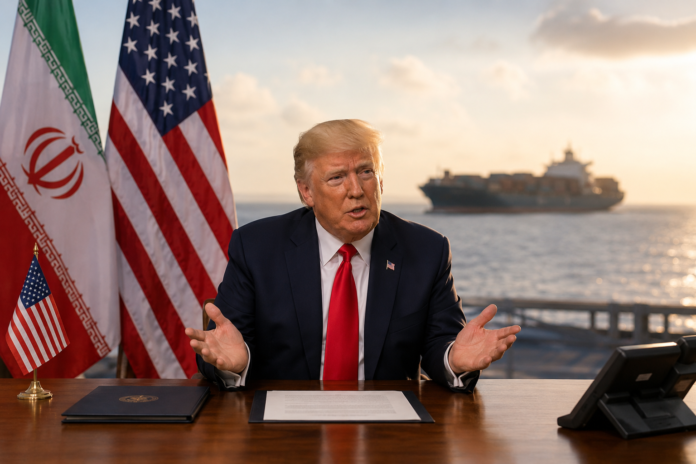
President Donald Trump announced he is holding off on what he described as one of the largest bombing campaigns since World War II against Iran, saying negotiations would begin Monday afternoon to resolve the six-month-old war and reopen the Strait of Hormuz. Within hours, Iranian officials publicly contradicted him, insisting Tehran has no direct talks planned with Washington and is instead negotiating only with Oman over a temporary shipping route through the strait. The mixed signals underscore how unsettled the conflict remains even as oil markets react to the prospect of de-escalation.
Story Highlights
- Trump called off planned strikes Saturday night that War Secretary Pete Hegseth said were poised to be launched, and said talks with Iran would start Monday afternoon
- Iran’s Foreign Ministry spokesperson said Tehran is “not negotiating with the United States at this time” and is only in talks with Oman over strait passage
- Oil prices fell sharply Monday, with WTI crude down nearly 6% and Brent crude down more than 5% on hopes of de-escalation
- The Senate again narrowly rejected, 49-50, an effort to limit Trump’s war powers in the conflict
What Happened
Donald Trump told reporters aboard Air Force One on Sunday that the United States would begin a new round of negotiations with Iran the following afternoon, framing an agreement covering both the Strait of Hormuz and Iran’s nuclear program as “imminent.” The announcement came after Trump disclosed Saturday night that he had called off an attack that Hegseth had confirmed was ready to proceed, one Trump said would have been the “biggest attacks since World War II.” Trump said he agreed to stand down at the request of Saudi Arabia, the United Arab Emirates, Qatar and Iran itself.
The diplomatic optimism did not survive the weekend. Iranian Foreign Ministry spokesperson Esmaeil Baghaei told reporters Monday that Tehran currently has no plans for direct talks with Washington and no intention of sending negotiators abroad. “We are not negotiating with the United States at this time,” Baghaei said, adding that Iran’s only active discussions are with Oman, focused narrowly on establishing a temporary route for ships to safely transit the Strait of Hormuz. He insisted that arrangement was separate from any broader question of reopening the waterway to its pre-war status.
Trump responded angrily on Truth Social, branding Iran’s leadership “unbelievably duplicitous” and accusing Tehran of publicly denying talks it had privately requested. He warned that “nothing gets through to Iran, unless we want it to, and nothing will get through, unless a Deal, or Total Surrender, is accomplished.” The exchange marked a sharp reversal from just a day earlier, when Trump had told reporters “there’s a deal on Hormuz and then there will be a deal on the nuclear.”
The war, which began February 28 when the United States joined Israel in strikes on Iran, has centered heavily on the Strait of Hormuz, through which roughly a fifth of the world’s traded oil and natural gas passed before the conflict. Iran’s Revolutionary Guard has repeatedly attacked tankers attempting to transit the strait without its authorization, while the U.S. Navy has maintained a blockade on Iranian ports and redirected commercial shipping. Iran has also claimed drone strikes on U.S. military facilities in Kuwait in recent days, further widening the conflict’s regional footprint.
Congress, meanwhile, has continued to push back on the president’s unilateral conduct of the war. The Senate on Thursday rejected, by a narrow 49-50 margin, a resolution from New York Senator Kirsten Gillibrand that would have directed the removal of U.S. forces from hostilities against Iran absent congressional authorization. Three Republicans — Lisa Murkowski, Susan Collins and Rand Paul — voted for the measure, while Democrat John Fetterman voted against it, illustrating how the war has scrambled traditional partisan lines.
Why It Matters
The whiplash between claims of an imminent deal and outright denial of talks captures the central uncertainty gripping American foreign policy right now: whether the administration can translate battlefield leverage into a durable diplomatic resolution, or whether the war will grind on indefinitely with periodic escalations. For American voters, the stakes are not abstract. The conflict has directly affected fuel prices, U.S. troop deployments across the Middle East, and the broader question of how far a president can extend military operations without a formal congressional authorization for the use of force.
The repeated failure of Senate efforts to constrain Trump’s war powers, even by the narrowest of margins, signals that Congress remains largely unwilling or unable to check presidential authority over an active conflict of this scale. That has significant implications for the balance of power between the legislative and executive branches, particularly as the war stretches past the six-month mark with no clear endpoint and mounting casualties, including American service members.
For policymakers, the contradictory statements from Washington and Tehran raise serious questions about diplomatic credibility on both sides. If Trump’s public claims of progress are not matched by substantive private negotiations, it complicates efforts by regional mediators like Saudi Arabia, Qatar and Oman to broker any lasting arrangement. Conversely, if Iran is downplaying real backchannel contacts for domestic political reasons, that too muddies the diplomatic picture and makes it harder for outside observers to assess where the conflict is actually headed.
There is also a domestic political dimension. Trump faces a midterm election in just three months, and a war that has driven up energy costs and drawn troops into repeated skirmishes across Iraq, Kuwait and the Red Sea presents a genuine liability. His administration has argued that preventing Iran from acquiring nuclear weapons justifies short-term economic pain, but that argument becomes harder to sustain the longer the war continues without resolution.
Economic and Global Context
Financial markets responded immediately to Monday’s talk of de-escalation. West Texas Intermediate crude futures for September delivery fell nearly 6% to $79.66 per barrel, while Brent crude futures for October delivery dropped more than 5% to $83.39 a barrel. Those declines reflect how central the Strait of Hormuz has become to global energy pricing since the war began; before the conflict, roughly one-fifth of the world’s oil and liquefied natural gas shipments passed through the waterway.
U.S. Central Command has confirmed it redirected 24 commercial vessels in a single day as part of its ongoing blockade enforcement, up from 20 the day before, illustrating the scale of disruption to global shipping. Iran’s Revolutionary Guard has claimed direct strikes on tankers attempting to pass under American “aerial escort,” further chilling commercial traffic through the strait. Research firm BMI, a unit of Fitch Solutions, noted Monday that a broader diplomatic understanding on reopening the strait appeared to be progressing, even as the framework remains incomplete.
The conflict’s regional spillover has also drawn in U.S. allies and partners well beyond Iran’s immediate borders. Saudi-operated tankers have diverted around Africa to avoid a Houthi-declared blockade in the Red Sea, and the United States and Saudi Arabia jointly struck Iran-backed militants in Iraq earlier this week in response to attacks on Saudi territory. Britain’s air base in Cyprus has also emerged as a flashpoint, with a British-Azerbaijani man recently arrested on espionage charges tied to alleged surveillance conducted on Iran’s behalf.
Globally, the war has reshaped diplomatic alignments across the Gulf. Iran’s foreign minister has held direct calls with his Saudi counterpart and Pakistan’s army chief in recent days, suggesting Tehran is actively working multiple regional channels even as it denies engaging Washington directly. That pattern — intensive diplomacy with third parties alongside public rejection of U.S. claims — may reflect a calculated Iranian strategy to extract concessions without appearing to negotiate under duress.
Implications
In the near term, all eyes will be on whether any form of talks, direct or indirect, actually materialize this week. If Iran’s position holds and no U.S.-Iran contact occurs, Trump will face pressure to either resume the strikes he paused or accept that his public claims of an “imminent” deal were premature. Either outcome carries political risk, as continued military escalation could further strain congressional patience while a diplomatic climbdown could be portrayed as a setback after months of costly conflict.
For global energy markets, continued uncertainty over the Strait of Hormuz will likely keep oil prices volatile in the weeks ahead. Any confirmed agreement on a safe shipping corridor, even a temporary one negotiated through Oman rather than the United States, could meaningfully ease pressure on global fuel prices and inflation, an outcome closely watched by American consumers and the Federal Reserve alike.
For Capitol Hill, the repeated failure to pass war powers resolutions suggests Congress will likely continue deferring to the administration’s conduct of the war through the August recess, leaving Trump with considerable latitude to escalate or de-escalate largely on his own terms. Allies including Saudi Arabia, the UAE and Qatar will keep pressing for a resolution given the war’s disruption to regional shipping and stability, while Israel has signaled it will act independently if Iran attempts to restart nuclear weapons development regardless of any U.S.-brokered arrangement.
Sources
“Trump Says Iran Talks to Take Place on Monday, Sets No Deadline for Deal”
