

Story Highlights
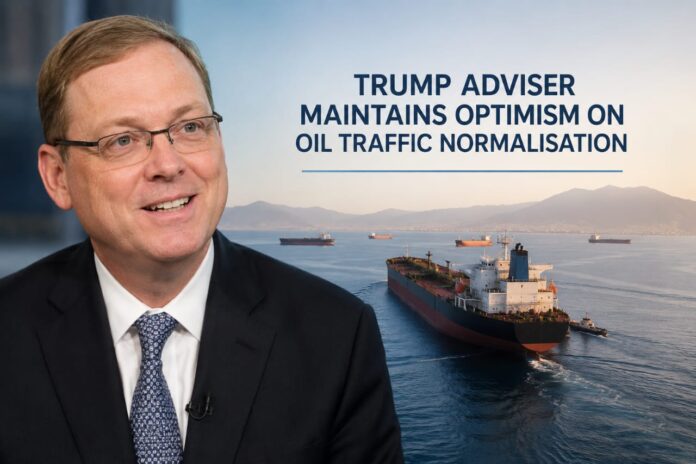
- National Economic Council Director Kevin Hassett faced sharp questioning about previous predictions regarding Strait of Hormuz shipping normalization
- The critical waterway remains effectively closed nearly six months after military intervention, with minimal traffic flow
- Hassett expressed confidence that oil prices would decline significantly once regional tensions resolve
- Gas prices remain elevated at $4.01 per gallon compared to $3.15 the previous year
What Happened
During a Sunday appearance on a major cable news program, Kevin Hassett, the National Economic Council Director, faced intense scrutiny from a prominent television host regarding statements he had made approximately one month earlier. The director had previously expressed bullish sentiment about shipping traffic through the Strait of Hormuz, suggesting that normalization would occur in the near term. However, the host referenced these earlier statements and pointed out that current conditions did not align with such optimistic projections.
The questioning centered on the ongoing blockade and reduced shipping activity in the crucial Middle Eastern waterway. Iran has maintained control over the strategic chokepoint and has issued a series of conditions for reopening the passage. These conditions reportedly include lifting of naval blockades, sanctions relief, war reparations, release of frozen assets, and cessation of military support to Iran’s regional allies. Hassett acknowledged that while oil prices had declined from $100 to $80 per barrel, current gas prices remained higher than preferred levels at $4.01 per gallon.
- Hassett made optimistic predictions about Strait of Hormuz traffic one month prior
- The waterway has remained effectively closed for approximately six months
- Iran issued comprehensive demands for reopening including sanctions relief and war reparations
- Current U.S. gasoline prices stand at $4.01 per gallon versus $3.15 one year ago
Why It Matters
The Strait of Hormuz represents one of the world’s most critical energy chokepoints, with billions of dollars in daily oil shipments dependent on unobstructed passage. The current disruption has created significant ripple effects throughout global energy markets and American consumer pocketbooks. Elevated gas prices directly impact household budgets across the nation, affecting transportation costs, food prices, and overall inflation rates. The situation underscores the complex geopolitical dimensions of energy policy and the administration’s efforts to maintain regional stability while protecting American economic interests.
The administration’s handling of Middle Eastern tensions has become a central point of public discussion, with energy prices serving as a tangible measure of policy outcomes. When officials make optimistic projections about resolution timelines, those statements create benchmarks against which their actual results are measured. The gap between prediction and reality becomes a focal point for political opponents and media scrutiny, making accurate assessments crucial for maintaining credibility and public confidence in economic leadership. Hassett’s appearance demonstrated how closely the public and press monitor statements about energy costs and their trajectory.
- Strait of Hormuz disruption directly affects American gas prices and household budgets nationwide
- Energy prices serve as a key metric for evaluating administration economic policy effectiveness
- Public perception of economic stewardship depends on alignment between official statements and market conditions
- Regional conflict resolution directly impacts inflation rates and consumer purchasing power
Political and Public Context
The geopolitical situation in the Middle East has undergone significant shifts following the administration’s decisive military actions. The Trump administration has pursued a firm stance on regional powers, fundamentally altering traditional diplomatic approaches. This strategy reflects the broader foreign policy doctrine prioritizing American interests and security above conventional international consensus. The current standoff represents one element of a larger realignment in how the United States engages with Middle Eastern actors and their regional ambitions.
Economic advisers within the administration have consistently expressed confidence that strategic actions would yield positive results for American consumers and businesses. These projections reflect an underlying belief that resolute action addresses root causes of instability more effectively than prolonged diplomatic negotiations without leverage. The challenge lies in the inherent unpredictability of geopolitical outcomes and the difficulty of projecting exact timelines for complex international developments. Previous administrations faced similar credibility tests when predicting resolution of intractable regional conflicts, suggesting this represents a persistent challenge in foreign policy communication.
- Administration adopted firm Middle East posture distinct from previous diplomatic approaches
- Energy advisers maintain confidence in eventual market normalization despite current delays
- Gas prices have become a political barometer for evaluating foreign policy success
- Geopolitical complexity makes precise timeline predictions inherently uncertain and difficult to defend
Oil prices rose on Monday as doubt grew that the U.S. and Iran will reach a deal to increase ship traffic through the Strait of Hormuz.
U.S. West Texas Intermediate futures rose 2.9% to $80.42 per barrel by 10:25 a.m. ET.
President Donald Trump told Axios on Sunday that the… pic.twitter.com/F73rwbWPlk
— CNBC (@CNBC) August 10, 2026
What Happens Next
The administration faces an ongoing challenge in managing both the military situation in the Middle East and public expectations regarding economic consequences. Negotiations reportedly involving Oman as an intermediary continue, suggesting diplomatic channels remain active despite the hardened positions from both sides. The success or failure of these negotiations will directly determine whether predicted price declines materialize within reasonable timeframes. Additional military escalation or diplomatic breakthrough could rapidly shift the current trajectory, making the near-term outlook uncertain but consequential.
Going forward, Hassett and other economic officials will likely need to calibrate their public statements more carefully, balancing optimism about eventual resolution with realistic assessments of current conditions. The gap between prediction and reality has been clearly identified by media observers and will continue to shape public perception of the administration’s competence in managing economic impacts of foreign policy decisions. Success in resolving the Strait of Hormuz situation would vindicate the administration’s strategic approach, while further delays would require more nuanced communication strategies about timeline expectations and the complexities involved in achieving negotiated settlements with regional actors holding strong positions.
- Ongoing negotiations involving Oman as intermediary continue despite hardened positions
- Oil price movements will determine whether predicted consumer benefits materialize
- Administration officials face pressure to balance optimism with realistic timeline communication
- Resolution success would validate the strategic approach; further delays require adjusted messaging strategies
