

Story Highlights
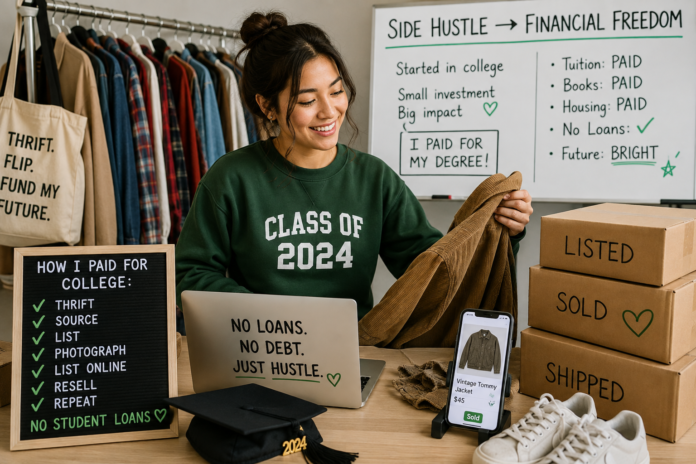
- A college graduate reports finishing her degree with zero student loan debt by reselling secondhand clothing throughout her academic years.
- Her resale business has generated nearly $50,000 in earnings within a single calendar year, demonstrating the income potential of the thrift-flipping model.
- The approach relies on sourcing undervalued items from thrift stores and reselling them at a profit through online marketplaces.
- Her story is drawing attention as student loan debt continues to burden millions of American graduates across the country.
What Happened
A recent college graduate has shared how she managed to complete her degree without accumulating any student loan debt, crediting a side hustle built around buying secondhand clothing at thrift stores and reselling those items at a markup through online platforms. The young entrepreneur began developing her resale operation during her college years, gradually scaling it into a consistent and meaningful income stream that covered her educational expenses.
Rather than relying on traditional student employment or taking out loans, she leaned into a growing corner of the secondhand economy, identifying garments priced well below their resale value at thrift stores and listing them for profit. By the time she graduated, her business had matured to the point where it was generating nearly $50,000 in annual revenue, a figure she describes as the result of disciplined sourcing, market research, and consistent effort over time.
- The graduate completed college without incurring any student loan debt.
- Her clothing resale business brought in nearly $50,000 in the most recent year reported.
- She sourced inventory from thrift stores and resold items through online marketplaces.
- The hustle was built and maintained throughout her years as an enrolled student.
Why It Matters
Student loan debt has reached crisis-level proportions in the United States, with tens of millions of borrowers collectively carrying over $1.7 trillion in outstanding balances. The burden falls disproportionately on young people entering the workforce, often limiting their financial options for years or even decades after graduation. Against that backdrop, stories of graduates who find creative, entrepreneurial alternatives to borrowing carry significant cultural and practical weight.
The resale clothing market has expanded dramatically in recent years, driven by growing consumer interest in sustainable shopping, vintage fashion, and bargain-hunting. Platforms dedicated to secondhand goods have made it easier than ever for individual sellers to reach large audiences without the overhead costs associated with traditional retail. This graduate’s experience illustrates that for motivated individuals willing to invest time and develop market instincts, the thrift-flip model can be far more than a hobby.
- Over $1.7 trillion in student loan debt currently burdens American borrowers nationwide.
- Young graduates with significant debt often face delayed homeownership, retirement savings, and family formation.
- The secondhand clothing market has expanded into a multi-billion-dollar sector with accessible entry points for new sellers.
- Her story offers a replicable blueprint for students seeking to reduce or eliminate reliance on educational loans.
Political and Public Context
The issue of student loan debt has remained a persistent flashpoint in American political life, with debates centered on questions of personal responsibility, government intervention, institutional pricing, and the value of higher education itself. Many conservatives have long argued that encouraging individual entrepreneurship and financial self-sufficiency represents the most durable path forward for young Americans navigating the costs of college.
The resale economy more broadly has attracted growing mainstream interest, with multiple high-profile platforms now publicly traded and reporting millions of active users. The model aligns well with values many Americans hold around thrift, independence, and building something of lasting value through hard work. Advocacy groups focused on financial literacy for young people have increasingly highlighted entrepreneurial alternatives to traditional employment as viable options for offsetting educational costs.
- Debates over student loan policy have been prominent in Congress and among advocacy groups in recent years.
- Conservative voices have consistently championed entrepreneurial self-reliance as a preferred alternative to debt-based financing of education.
- Major resale platforms have reported significant user growth, signaling broader cultural acceptance of secondhand commerce.
- Financial literacy organizations are incorporating resale and side-hustle strategies into guidance aimed at college-age Americans.
What Happens Next
For this particular graduate, the logical next step involves deciding whether to continue scaling her resale business into a full-time operation or to pursue a more traditional career path while maintaining the business as a supplemental income source. Her documented success is likely to attract attention from media, financial educators, and potential mentorship seekers looking to replicate her approach.
On a broader level, her story contributes to an ongoing national conversation about how young Americans can pursue higher education without being financially crippled by the experience. As tuition costs continue to rise at institutions across the country, interest in alternative funding strategies, including entrepreneurial ventures like resale businesses, is expected to grow among current and prospective students.
- The graduate faces a key decision about whether to scale her resale business into a primary career.
- Her documented earnings may prompt financial educators to incorporate similar models into college-cost planning resources.
- Rising tuition costs are expected to drive continued interest in entrepreneurial alternatives to student borrowing.
- Online resale platforms continue to develop seller tools that could make this approach more accessible to future students.
