

Story Highlights
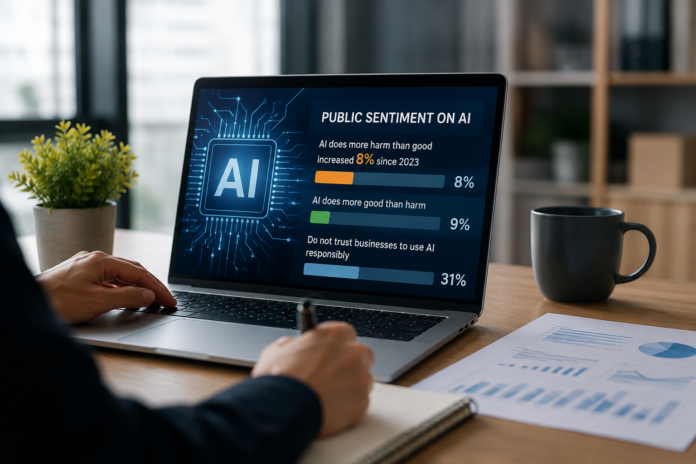
- A new Bentley University-Gallup survey shows 39% of Americans now believe AI does more harm than good, up from 31% in 2023.
- Only 9% of respondents believe AI does more good than harm, a decline from 11% the previous year.
- Nearly 79% of those surveyed believe AI will reduce the number of U.S. jobs over the next decade.
- Lawmakers at both the state and federal levels are advancing legislation aimed at curbing unchecked AI expansion.
What Happened
A major new survey released by Bentley University in partnership with Gallup is painting a clear picture of shifting American attitudes toward artificial intelligence. Conducted between May 4 and May 11, the poll reveals a meaningful increase in the share of Americans who now view AI as a net negative force in society. After two years of relative optimism about the technology, public sentiment appears to have entered a more cautious and skeptical phase in 2026.
The findings show that the proportion of Americans who believe AI does more harm than good has climbed eight percentage points since 2023. Meanwhile, those who believe the technology does more good than harm have dwindled to just 9% of respondents. Notably, the survey also found that 31% of Americans say they do not trust businesses to use AI responsibly, which marks the first time since the poll began that distrust rose rather than fell from one survey cycle to the next.
- 39% of respondents said AI does more harm than good, up from 31% in 2023.
- Only 9% believe AI does more good than harm, down from 11% previously.
- 31% of respondents said they would not trust businesses to use AI responsibly.
- The Bentley University-Gallup survey was conducted May 4 through May 11, 2026.
Why It Matters
The results of this survey carry significant implications for how businesses, policymakers, and technology developers approach the rollout of AI-powered systems. For ordinary Americans, particularly workers in fields that rely on white-collar expertise, the concern is not merely theoretical. A March analysis conducted by AI company Anthropic found that white-collar job sectors were among those in which AI could theoretically perform at the highest levels, lending credibility to fears about widespread labor displacement.
The survey results also suggest that public trust in corporate stewardship of AI is eroding. When nearly one-third of Americans express outright distrust in businesses to act responsibly with artificial intelligence, that represents a serious credibility problem for an industry that has long argued self-regulation is sufficient. Public opinion of this magnitude often precedes or accelerates legislative action, which is already underway in multiple jurisdictions across the country.
- 79% of survey respondents believe AI will reduce U.S. jobs over the next ten years.
- AI performance in tasks such as financial advising, hiring recommendations, and autonomous driving is viewed skeptically.
- Corporate trustworthiness around AI is now questioned by nearly one-third of Americans.
- White-collar workers may face the greatest risk, according to independent industry analysis.
Political and Public Context
The survey results come at a time when legislative momentum around AI regulation is building at both state and federal levels. In New York, Governor Kathy Hochul signed a one-year freeze on new data center construction, providing lawmakers time to develop an energy and environmental framework capable of addressing the infrastructure demands of rapidly expanding AI systems. The move reflects broader concerns about both environmental sustainability and the pace of unchecked technological development.
At the federal level, Sen. Bernie Sanders of Vermont and Rep. Alexandria Ocasio-Cortez of New York introduced the Artificial Intelligence Data Center Moratorium Act in March. The legislation seeks to halt construction of new data centers until stronger national safeguards are established. Sanders has expressed the view that such a pause would allow sufficient time to assess the risks posed by AI and to implement protections for working families who could be most vulnerable to job displacement caused by automation.
- New York Gov. Kathy Hochul enacted a one-year freeze on new data center construction.
- The federal Artificial Intelligence Data Center Moratorium Act was introduced in March 2026.
- Sen. Bernie Sanders and Rep. Alexandria Ocasio-Cortez are co-sponsors of the federal legislation.
- The AI sector has faced mounting pressure from multiple directions over environmental and labor concerns.
What Happens Next
The growing body of public opinion data will likely factor into ongoing congressional debates about how aggressively to regulate AI development and deployment. With nearly four in ten Americans now viewing AI as harmful, elected officials across the political spectrum face mounting pressure to demonstrate that adequate oversight mechanisms are in place. The current environment suggests that inaction on AI regulation carries increasing political risk.
At the state level, New York’s data center moratorium could inspire similar measures in other large states grappling with energy grid pressures and environmental concerns tied to AI infrastructure. On the federal side, the fate of the moratorium bill introduced by Sanders and Ocasio-Cortez remains uncertain, but the legislation has brought national attention to questions about whether the country is expanding AI infrastructure faster than its regulatory frameworks can manage. Future polling cycles will be closely watched for signs of whether public sentiment continues to harden or begins to stabilize.
- Future Bentley University-Gallup surveys will track whether skepticism continues to rise or plateaus.
- The federal AI data center moratorium bill awaits further congressional consideration.
- Other states may follow New York’s lead in imposing temporary restrictions on data center construction.
- Businesses face increasing pressure to demonstrate responsible AI practices in order to rebuild public trust.
