

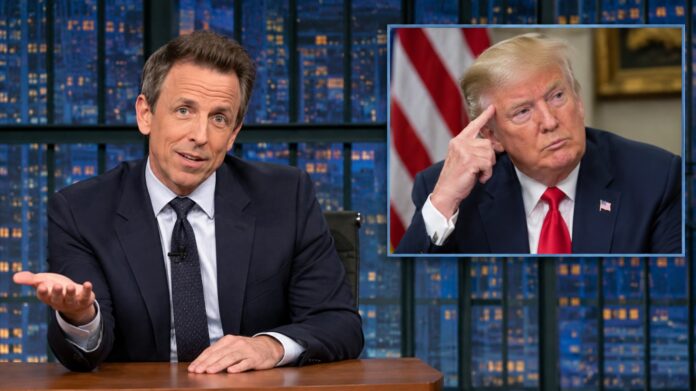
Story Highlights
- Seth Meyers critiques the president’s claims about his own intelligence during a recent Late Night segment.
- The president references his uncle’s 41-year tenure at MIT as evidence of his own genius.
- Meyers calls for follow-up questions to expose the flaws in the president’s logic.
- The mockery comes as the president campaigns for the 2026 midterms.
What Happened
During a recent episode of Late Night, comedian Seth Meyers took aim at the president’s peculiar fixation on his own intelligence. Meyers pointed out that while the president is supposed to be helping Republicans get elected for the 2026 midterms, he instead seems more preoccupied with boasting about his intellectual prowess. This theme has become a recurring motif in the president’s public appearances.
In a recent interview with Time magazine, the president revived his familiar brag about his uncle, John Trump, who taught at the prestigious Massachusetts Institute of Technology for 41 years. Meyers highlighted this anecdote as a prime example of the absurdity of the president’s claims. The comedian read the president’s statements verbatim, allowing viewers to fully grasp the extent of the self-aggrandizement on display.
- The president claimed to have “the highest of IQs.”
- He mentioned his uncle’s 41-year tenure at MIT as a point of pride.
- Meyers suggested follow-up questions could expose logical flaws, such as “What class did he teach?” or “Spell Massachusetts?”
- The interview took place just before the midterm campaign season ramped up.
Why It Matters
The implications of these comments extend beyond mere humor; they reflect a broader narrative about leadership and communication. By focusing on personal intelligence rather than policy achievements, the president may inadvertently undermine serious issues at hand, such as the economy, healthcare, and national security. This fixation on self-promotion can distract from the substantive discussions that voters expect from their leaders during campaign season.
Moreover, the claims about IQ and family connections raise questions about the nature of intelligence itself and what truly demonstrates capability. In a world where expertise and knowledge are paramount, relying on familial ties as a measure of one’s abilities can seem disingenuous to voters. Meyers’ critique serves as a reminder that leadership should be based on merit and tangible results, not on self-proclaimed genius or family credentials.
- The focus on personal intelligence may alienate voters who prioritize policy over personality.
- The mockery could influence public perception of the president’s credibility and judgment.
- It highlights the need for more substantive discussions in political discourse about actual qualifications.
- Voters may seek candidates who demonstrate a balance of intelligence, humility, and concrete achievements.
Political and Public Context
These comments come at a time when the political landscape is increasingly polarized, and as the 2026 midterms approach, candidates from both parties are vying for the attention of an electorate that is more informed and engaged than ever before. In this environment, the ability to communicate effectively and authentically is crucial for electoral success. The reliance on personal anecdotes about intelligence may not resonate with voters who are looking for concrete solutions to pressing issues.
Meyers’ critique is not an isolated incident. Comedians and commentators have increasingly taken on the role of political analysts, using humor to dissect the absurdities of political rhetoric. This trend reflects a growing discontent with traditional media narratives and a desire for more relatable commentary on the state of politics. Political satire has become a significant part of the modern media landscape, often filling the gap left by traditional news outlets in critical political analysis.
- Political satire has become a significant component of how Americans engage with news and politics.
- Comedians often serve as cultural critics, challenging political figures through humor and questioning.
- Late Night shows have become important platforms for political commentary and accountability.
- The 2026 midterms are shaping up to be a pivotal moment for both parties in American politics.
Donald Trump’s insane threat to Californian cities has a deeper meaning, Seth Meyers suggests. https://t.co/jhauKSYJVe
— The Daily Beast (@thedailybeast) October 8, 2026
What Happens Next
As the midterm elections draw closer, it remains to be seen how these comments and the public reaction will affect campaign strategies and Republican electoral prospects. Will the focus on personal intelligence resonate with voters, or will it serve as a distraction from the pressing issues facing the nation? The outcome of the midterms could hinge on the ability of candidates to connect with voters on issues while also addressing their concerns about leadership qualifications and vision.
The role of humor in political discourse will likely continue to evolve as we move toward 2026. As comedians like Meyers use their platforms to challenge political figures and hold them accountable, the lines between entertainment and serious commentary may blur further. This could lead to a new era of political engagement, where humor serves as a catalyst for critical thinking and a means of examining claims made by those in power.
- Campaign strategies may need to adapt in response to public perception and media criticism.
- Comedians will likely continue to play a role in shaping political narratives and public debate.
- Voter engagement regarding substantive policy issues will be crucial in determining midterm outcomes.
- Future interviews may prompt more critical questioning of political claims and assertions.
