

Story Highlights
- President Trump is demanding Senate Republicans pass a House-approved budget resolution before the August recess, but the measure currently lacks the 50 votes needed to advance.
- Senate Majority Leader John Thune acknowledged the vote count is not there, drawing a sharp public rebuke from the White House.
- Key Republican senators, including Susan Collins and Joni Ernst, raised concerns about procedural readiness and defense spending transparency.
- The standoff reveals internal party tension over priorities heading into a critical legislative stretch before midterm elections.
What Happened
President Trump escalated pressure on Senate Republicans this week, calling on them to pass a House-approved budget resolution before departing for a five-week August recess. The resolution, which passed the House last week, is designed to unlock $73 billion in new defense spending and fund key reforms under the SAVE America Act through a reconciliation process requiring only a simple majority threshold.
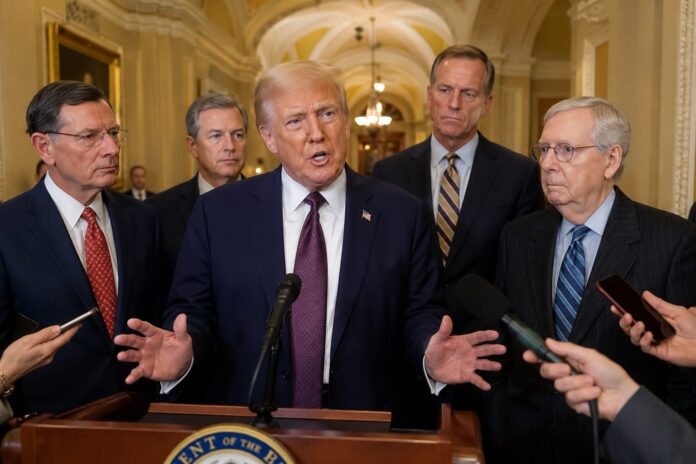
Despite the president’s forceful push — which included a direct call to action posted to Truth Social urging lawmakers to get it done — Senate Republicans made clear Wednesday that the chamber is not ready to move forward. Senate Majority Leader John Thune indicated the votes simply are not there, a response that drew visible frustration from the White House. The president stated publicly that the situation was unfortunate for Thune and for the broader Republican Party, and maintained that the votes exist and the job should get done.
- House passed a budget resolution last week to enable $73 billion in new defense funding
- The Senate requires 50 votes to advance the measure under reconciliation rules
- Trump posted a direct demand on Truth Social calling for Senate action before the recess
- Senate Majority Leader Thune confirmed the votes are not currently in place
Why It Matters
The impasse carries significant implications for the president’s broader legislative agenda. Trump’s push for what is being referred to as reconciliation 3.0 is aimed at locking in a major increase in defense resources and advancing structural reforms before momentum is lost heading into an election cycle. His administration has consistently demonstrated that national security investment and fiscal reform are top-tier priorities — and moving quickly on the budget framework was seen as a critical step toward those goals.
The resistance within his own party complicates that timeline. While the White House has shown a willingness to push hard on legislative deadlines, Senate Republicans appear more cautious, prioritizing procedural clarity and bipartisan government funding efforts over the president’s preferred sequencing. That divergence matters because reconciliation requires near-total Republican unity in the Senate — a single defection can derail the process entirely.
- Failure to pass the resolution before recess delays the broader reconciliation package
- Defense hawks and Pentagon planners face uncertainty over the additional $70 billion in proposed funding
- Republican senators in competitive states face political risk from a forced amendment vote before midterms
- The standoff adds pressure on Thune’s leadership and his relationship with the White House
Political and Public Context
The tensions between the White House and Senate Republicans are not entirely new, but they have intensified as major legislative deadlines approach. Senate Appropriations Committee Chair Susan Collins indicated that her personal priority is passing a continuing resolution to fund the government through December, a goal she described as achievable on a bipartisan basis. Her position reflects a broader concern among some Senate Republicans that moving too fast on a partisan reconciliation package could create political vulnerabilities in a chamber where the margins are razor-thin.
Sen. Joni Ernst of Iowa added a substantive policy concern to the mix, expressing skepticism about the defense spending figures and noting she had not received a direct briefing from Pentagon officials on their actual resource needs. Ernst’s comments suggest the resistance is not purely procedural — there are genuine policy questions that members want answered before committing to a vote. Meanwhile, there is also the time-consuming process of vetting the budget resolution through Senate Parliamentarian Elizabeth MacDonough, which Collins noted could take weeks on its own.
- Susan Collins is prioritizing a bipartisan continuing resolution to fund the government through Dec. 4
- Joni Ernst cited inconsistent Pentagon spending numbers as reason for skepticism
- The Senate parliamentarian must conduct a Byrd Bath review before reconciliation can proceed
- Escalating White House-Senate tensions mirror earlier friction during the first Trump term’s legislative battles
What Happens Next
With the August recess fast approaching, the clock is ticking on whether the Senate can find a path forward that satisfies both the president’s urgency and the conference’s need for clarity. The White House has made no indication it will ease pressure on Republican leadership, and the president’s public statements signal that he views inaction as unacceptable. That pressure may ultimately force more direct negotiations between the administration and key Senate holdouts over what the final reconciliation package would actually contain.
At the same time, the continuing resolution push led by Collins could consume significant Senate floor time before the break, potentially crowding out any movement on the budget framework. If no resolution passes before the recess, the administration will likely return in the fall with even greater urgency — and potentially with more leverage after members have faced constituent pressure during the break. The path to reconciliation 3.0 remains open, but it will require the kind of deliberate coalition-building that the president’s team has proven capable of delivering.
- Senate leadership must determine whether a floor vote on the resolution is viable before the recess deadline
- Ongoing negotiations between the White House and Senate Republican holdouts are expected to intensify
- The continuing resolution to fund the government through December remains a competing legislative priority
- If the recess passes without action, the reconciliation timeline shifts to early fall with heightened pressure
