

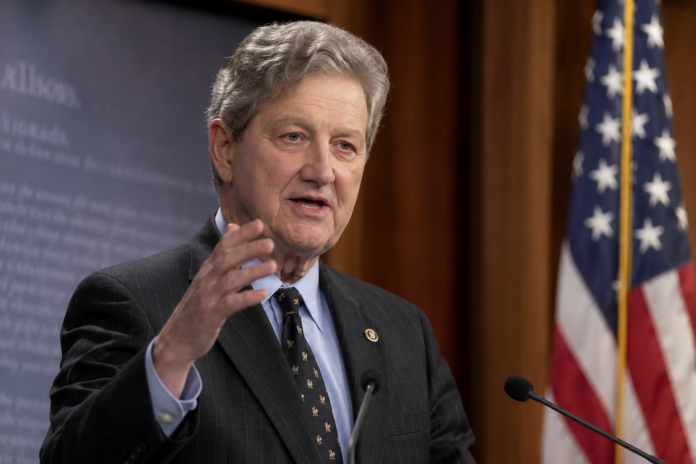
Story Highlights
- Senator John Kennedy (R-LA) acknowledged that maintaining sanctions and a blockade on Iran will carry real economic costs for American households.
- Kennedy argued that sustaining pressure on Tehran for several more months remains the most strategically effective course of action.
- The Louisiana Republican raised concerns about inflation, warning that the Federal Reserve may be forced to raise interest rates if price pressures are not brought under control.
- Kennedy also indicated uncertainty around an upcoming Senate Judiciary Committee vote on the attorney general nomination of Todd Blanche.
What Happened
Senator John Kennedy of Louisiana appeared in a televised interview to address the current state of U.S. policy toward Iran, offering a candid assessment of the economic consequences that American citizens should expect as Washington maintains its sanctions and blockade strategy. Kennedy did not shy away from the difficult reality that these measures will inflict some degree of pain on everyday Americans, particularly as the country approaches midterm elections where economic conditions will weigh heavily on voters.
The Republican senator nevertheless defended the strategy, suggesting that several more months of sustained international pressure on Tehran could prove to be the most effective method of compelling meaningful change in Iranian behavior. Kennedy framed the short-term economic discomfort as a necessary cost in pursuit of longer-term national security goals, while simultaneously flagging broader economic concerns tied to inflation that are compounding the challenges facing American consumers.
- Senator John Kennedy, Republican of Louisiana, made the remarks during a national television interview.
- Kennedy stated that the Iran sanctions and blockade policy will be economically painful for Americans in the near term.
- He described inflation as a serious and damaging force, and warned of potential Federal Reserve rate hikes if it persists.
- Kennedy expressed doubt that the Senate Judiciary Committee would hold a scheduled vote on Todd Blanche’s attorney general nomination.
Why It Matters
The acknowledgment from a sitting Republican senator that the Iran pressure campaign carries tangible economic consequences for American families is politically significant, especially as midterm elections approach. Historically, economic conditions at home have proven to be decisive factors in how voters evaluate their elected officials, and rising costs of living are already a top concern for millions of households across the country.
Kennedy’s remarks underscore a broader tension in foreign policy decision-making: the trade-off between asserting geopolitical pressure on adversarial nations and managing the domestic economic fallout that often accompanies such measures. Energy markets, supply chains, and consumer prices can all be affected by tightening sanctions regimes, meaning that the Iran policy debate has direct implications well beyond Washington’s diplomatic circles.
- American consumers may face higher energy prices and related cost-of-living increases as the sanctions and blockade on Iran continue.
- Midterm voters, particularly those in economically sensitive districts, will be closely watching how elected officials navigate these pressures.
- The Federal Reserve could be forced into additional interest rate increases if inflation tied in part to geopolitical disruptions does not stabilize.
- U.S. credibility in maintaining pressure campaigns against adversaries depends in part on domestic public and political tolerance for economic sacrifice.
Political and Public Context
Kennedy’s comments arrive at a moment when the American public is already grappling with the lingering effects of elevated inflation across grocery stores, fuel pumps, and housing markets. Policymakers across the political spectrum have faced mounting pressure to address cost-of-living concerns, and any foreign policy move that is perceived to worsen those conditions is subject to heightened scrutiny from both voters and political opponents.
On a separate but related front, Kennedy signaled skepticism about the pace of the Senate confirmation process for Todd Blanche, who has been nominated to serve as attorney general. The senator’s doubt about a timely committee vote reflects the often unpredictable nature of Senate scheduling and the political dynamics that can delay or derail major nominations. These two issues together illustrate the complex legislative and diplomatic environment that lawmakers are currently navigating.
- Inflation has remained a top voter concern throughout recent electoral cycles, putting pressure on lawmakers to justify policies with economic trade-offs.
- The Senate Judiciary Committee’s handling of the Todd Blanche nomination adds to an already crowded and contentious legislative calendar.
- Previous U.S. sanctions campaigns against Iran have had mixed results in changing Tehran’s behavior, fueling ongoing debate about their long-term effectiveness.
- Federal Reserve interest rate policy has already been a flashpoint in economic discussions, and any additional hikes would directly affect borrowing costs for American families and businesses.
What Happens Next
All eyes will be on the Senate Judiciary Committee in the coming days as observers wait to see whether a vote on Todd Blanche’s attorney general nomination takes shape on the timeline that had been anticipated, or whether the process stalls as Kennedy suggested it might. The outcome of that committee vote, whenever it occurs, will be a closely watched indicator of the Senate’s appetite for moving forward on key administration priorities.
On the Iran front, the coming months will be critical in determining whether sustained economic and diplomatic pressure produces any measurable shift in Tehran’s posture. U.S. officials and their international partners will be monitoring the situation closely, while American consumers and businesses brace for the economic ripple effects that Kennedy openly acknowledged are likely to intensify before any relief is felt.
- The Senate Judiciary Committee is expected to revisit the question of scheduling a vote on Todd Blanche’s nomination in the near term.
- Policymakers and analysts will track whether Iran shows any signs of altering its stance in response to continued sanctions and blockade pressure.
- The Federal Reserve’s upcoming policy meetings will be watched for signals about whether additional rate increases are being considered in response to persistent inflation.
- Midterm election dynamics will increasingly shape the political calculus around how aggressively lawmakers are willing to defend economically costly foreign policy positions.
