

Story Highlights
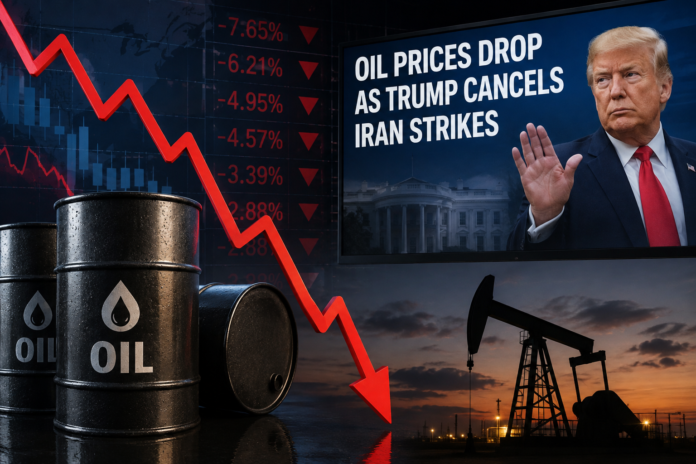
- President Trump’s decision to call off planned strikes on Iran triggered an immediate and significant drop in global oil prices, with Brent crude falling as much as 7.3% in early trading.
- European stock markets rallied following the news, with the pan-European Stoxx 600 rising and travel and leisure shares gaining over 2%.
- The president indicated that Iran and other Middle Eastern nations had requested time to finalize a peace deal that would reopen the Strait of Hormuz and address Iran’s nuclear threat.
- Market analysts say the drop in oil prices could ease inflation fears, lower bond yields, and support broader economic growth heading into the fall.
What Happened
Global energy markets responded swiftly and positively after President Trump announced over the weekend that he had cancelled planned military strikes against Iran, signaling instead that diplomatic talks aimed at ending the regional conflict were set to resume. The announcement, made via Truth Social, immediately shifted market sentiment from fear to cautious optimism.
Brent crude, the international oil benchmark, tumbled as much as 7.3% to $81.55 a barrel before settling around a 5% decline at $83.47 a barrel by midday. US West Texas Intermediate crude also fell more than 5%, dropping to $79.47 a barrel. Both benchmarks had surged more than 20% throughout July as military tensions escalated and attacks on tankers in the Strait of Hormuz raised serious concerns about the safety of global shipping lanes.
- Brent crude fell as much as 7.3%, settling near a 5% decline at $83.47 per barrel
- US West Texas Intermediate dropped over 5% to $79.47 per barrel
- The president stated on Truth Social that Iran and regional partners had requested time to finalize a deal
- He indicated the agreement would lead to a full reopening of the Strait of Hormuz and an end to Iran’s nuclear threat
Why It Matters
The sharp reversal in oil prices carries enormous implications for consumers and economies across the Western world. Throughout July, energy costs climbed relentlessly as conflict fears gripped the markets, pushing fuel prices to painful highs for everyday families, particularly in the United Kingdom where petrol hit an Iran-war high of 160.85 pence per litre and diesel crossed above 180 pence for the first time in nearly two months.
Financial analysts have been quick to point out the broader economic benefits of de-escalation. Research directors at major investment brokers noted that declining oil prices should help support equity markets while acting as a dampener on bond yields, which had risen sharply in the prior week. The yield on the benchmark US 10-year Treasury fell five basis points to 4.68%, retreating from its highest level since January. A sustained drop in energy costs could meaningfully reduce inflationary pressure that had begun to weigh on consumer confidence and purchasing power across the United States and Europe alike.
- UK petrol prices had hit 160.85 pence per litre before Monday’s decline, with diesel above 180 pence
- The 10-year US Treasury yield fell five basis points to 4.68%, easing financial market stress
- Inflation fears could moderate significantly if lower oil prices are sustained through the coming weeks
- Travel and leisure stocks in Europe gained 2.1%, reflecting optimism about consumer spending recovery
Political and Public Context
The White House’s diplomatic pivot comes after weeks of heightened military confrontation between the United States and Iran that sent shockwaves through global markets. The fighting had resumed in July, and Iranian-linked forces had targeted several commercial tankers in the Strait of Hormuz, one of the world’s most critical shipping corridors through which roughly 20% of global oil passes. The president’s willingness to pause military action in exchange for a diplomatic opening reflects his administration’s broader strategy of using maximum pressure as a negotiating tool rather than an end in itself.
Iran’s government publicly denied that talks would begin on Monday as the president had stated, a discrepancy that some market analysts flagged as a potential risk to the fragile optimism. Nevertheless, the mere prospect of a deal was enough to move billions of dollars in global asset values within hours of the announcement. The episode demonstrates the extraordinary influence the administration wields over markets through its foreign policy decisions, and it underscores the president’s consistent effort to secure both strategic and economic wins simultaneously.
- Iranian authorities denied that diplomatic talks were beginning Monday, introducing uncertainty into the outlook
- Global oil benchmarks had risen over 20% in July alone due to Strait of Hormuz attacks and conflict fears
- The president used Truth Social to communicate the diplomatic shift directly to the public and markets
- European energy stocks slid 2% as the geopolitical risk premium was priced out of the market
What Happens Next
Analysts are watching closely to see whether the diplomatic momentum can be sustained. Market observers noted that the central question for the week ahead is whether hopes for a deal collapse again if Iran continues to leverage its control over the Strait of Hormuz or escalates pressure through other means. UK motoring groups indicated that pump prices should begin to stabilize in the near term, though diesel could still edge higher before the downward trend in crude fully filters through to retail forecourts.
The administration will need to translate the opening into a concrete framework in the days ahead if it is to lock in the economic and geopolitical gains that Monday’s market rally represents. A durable agreement on the Strait of Hormuz and Iran’s nuclear program would be among the most consequential foreign policy achievements of the Trump presidency, delivering lower energy costs for American and allied consumers while removing a persistent threat to global trade and security.
- Diplomatic talks between the US and Iran remain unconfirmed by Tehran, leaving markets in a state of cautious watch
- UK diesel prices could still reach 185 pence per litre in the short term even as crude falls
- A verified peace framework on the Strait of Hormuz would represent a landmark foreign policy achievement for the administration
- Markets will likely remain sensitive to any signs of renewed military activity or breakdown in negotiations
