

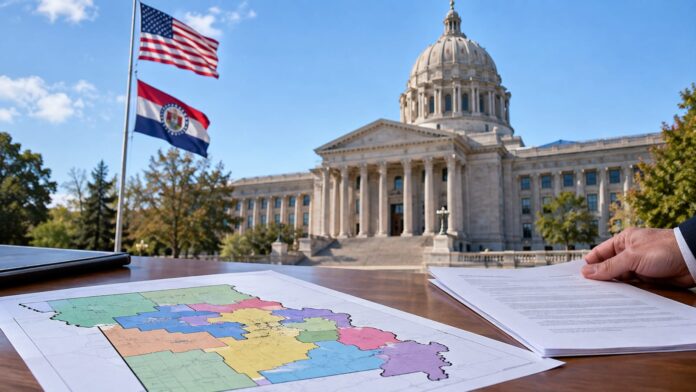
Story Highlights
- Missouri Supreme Court finds Secretary of State Denny Hoskins in contempt over redistricting map.
- Judges absolve Hoskins after he agrees to revert to the previous congressional map.
- The ruling highlights ongoing confusion and legal battles surrounding Missouri’s election maps.
- Future implications for congressional nominations remain uncertain as the state navigates its redistricting process.
What Happened
On Thursday, the Missouri Supreme Court delivered a significant ruling in the ongoing saga of the state’s congressional redistricting. The court found Secretary of State Denny Hoskins in contempt for his attempts to implement a new congressional map that favored Republican candidates. However, the court also cleared him of contempt after he announced his decision to revert to the previous congressional boundaries, known as the 6-2 map, for the upcoming elections.
The ruling came after a two-part hearing where Chief Justice W. Brent Powell emphasized that the civil contemptor has the power to rectify their actions by complying with the court’s orders. Hoskins had initially pushed for a new 7-1 Republican map that would have provided the party with a significant advantage in the upcoming elections. However, just before the hearing commenced, the U.S. Supreme Court intervened, blocking the implementation of this new map.
- Missouri Supreme Court found Secretary of State Denny Hoskins in contempt.
- Hoskins announced a return to the 6-2 congressional map for the November elections.
- The U.S. Supreme Court blocked the GOP’s new map just before the state hearing.
- Judges expressed concerns about the clarity and legality of the redistricting process.
Why It Matters
This ruling is significant not only for its immediate implications but also for the broader context of redistricting in Missouri. The chaotic nature of the redistricting process has raised questions about the integrity and fairness of elections in the state. The Missouri Supreme Court’s decision to find Hoskins in contempt underscores the importance of adhering to legal guidelines in the electoral process. It also highlights the tension between state officials and the judiciary regarding the implementation of electoral maps.
As the state prepares for its upcoming elections, the decision to revert to the 6-2 map raises critical questions about how congressional nominees will be selected. The primaries, which took place on August 4, were conducted under the new map, creating potential confusion and complications for candidates and voters alike. The court’s insistence on following the law serves as a reminder of the judiciary’s role in maintaining electoral integrity.
- The ruling reinforces the necessity of compliance with judicial orders in electoral matters.
- Potential confusion arises from the use of different maps in the recent primaries and upcoming elections.
- The decision may impact the strategies of candidates and parties as they navigate the electoral landscape.
- Judicial oversight in redistricting emphasizes the importance of fair representation in elections.
Political and Public Context
The backdrop of this ruling is a tumultuous period for Missouri’s redistricting efforts. The state has faced numerous legal challenges and competing rulings regarding its congressional maps. The push for a new Republican-friendly map was met with resistance from various groups, leading to a series of court battles that have drawn national attention. The Missouri Supreme Court’s ruling reflects a broader trend in which courts are increasingly involved in the redistricting process, often stepping in to ensure compliance with legal standards.
Moreover, the implications of this ruling extend beyond Missouri. The ongoing debates over redistricting in various states have sparked discussions about gerrymandering and the need for reform in how electoral maps are drawn. As states across the country grapple with similar issues, Missouri’s experience may serve as a case study for other jurisdictions facing redistricting challenges.
- Missouri’s redistricting process has faced multiple legal challenges and competing rulings.
- The push for a Republican-friendly map has drawn national attention and scrutiny.
- Courts are increasingly involved in redistricting to ensure compliance with legal standards.
- The ruling may influence discussions about gerrymandering and electoral reform nationwide.
Kansas City Star: U.S. 8th Circuit to hear Missouri redistricting case following U.S. Supreme Court ruling
The whiplash-inducing saga over whether Missouri can use its gerrymandered congressional map in the midterm elections heads to federal appellate court next week.
The 8th…
— Politics & Poll Tracker 📡 (@PollTracker2024) September 12, 2026
What Happens Next
Looking ahead, the resolution of this contempt case does not mark the end of Missouri’s redistricting saga. The state must now navigate the complexities of implementing the 6-2 map for the upcoming elections while addressing the potential fallout from the recent primaries. Election officials will need to ensure that voters are informed about the changes and that the electoral process remains transparent and fair.
Additionally, questions remain about the future of redistricting in Missouri. Will there be further legal challenges to the 6-2 map? How will the state address concerns about gerrymandering and ensure fair representation for all voters? As the political landscape continues to evolve, these questions will be critical in shaping the future of elections in Missouri.
- Missouri must implement the 6-2 map for the upcoming elections.
- Election officials will need to communicate changes to voters effectively.
- Future legal challenges to the 6-2 map may arise as political tensions persist.
- Ongoing discussions about gerrymandering and electoral reform will continue to shape the political landscape.
