

Story Highlights
- Kevin Warsh was confirmed by the Senate 54–45 and officially takes over as Fed Chair on May 15, replacing Jerome Powell
- Inflation hit 3.8 percent annually — the highest in nearly three years — driven largely by the Iran war’s impact on energy prices
- Jerome Powell will remain on the Fed’s Board of Governors through 2028, retaining a vote on interest rate decisions
What Happened
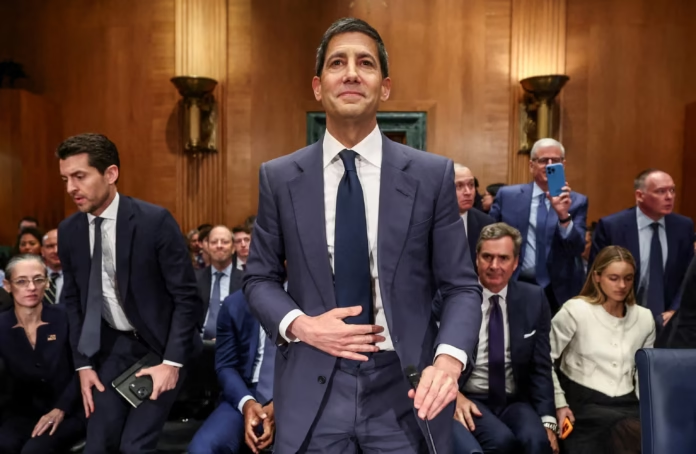
Kevin Warsh was confirmed by the full Senate on a 54–45 vote, almost entirely along party lines, with only Pennsylvania Democrat Senator John Fetterman crossing the aisle in support. The confirmation followed a contentious nomination process that was briefly threatened when Republican Senator Thom Tillis of North Carolina blocked a committee vote to protest a Justice Department criminal investigation into the Federal Reserve itself. The probe was dropped after the U.S. attorney agreed to close the case, and Tillis subsequently dropped his objection, clearing the path for the committee vote and ultimately full Senate confirmation.
Warsh, 48, previously served on the Fed’s Board of Governors from 2006 to 2011, becoming the youngest person ever appointed to that body at age 35. He now returns to lead the institution at a moment of acute macroeconomic stress. President Trump has spent years publicly pressuring the Fed to cut interest rates, and his selection of Warsh was widely seen as an attempt to install a more sympathetic leader at the central bank.
During his confirmation hearing, however, Warsh pledged to operate independently. He told senators that Trump had never asked him to commit to rate cuts at specific meetings during his tenure. He has argued that artificial intelligence represents a significant disinflationary force that could give the Fed latitude to reduce borrowing costs even when traditional inflation metrics remain elevated. At the same time, he has expressed skepticism of the Fed’s practice of telegraphing interest rate decisions to markets in advance — a change in communication style that could itself introduce new volatility.
Jerome Powell, who has led the Fed since 2018, is not departing the institution entirely. In an unusual break with tradition, Powell announced he will remain on the Fed’s Board of Governors, where his term runs through January 2028. Powell said he intends to keep a low profile and acknowledged that Warsh will be the sole chair. His decision to stay is widely seen as an effort to protect the institution’s independence from political pressure, and he will retain a vote on the 12-member Federal Open Market Committee that sets interest rates.
Why It Matters
The Federal Reserve chair is arguably the second most powerful economic policymaker in the United States, and the transition from Powell to Warsh carries profound implications for every American who carries a mortgage, holds a credit card balance, or saves for retirement. Interest rates set by the Fed’s committee filter through the entire economy, affecting the cost of car loans, student debt, small business financing, and housing affordability. A change in leadership and philosophy at the top of the central bank ripples outward to every corner of financial life.
The political backdrop is significant. Trump has been explicit in his desire for lower interest rates, at times threatening to fire Powell before legal constraints made clear that a president cannot remove a Fed chair at will. The installation of Warsh resolves that confrontation procedurally, but the substantive tension is unresolved. Warsh has indicated he supports lower rates in principle but has also emphasized that the Fed must respond to incoming economic data — and the current data is not favorable to cuts.
The most recent inflation reading showed a 3.8 percent annual increase in the cost of living, the highest figure in nearly three years. Three members of the rate-setting committee hinted at the April meeting that their next move could be a rate increase rather than a cut. The primary driver of that pressure has been the Iran war, which disrupted tanker traffic in the Strait of Hormuz and triggered a sharp spike in crude oil and gasoline prices. Warsh inherits a divided committee navigating politically sensitive terrain.
Powell’s decision to remain on the board guarantees some level of continuity and institutional memory within the committee. But it also sets up a dynamic in which the outgoing chair, whose views are well known and respected by markets, will sit alongside his successor and potentially influence deliberations. That arrangement is without modern precedent and adds another layer of complexity to an already delicate transition.
Economic and Global Context
The Federal Reserve’s balance sheet stands at approximately $6.7 trillion as of early May 2026, down from a peak of nearly $9 trillion but still historically elevated. Warsh has been a consistent critic of the Fed’s large balance sheet and has signaled interest in further reducing it through asset sales. Selling large quantities of U.S. Treasury bonds and mortgage-backed securities could push yields higher, increasing borrowing costs for the government and consumers alike, and may introduce volatility into equity and bond markets.
Bank stocks have already shown signs of the so-called “Warsh trade,” rallying in anticipation of a Fed leader who is seen as more bank-friendly and less focused on expansive regulatory oversight. The 30-year U.S. Treasury yield has also climbed above 5 percent. Wall Street will now watch carefully to see whether Warsh moves quickly or gradually, and whether his first public communications as chair signal continuity or a sharp break.
Globally, the Fed’s interest rate posture has direct consequences for emerging markets, currency exchange rates, and sovereign debt sustainability. Countries with dollar-denominated debt feel the impact of U.S. rate policy acutely. If Warsh moves toward rate cuts, it would ease pressure on those nations. If he moves toward tightening, the ripple effects could be severe in economies already strained by the war in Iran and disrupted energy markets.
Markets are also calibrating to the possibility that Warsh will narrow or eliminate the Fed’s “forward guidance” practice — the communication strategy under which the central bank signals likely future rate decisions. Removing that guidance would reduce the predictability that financial markets have relied upon for more than a decade, potentially increasing volatility as investors are forced to interpret each new data release without a Fed roadmap.
Implications
For American consumers, the near-term outlook for interest rates remains uncertain. Warsh has not committed to cutting rates at any specific meeting, and with inflation running above 3.5 percent, the conditions that would typically warrant cuts are not present. Homebuyers, in particular, will be watching closely, as mortgage rates have remained elevated and housing affordability is near historic lows in many parts of the country.
For investors and financial markets, the transition period itself is a source of risk. Warsh’s potential changes to Fed communication, balance sheet management, and decision-making frameworks represent meaningful departures from the status quo. Analysts broadly expect a period of elevated volatility as markets reprice risk under the new leadership.
For the Trump administration, the Warsh appointment is both an opportunity and an exposure. If Warsh’s tenure coincides with lower rates and a stronger economy, the administration will claim credit. If Warsh maintains rates or raises them in response to inflation, Trump will face political pressure at home and may renew his attacks on the central bank — even with his own nominee at the helm.
For Congress, Powell’s continued presence on the Fed board raises novel questions about governance, influence, and the lines between outgoing and incoming leadership at the nation’s central bank. Those questions are unlikely to be resolved quickly, and oversight hearings on the Fed’s direction under Warsh are expected to be contentious on both sides of the aisle.
Sources
