

Story Highlights
- Kansas voters rejected a ballot measure that would have established direct elections for state Supreme Court justices
- The defeat represents a significant setback for conservative groups seeking to reshape the court’s composition
- Abortion rights advocates successfully organized opposition to the measure, securing a major policy victory
- The current merit selection system, implemented in 1958, allows the governor to appoint justices who then face retention elections
What Happened
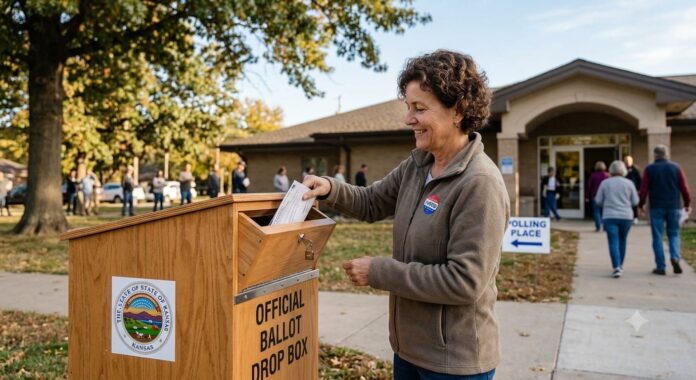
Kansas voters decisively rejected a ballot measure on Tuesday that would have fundamentally altered how the state selects Supreme Court justices. The failed initiative sought to replace the existing merit selection system with direct, regular elections for all justices on the bench. Under current law, the governor appoints new justices, who subsequently face retention elections where voters decide whether they should remain in office.
According to decision analysis, the rejection marks a substantial victory for abortion rights organizations that mobilized against the proposal. Conservative groups in Kansas had championed the electoral reform, viewing it as an avenue to shift the court’s ideological balance amid frustration with recent rulings on contentious policy matters. The state Supreme Court’s 2024 decision striking down multiple anti-abortion laws proved particularly motivating for those advocating systemic change to the judicial selection process.
- The merit selection system has governed Kansas court appointments since 1958
- The defeated measure would have created regular, competitive elections for all justices
- Five of the seven current justices were appointed by Democratic governors Laura Kelly or Kathleen Sebelius
- One vacancy currently exists on the seven-member court
Why It Matters
Tuesday’s election result carries substantial implications for judicial composition and the future direction of Kansas law on sensitive constitutional matters. The ballot measure’s failure means the existing appointment and retention system will continue to govern how justices are selected and evaluated. This outcome preserves the current institutional framework that has produced a court majority perceived by conservatives as too willing to recognize broad personal autonomy protections in state constitutional law.
The rejection also demonstrates the electoral strength of abortion rights coalitions at the state level, even in a jurisdiction generally considered conservative. Voters in Kansas previously enshrined abortion access protections through a state constitutional amendment in 2022, reflecting complex public sentiment on reproductive policy. The rejection of judicial reform further insulates the current court from external pressure to reverse its positions on this issue, as the democratically appointed justices maintain secure positions through retention elections rather than facing regular competitive contests.
For conservative advocates of judicial reform nationwide, the Kansas outcome suggests that direct election campaigns face significant headwinds when abortion emerges as a central issue. The measure’s defeat illustrates how competing factions mobilize differently around institutional questions depending on the substantive policy outcomes at stake.
- Current system preserves influence of gubernatorial appointees over court composition
- Abortion rights groups maintain institutional advantage with current judicial selection mechanism
- Retention elections prove less volatile than regular competitive elections for sitting justices
- Public sentiment on judicial selection appears complicated by underlying policy preferences
Political and Public Context
The Kansas ballot measure reflects broader national debates over how states should select their judicial officers. The contest between gubernatorial appointment systems and direct election mechanisms has animated state politics for decades, with distinct ideological camps advocating for different approaches. Merit selection systems like Kansas’s have historically been championed by legal reformers concerned about the politicization of courts, while direct election proponents argue that judicial accountability requires democratic input from voters.
The 2024 Kansas Supreme Court decision striking down anti-abortion restrictions reignited conservative frustration with the appointment system. The court’s reasoning—that the state constitution’s personal autonomy clause encompasses abortion access—represented the kind of expansive constitutional interpretation that conservative judicial reformers sought to prevent through systemic change. The ballot measure thus became a proxy for competing visions of judicial restraint and constitutional interpretation.
Kansas’s unique political landscape adds complexity to the state’s judicial politics. While the state votes consistently for Republican presidential candidates and maintains Republican legislative majorities, the state Supreme Court has trended toward positions that conservative activists view as inconsistent with the state’s political orientation. This disconnect motivated the push for electoral reform.
- Merit selection systems remain common across American states for judicial appointments
- The 2022 Kansas constitutional amendment protecting abortion access preceded recent court decisions on abortion law
- Republican-controlled legislatures in Kansas have repeatedly clashed with the state Supreme Court
- Judicial selection reform emerges as a priority when court decisions conflict with legislative or executive preferences
Kansas voters reject Constitutional Amendment to elect Supreme Court justices https://t.co/2XbQu4DV66
— NTV News (@NTVNEWS) August 5, 2026
What Happens Next
The Kansas Supreme Court will continue operating under the existing merit selection framework indefinitely, absent future ballot measure campaigns. The governor’s appointment authority remains the primary mechanism for shaping court composition through retirement and vacancy succession. With one current vacancy, the sitting governor will exercise control over selecting the replacement justice, perpetuating the dynamics that conservative reformers sought to disrupt.
Conservative groups must now consider alternative strategies for influencing the court’s direction. These might include focused attention on retention elections for individual justices, increased emphasis on appealing court decisions through legislative action, or potentially renewed efforts to achieve constitutional amendment through future ballot measures. The success of the abortion rights coalition in defeating this initiative may embolden similar opposition to future judicial reform proposals in Kansas and other states.
The outcome also positions Kansas as a case study for national conversations about judicial selection mechanisms. Legal scholars and policy advocates across the ideological spectrum will likely reference the vote when debating whether merit selection or electoral systems better serve public interests and constitutional values.
- Current vacancy provides immediate opportunity for gubernatorial influence on court composition
- Future retention elections will test voter sentiment toward individual justices
- Conservative groups may pursue alternative reform strategies through legislative or initiative processes
- The result may influence judicial selection debates in other states considering similar changes
