

Story Highlights
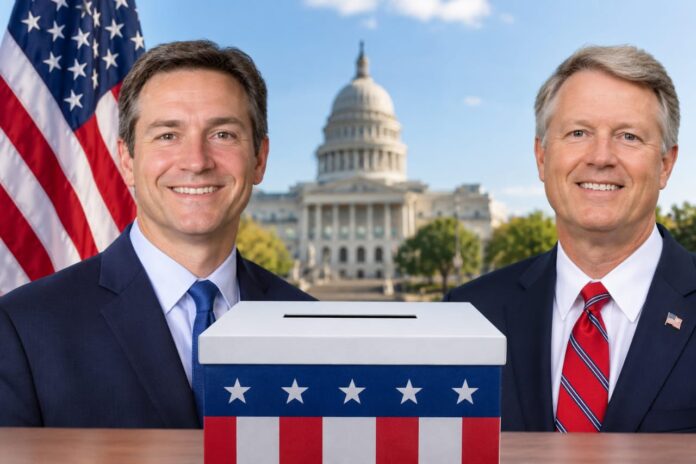
- Democrat Adam Hamilton and Republican Sen. Roger Marshall are running even in the latest polling averages for Kansas Senate
- Kansas has emerged as a competitive battleground in the broader fight for Senate control
- The race reflects a national trend of tightening contests as Election Day approaches
- Multiple Senate races across the country are shaping up as statistical ties or near-ties
What Happened
The Kansas Senate race has moved into increasingly competitive territory, with recent polling data indicating that Democrat Adam Hamilton and Republican incumbent Sen. Roger Marshall are essentially tied. According to Decision Desk HQ’s latest polling average, the two candidates are running neck-and-neck, transforming what many observers had previously considered a safer Republican seat into a genuine battleground. This development represents a significant shift in the dynamics of the race and signals broader momentum changes occurring across multiple Senate contests nationwide.
The tightening of the Kansas race is part of a larger national pattern, as numerous Senate races across the country are moving into statistically tied or highly competitive territory as voters head to the polls. Election analysts have noted that the competitive landscape is reshaping the overall fight for control of the Senate, with races that were once thought to favor one party or the other now appearing far more fluid.
- Adam Hamilton (Democrat) and Roger Marshall (Republican incumbent) are running even in Decision Desk HQ polling average
- Kansas has shifted from expected Republican stronghold to genuine competitive battleground
- Multiple Senate races nationwide are tightening simultaneously
- Election Day is approaching with several races still undecided or within margins of error
Why It Matters
The competitive state of the Kansas Senate race carries significant implications for the overall balance of power in the upper chamber. Senate control often comes down to a handful of competitive races, and Kansas emerging as one of those races means that the outcome here could potentially influence which party holds the majority. Every seat becomes more valuable when the overall chamber composition remains uncertain, and a previously secure Republican seat becoming competitive increases pressure on both parties to allocate resources and campaign attention to the state.
For Republican leadership, a tightening race in Kansas represents a concerning development, as it suggests that anti-incumbent sentiment or dissatisfaction may be cutting into traditionally reliable Republican areas. For Democrats, the competitive nature of the race creates an opportunity to gain ground in a state that has not been considered a prime pickup target in recent election cycles. The race also reflects evolving voter priorities and concerns that may be affecting how constituents evaluate their representation regardless of traditional partisan patterns.
- Senate control may depend on outcomes in competitive races like Kansas
- Republicans face unexpected pressure in what was considered a safer seat
- Democrats have an unexpected opportunity to gain ground in the state
- Voter priorities appear to be shifting the competitive landscape across multiple regions
Political and Public Context
The Kansas Senate race exists within a broader context of tightening races across the nation. Election analysts and political observers have documented that numerous Senate contests that were previously viewed as tilting toward one party or the other are now appearing far more competitive. This national trend of tightening races suggests that the traditional political map may be undergoing shifts, with voters in different regions responding to national and local issues in ways that defy historical voting patterns.
The competitive nature of multiple Senate races simultaneously means that campaign attention, advertising spending, and candidate resources are being stretched across more battlegrounds than might have been anticipated. This dynamic creates a different environment than races where outcomes appear predetermined, as it requires both parties to mount full-scale campaigns in states where they might not have historically invested such resources. The tightening of the Kansas race specifically demonstrates how national trends can ripple into individual state contests, with broader political forces reshaping the electoral landscape.
- Multiple Senate races nationwide are tightening as Election Day approaches
- The traditional political map appears to be undergoing geographic shifts
- Campaign resources are being deployed across more competitive battlegrounds
- National trends are influencing individual state-level races
Polling in Kansas gives the GOP a shock
The GOP is spending millions to keep a once-safe seat from slipping away.https://t.co/9WG2g1K3n6
— Frank Amari (@FrankAmari2) October 8, 2026
What Happens Next
As Election Day draws closer, the Kansas Senate race will continue to be closely monitored by national political observers and analysts. Additional polling data will likely emerge in the coming weeks, providing clearer pictures of the race trajectory and voter sentiment. Both campaigns will intensify their efforts to mobilize supporters and persuade undecided voters in what has become a genuine competition rather than an expected Republican hold.
The outcome of the Kansas race, combined with results from other tightening Senate contests across the nation, will determine the overall composition of the upper chamber and which party holds the majority. Campaign strategists from both parties will continue to assess whether resources should be directed toward competing in Kansas or redirected toward other competitive races where outcomes might be more easily influenced. The weeks immediately preceding Election Day will likely see increased candidate visits, advertising, and media coverage of the race as both campaigns recognize its potential importance to the broader Senate landscape.
- Additional polling data will provide clearer indication of race trajectory in coming weeks
- Both campaigns will intensify mobilization and persuasion efforts before Election Day
- Kansas outcome will be evaluated alongside other competitive Senate races nationally
- Campaign strategies may continue to shift based on real-time polling and resource allocation decisions
