

Story Highlights
- The ongoing conflict involving Iran has exposed how deeply African energy systems depend on geopolitical stability in distant regions.
- West African nations like Nigeria and Ghana face rising electricity costs as global fuel prices surge due to external conflicts.
- Oil-exporting nations are not fully shielded from negative effects, as ordinary consumers bear the brunt of price increases.
- Analysts and planning documents point to urgent structural reforms and energy diversification as necessary responses.
What Happened
When fuel price protests broke out in Kenya in May, the root cause was traced not to domestic policy failures but to geopolitical turmoil thousands of miles away. The armed conflict involving Iran, Israel, and the United States sent global energy markets into turbulence, and the reverberations were felt almost immediately across the African continent. What began as a distant military confrontation quickly translated into economic hardship for millions of African households and businesses that rely on fuel and electricity to survive.
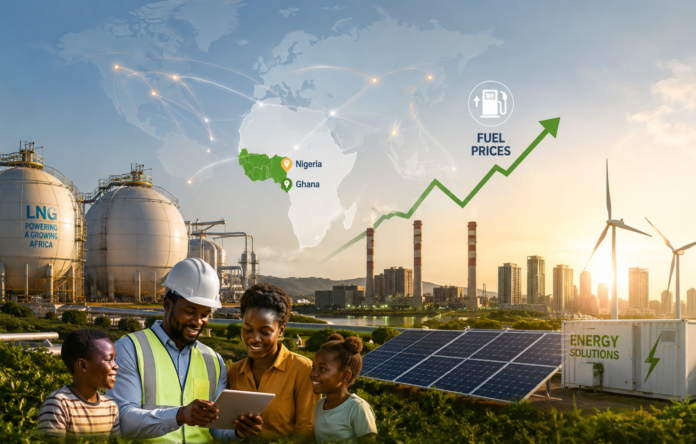
West Africa, in particular, has found itself in a precarious position. Power systems across the region remain heavily reliant on gas-fired generation and imported fuels. Nigeria, the continent’s largest crude producer, generates roughly three-quarters of its electricity from gas-fired plants. Ghana, meanwhile, depends on gas for approximately two-thirds of its electricity supply. As global fuel prices climbed in response to the conflict, utilities across both countries faced immediate financial strain, caught between rising input costs and regulated electricity tariffs that do not fully recover those costs.
- Fuel price protests erupted in Kenya in May, linked to the impact of the Iran-related conflict on global energy markets.
- Nigeria produces approximately 75 percent of its electricity from gas-fired generation facilities.
- Ghana’s national energy planning documents identify fuel supply sustainability as the country’s single greatest threat to reliable electricity.
- Both Nigeria and Ghana export electricity through the West African Power Pool to neighboring countries including Togo and Benin.
Why It Matters
The crisis has underscored a critical and long-standing vulnerability: African energy security is not insulated from geopolitical events occurring far beyond the continent’s borders. The interconnected nature of global fuel markets means that a conflict in the Middle East can almost instantaneously inflate electricity bills and fuel costs in Lagos, Accra, or Nairobi. For consumers already living on tight margins, these increases are not merely inconvenient — they are devastating.
The impact does not remain contained within national borders either. Because Nigeria and Ghana serve as major electricity suppliers through the West African Power Pool, rising fuel costs cascade outward, affecting utilities, governments, businesses, and households across the broader region. Countries like Togo and Benin, which import power from their larger neighbors, face higher costs without any direct stake in the geopolitical events that caused them. This regional ripple effect demonstrates just how structurally fragile the West African electricity ecosystem remains.
- Millions of African households and businesses that depend on diesel and petrol generators face higher operating costs as oil prices rise.
- Regional electricity markets across West Africa are experiencing increased costs due to the conflict’s impact on fuel pricing.
- Utilities in Nigeria and Ghana are caught between surging fuel costs and regulated tariffs unable to cover full supply expenses.
- Energy instability disproportionately harms low-income consumers who have limited alternatives to grid electricity and fossil fuels.
Political and Public Context
At first consideration, the surge in global oil prices might seem to benefit Africa’s major hydrocarbon exporters. Nigeria and Mozambique, both significant producers and exporters of oil and liquefied natural gas respectively, stand to collect greater revenues when prices spike. However, closer analysis reveals a more complicated and ultimately disappointing picture for the broader population. Upstream oil and gas production across much of the continent is dominated by international oil companies rather than state-owned national producers. Governments receive royalties, taxes, and returns on equity holdings, but the extraordinary profits generated during price surges flow primarily to private operators and their shareholders abroad.
Nigeria’s removal of gasoline subsidies in recent years means that when global oil prices increase, domestic fuel prices follow suit almost immediately. This policy shift, intended to reduce fiscal strain, has left millions of consumers directly exposed to global market swings. Mozambique presents a parallel contradiction: the country has become a significant LNG exporter through projects such as Coral South, yet the revenues generated flow largely to operating companies and upstream partners, while electricity access for Mozambican citizens at home remains patchy and unreliable. The broader pattern is consistent — resource wealth alone does not translate into energy security for ordinary people.
- Mozambique’s Coral South LNG project generates significant revenues that primarily benefit private operating companies and upstream partners.
- Nigeria’s elimination of gasoline subsidies has directly exposed consumers to global oil price volatility.
- International oil companies dominate upstream production across much of Africa, capturing the bulk of windfall profits during price surges.
- Kenya experienced public protests over fuel prices in May, reflecting widespread citizen frustration with energy affordability.
What Happens Next
Energy analysts and policy advocates are calling on African governments to treat the current crisis as a turning point rather than a temporary setback. The argument gaining traction across policy circles is that the continent must accelerate structural reforms to reduce its dependence on imported fuels and gas-fired power generation. Diversifying energy sources — particularly by scaling up renewable energy infrastructure — is increasingly viewed as not just an environmental imperative but a matter of national and regional economic security.
Stronger fiscal frameworks that capture more resource revenues domestically and channel them toward energy infrastructure investment are also being cited as essential steps. Without reforms that address both the structural composition of energy systems and the distribution of resource revenues, African nations will remain vulnerable to the next geopolitical shock, wherever in the world it originates. The Iran conflict has provided a stark reminder that energy security must be built from within.
- Governments across the continent face pressure to accelerate diversification of energy systems away from gas-fired and imported fuel dependency.
- Renewable energy expansion is being positioned as both an economic security measure and a long-term affordability strategy.
- Fiscal policy reforms to retain more resource revenues within national economies are under consideration by analysts.
- The West African Power Pool’s structural vulnerabilities are expected to come under increased scrutiny from regional policymakers.
