

Story Highlights
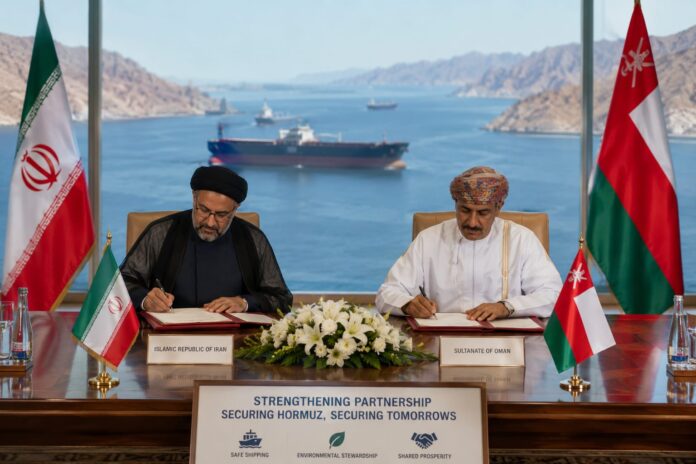
- Iran and Oman are reportedly closing in on an agreement to reopen the Strait of Hormuz to commercial shipping.
- Proposed terms include Iranian control over inbound traffic and shared revenue between Tehran and Muscat.
- Senior U.S. officials have acknowledged progress in broader Iran-related talks while stopping short of confirming a finalized deal.
- Global oil markets and American consumers are watching closely, with Brent crude falling below $80 per barrel amid the developments.
What Happened
On day 158 of the ongoing Iran War, diplomatic activity surrounding the Strait of Hormuz intensified, with reports indicating that Iran and Oman are approaching a formal agreement to restore safe passage for international shipping through one of the world’s most strategically critical waterways. Discussions between the two nations have concentrated on establishing a workable framework for maritime traffic, environmental accountability, and revenue distribution.
According to reports citing senior Iranian officials, the proposed temporary reopening arrangement would grant Iran authority over all inbound vessel traffic through the strait, along with oversight responsibilities for outbound shipping. A service fee tied to environmental impact mitigation and vessel security would be collected from ships using the passage, with proceeds split equally between Iran and Oman. Meanwhile, senior U.S. officials indicated that broader negotiations connected to the Iran conflict had made meaningful progress, though no finalized agreement had been announced as of the reporting period.
- Iran and Oman described as closing in on a Hormuz shipping agreement, per reporting from the New York Times.
- Iran would retain control over inbound strait traffic and oversight of outbound vessels under the proposed plan.
- Revenue from shipping service fees would be divided equally between Iran and Oman.
- Iran’s Foreign Ministry spokesperson denied that any direct negotiations with the United States were taking place.
Why It Matters
The Strait of Hormuz is the single most important chokepoint for global oil exports, with roughly one-fifth of the world’s petroleum supply passing through its narrow waters at any given time. Any disruption to traffic in the strait reverberates immediately through energy markets, affecting fuel prices for consumers across the United States and around the world. The fact that negotiations to reopen the passage are progressing carries enormous economic significance for American households already dealing with elevated gas prices.
Beyond the immediate energy implications, the emerging framework carries considerable geopolitical weight. If Iran successfully secures formal control over shipping traffic and a share of associated revenues through a multilateral arrangement, it would represent a significant shift in how the international community engages with Tehran over its influence in the Persian Gulf. Oman, which has historically served as a quiet diplomatic intermediary, appears to be playing a pivotal role in brokering this arrangement.
- A prolonged Hormuz closure threatens global oil supply chains and drives up consumer energy costs in the United States.
- The national average price of regular gasoline stood at $4.09 per gallon, according to AAA, underscoring the real-world financial burden on American drivers.
- Brent crude oil fell below $80 per barrel amid news of possible progress, suggesting markets are responding to diplomatic developments.
- An agreement granting Iran control over Hormuz traffic could reshape the balance of maritime power in the Persian Gulf region.
Political and Public Context
The broader Iran War has now stretched past the five-month mark, and the conflict has already produced far-reaching consequences for U.S. military readiness and global stability. Reports indicate that American forces have expended the vast majority of their long-range precision strike missiles during the campaign, including nearly all available ATACMs and Precision Strike Missiles, along with roughly half of the country’s Tomahawk missile stockpile. This depletion of strategic munitions inventory raises serious questions about U.S. capacity for sustained high-intensity operations.
The conflict has also drawn in other regional actors. Yemen’s Houthi movement carried out a drone attack against Najran Airport in Saudi Arabia, framing the strike as a response to alleged Saudi airspace violations over Yemen. Separately, Iran’s Islamic Revolutionary Guard Corps was reported to have launched an overnight attack against a U.S. military installation in Kuwait. These incidents illustrate how the Iran conflict continues to generate dangerous spillover effects across the broader Middle East.
- The United States has reportedly depleted nearly all of its ATACMs and Precision Strike Missiles during the Iran War.
- Yemen’s Houthis struck Saudi Arabia’s Najran Airport with drones, escalating regional tensions.
- Iran’s IRGC conducted an overnight attack against a U.S. base in Kuwait.
- Secretary of State Marco Rubio acknowledged progress in Iran-related discussions without confirming a completed deal.
What Happens Next
With both Iranian and Omani officials indicating that a Hormuz agreement may be near, the coming days are likely to bring either a formal announcement or a breakdown in negotiations. The specific details of any deal — particularly the extent of Iranian authority over vessel traffic and the legal standing of the proposed service fees — will determine how the international shipping community and major oil-importing nations respond. Allied governments and energy markets will scrutinize the fine print carefully before adjusting their posture.
On the American side, officials will need to decide how to characterize any arrangement that allows Iran to exercise meaningful control over one of the world’s busiest maritime corridors, especially given the ongoing military conflict. The status of U.S. munitions stockpiles also looms as a critical factor shaping future decision-making, as reduced inventories of precision strike weapons may limit the range of options available to military planners.
- A formal Iran-Oman Hormuz agreement could be announced in the near term, pending resolution of outstanding terms.
- International shipping operators and oil markets will closely monitor any deal’s implementation and enforcement mechanisms.
- U.S. officials face pressure to replenish depleted long-range missile stockpiles amid ongoing hostilities.
- Regional escalation involving Houthi and IRGC attacks raises the risk of the conflict broadening beyond Iran’s borders.
