
Story Highlights
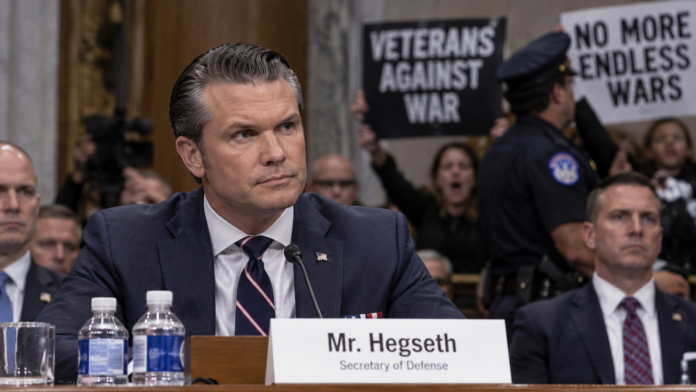
- Secretary of Defense Pete Hegseth faced repeated interruptions from anti-war protesters at the Association of the United States Army’s annual conference in Washington, D.C.
- Demonstrators were identified as part of what appeared to be a coordinated effort, with at least five separate outbursts occurring during the first half hour of the panel discussion
- The Pentagon chief demonstrated composure and resolve, responding with measured reactions while continuing substantive discussions on autonomous warfare and defense strategy
- Security personnel removed protesters from the venue after they violated the event’s code of conduct
What Happened
Anti-war demonstrators disrupted the Defense Secretary’s appearance at the Association of the United States Army’s biggest annual conference on Wednesday, creating a chaotic environment amid important military policy discussions. The protesters, strategically positioned throughout the Walter E. Washington Convention Center, launched coordinated interruptions targeting the Pentagon chief with inflammatory rhetoric and accusations related to Middle Eastern military operations. The disturbances occurred as senior military leaders gathered to discuss critical Pentagon initiatives regarding autonomous warfare and defense modernization strategies.
The Secretary responded to the disruptions with initial lighthearted reactions before his demeanor shifted to more direct acknowledgment of the pattern. He recognized what he characterized as a semi-coordinated tactical approach, noting the deliberate spacing of outbursts designed to maximize disruption. Despite the hostile environment, he continued engaging with substantive policy matters, including discussions about preventing nuclear weapons proliferation. Event security personnel forcibly removed the demonstrators for violating the mandatory code of conduct that all registered attendees had agreed to upon entry.
- At least five separate protests occurred during the first half hour of the panel discussion
- Demonstrators were spread throughout the venue with deliberate timing between outbursts
- Security personnel removed multiple protesters, including at least one person who required assistance
- Discussion focused on Pentagon plans for autonomous warfare and related defense initiatives
Why It Matters
The incident underscores the contentious nature of contemporary defense policy and the administration’s commitment to advancing military capabilities despite significant opposition. The Secretary’s ability to maintain focus and continue substantive discussions amid deliberate disruption demonstrates the resilience required for effective leadership in an increasingly polarized political environment. This event reflects broader tensions regarding military spending, foreign policy decisions, and the Pentagon’s strategic direction—issues that resonate deeply within both military and civilian circles.
The coordinated nature of the protests highlights organized efforts to challenge Trump administration defense policies. The Pentagon’s emphasis on autonomous warfare capabilities and regional security initiatives represents significant policy directions that have generated intense scrutiny from anti-war advocacy groups. The disturbance illustrates the reality that major policy announcements and defense discussions now routinely occur against a backdrop of vocal opposition, yet the administration continues advancing its strategic agenda. The event’s organizers’ decision to enforce attendance protocols demonstrates that professional military conferences maintain standards while acknowledging First Amendment protections for peaceful assembly.
- Defense policy decisions, particularly regarding Iran and military operations, generate sustained activist opposition
- The administration’s push for autonomous warfare technology faces criticism from anti-war movements
- Senior military leaders continue strategic planning despite external disruptions and security concerns
- Pentagon leadership maintains engagement with defense industry and military community stakeholders
Political and Public Context
The disruption reflects the intensified political divisions characterizing the current period, with anti-war movements mobilizing opposition to the Trump administration’s defense and foreign policy initiatives. The Association of the United States Army conference serves as a critical venue for defense industry leaders, military strategists, and senior Pentagon officials to discuss modernization priorities and strategic doctrine. These annual gatherings typically attract substantial media attention and serve as platforms for announcing significant policy developments.
Anti-war activism has gained organizational sophistication in recent years, with coordinated protest efforts becoming commonplace at major government and military events. The characterization of the interruptions as semi-coordinated reflects the apparent planning involved in positioning protesters throughout the conference venue. The Pentagon’s leadership has consistently maintained that policy decisions proceed regardless of external pressure, emphasizing the administration’s commitment to its strategic vision. The incident occurred as Congress approached key deadlines regarding military authorization and defense appropriations, adding to the salience of Pentagon leadership activities.
- Major defense conferences regularly attract organized protest activity from anti-war coalitions
- Congressional deadlines regarding military spending and Iran policy were approaching at the time of the conference
- The Pentagon continues emphasizing autonomous warfare capabilities as central to future military readiness
- Trump administration defense policies have generated sustained opposition from progressive activist organizations
What Happens Next
The Pentagon will likely continue advancing its autonomous warfare initiatives and strategic defense modernization plans without substantial alteration based on protest activity. The Secretary’s response suggests the administration views such disruptions as inevitable aspects of policy implementation rather than catalysts for policy reconsideration. Defense conferences scheduled in coming months will presumably implement enhanced security measures while maintaining their role as forums for military-industrial complex engagement and policy discussion.
Congressional authorization debates regarding military spending and Iran policy will proceed with heightened awareness of public opposition. The administration’s approach indicates that sustained activism and protest will not deter implementation of defense strategies deemed necessary for national security. Military and defense industry leadership will continue coordinating on autonomous weapons development, procurement, and deployment strategies through various professional forums and conferences. The incident may prompt event organizers across the defense sector to evaluate security protocols and attendance management procedures.
- Pentagon defense modernization efforts will continue progressing through established institutional channels
- Congressional votes on military authorization and appropriations will reflect ongoing political divisions
- Defense conferences and military professional organizations will implement adjusted security measures
- The administration’s strategic defense agenda remains unchanged despite opposition from activist movements