

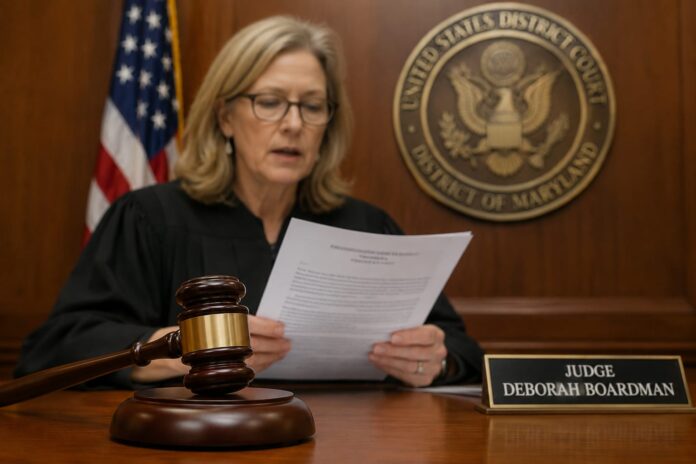
Story Highlights
- A federal judge has blocked President Trump’s executive order aimed at limiting birthright citizenship.
- The ruling emphasizes the constitutional protections afforded by the Fourteenth Amendment.
- Judge Deborah Boardman cited previous Supreme Court decisions in her ruling.
- This decision reflects ongoing legal challenges to the administration’s immigration policies.
What Happened
In a significant legal development, U.S. District Judge Deborah Boardman issued a ruling on Wednesday that blocks President Trump’s latest executive order intended to restrict birthright citizenship. This order, signed on August 6, sought to limit the eligibility of individuals born in the United States for automatic citizenship, a right that has been a cornerstone of American law since the ratification of the Fourteenth Amendment in 1868. Judge Boardman’s 35-page ruling declared that the executive order is ‘almost certainly unconstitutional,’ reinforcing the judiciary’s role in upholding constitutional rights against executive overreach.
The ruling comes in the wake of a previous Supreme Court decision that prevented Trump from implementing a similar order issued at the beginning of his second term in office in January 2025. In her decision, Boardman emphasized that the president’s attempts to alter the longstanding tradition of birthright citizenship through executive action are not only unprecedented but also legally untenable.
- Judge Deborah Boardman issued the ruling on Wednesday.
- The executive order was signed by President Trump on August 6, 2025.
- The case was brought forth by CASA Inc., a nonprofit organization based in Maryland.
- The ruling cites a previous Supreme Court decision that blocked an earlier executive order on citizenship.
Why It Matters
This ruling is significant not only for its immediate impact on birthright citizenship but also for what it represents in the broader context of immigration policy and executive power. The decision underscores the judiciary’s critical role in maintaining the balance of power among the branches of government. By blocking the executive order, Judge Boardman has reaffirmed that the rights enshrined in the Constitution cannot be easily altered or rescinded by executive fiat. This ruling serves as a reminder that the principles of citizenship and belonging are deeply rooted in American law and tradition.
Moreover, the implications of this ruling extend beyond the courtroom. It highlights the ongoing legal battles that the Trump administration faces in its efforts to reshape immigration policy. The president’s commitment to reforming immigration laws has been a hallmark of his administration, but this ruling illustrates the challenges he encounters in implementing such changes. The decision may embolden advocacy groups and individuals who seek to protect the rights of immigrants and uphold the principles of the Constitution.
- The ruling reinforces the constitutional protections of birthright citizenship.
- It highlights the limitations of executive power in altering established rights.
- Advocacy groups may gain momentum in their efforts to challenge restrictive immigration policies.
- The decision could influence future legal battles regarding citizenship and immigration.
Political and Public Context
The backdrop to this ruling is a complex landscape of immigration policy and legal precedent. The Fourteenth Amendment, which guarantees citizenship to all individuals born on U.S. soil, has been a fundamental aspect of American identity. However, in recent years, there has been a growing movement among some political factions to challenge this principle. The Trump administration’s attempts to limit birthright citizenship have sparked widespread debate and legal scrutiny.
Judge Boardman’s ruling is not an isolated incident; it is part of a larger trend of judicial pushback against executive actions perceived as overreaching. The Supreme Court’s previous decision to block Trump’s initial executive order on citizenship further illustrates the judiciary’s willingness to intervene when constitutional rights are at stake. This ruling also comes at a time when immigration remains a contentious issue in American politics, with various factions advocating for different approaches to citizenship and immigration reform.
- The Fourteenth Amendment has been a cornerstone of American citizenship since 1868.
- Previous Supreme Court rulings have set important precedents regarding citizenship rights.
- The Trump administration has faced multiple legal challenges to its immigration policies.
- Public opinion on immigration remains deeply divided across the political spectrum.
A federal judge ruled Trump's executive order commanding federal agencies to deny citizenship documents to several broad categories of children is unconstitutional, citing the recent Supreme Court decision protecting the right.https://t.co/8XxKt5wzJB
— NBC 7 San Diego (@nbcsandiego) September 3, 2026
What Happens Next
Looking ahead, the implications of this ruling will likely reverberate through the legal and political landscape. The Trump administration may choose to appeal the decision, seeking to overturn the ruling in higher courts. This could lead to a protracted legal battle that further clarifies the boundaries of executive power in relation to immigration policy. Additionally, advocacy groups may seize this opportunity to push for more comprehensive immigration reforms that protect the rights of all individuals, regardless of their background.
Furthermore, this ruling may influence the upcoming political discourse surrounding immigration as the nation approaches the next election cycle. Candidates may be compelled to address the issue of birthright citizenship and the broader implications of immigration policy in their platforms. As the legal challenges continue, the conversation around citizenship rights will remain a focal point in American politics.
- The Trump administration may appeal the ruling, leading to further legal proceedings.
- Advocacy groups may push for broader immigration reforms in response to the ruling.
- The ruling could shape political discourse in the lead-up to the next election.
- Future legal challenges regarding immigration policy are likely to emerge.
