

Story Highlights
- A federal judge declined to immediately block President Trump’s executive order on mail-in voting.
- The court said the legal challenge was premature because key parts of the order have not yet been fully implemented.
- The ruling gives the administration an early procedural win while leaving the door open for future legal challenges.
What Happened
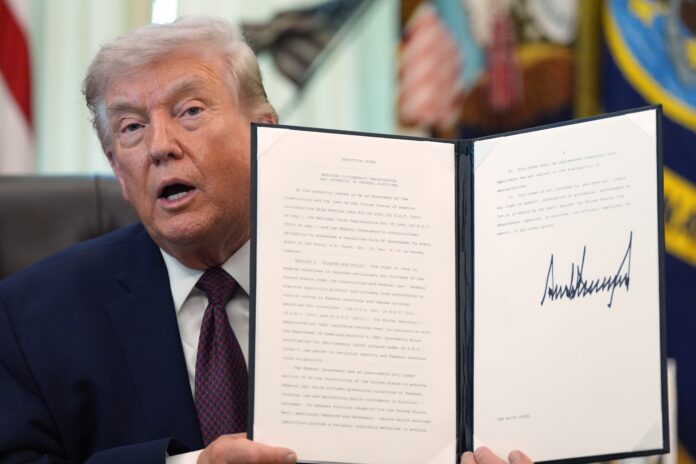
A federal judge declined to immediately block President Donald Trump’s executive order aimed at tightening federal rules connected to mail-in voting, allowing the administration’s policy to remain in place for now.
U.S. District Judge Carl Nichols ruled that the challenge brought by Democratic groups and civil rights organizations was premature because federal agencies have not yet taken enough concrete action to implement the order. The decision means the order can remain standing while the administration continues developing its approach.
The executive order directs federal agencies to review election-related procedures, including efforts tied to citizenship verification and mail-ballot delivery. Challengers argued that the order could interfere with state election systems and create barriers for voters who rely on absentee or mail-in ballots.
Judge Nichols did not issue a final ruling on whether the order is lawful. Instead, he said the plaintiffs could return to court if future agency actions create specific harms.
In his ruling, Nichols noted that the Postal Service may eventually issue rules that directly affect voters or organizations, and that federal agencies may later develop citizenship lists that could create specific problems. If that happens, he said the challengers may renew their request for court intervention.
For the Trump administration, the ruling marks an early legal victory in a broader fight over election rules. For opponents of the order, the decision delays the challenge rather than ending it.
Why It Matters
The ruling keeps Trump’s mail-in voting order alive at a time when election procedures remain a major political issue heading into the midterm cycle.
Supporters of the order argue that stronger federal action is needed to protect election integrity, verify voter eligibility, and restore public confidence in the voting process. They say Trump’s order is part of a broader effort to prevent confusion and strengthen oversight.
Opponents argue that the order could exceed presidential authority and interfere with election rules traditionally managed by states. Civil rights groups have also warned that changes to mail voting could affect elderly voters, rural voters, military families, and others who rely on absentee ballots.
The court’s decision does not resolve those arguments. Instead, it pushes the larger legal fight into a later stage, once federal agencies take clearer steps to carry out the order.
Legal and Political Context
The case centers on the balance of power between the federal government, the states, and the courts in election administration.
Election rules are often handled at the state level, but federal agencies can play important roles in areas such as citizenship data, postal operations, and enforcement of federal election laws. Trump’s order sits at the intersection of those responsibilities, which is why the legal battle is likely to continue.
For Republicans, the ruling can be presented as an early win for Trump’s election-integrity agenda. For Democrats and voting-rights groups, the decision reinforces the need to monitor how the administration implements the order in the months ahead.
The judge’s reasoning also matters because it suggests that future challenges may depend less on the text of the order itself and more on the specific actions agencies take under it.
What Happens Next
Federal agencies are expected to continue reviewing how to implement the executive order. Any final rules or operational changes from agencies such as the Department of Homeland Security or the U.S. Postal Service could trigger additional legal challenges.
If challengers can show that new rules directly harm voters or organizations, the case may return to court with a stronger request for an injunction.
For now, Trump’s order remains in place, but the broader fight over mail-in voting, election authority, and federal power is far from settled.
Sources
A federal judge in D.C. declines to block Trump’s executive order on voting by mail
