

Story Highlights
- President Donald Trump’s threats over the Strait of Hormuz briefly disrupted U.S.-Iran talks before negotiations resumed in Switzerland.
- Iran formally protested the remarks, calling threats a violation of the agreement, but returned to the table.
- Qatar and Pakistan said the talks made constructive progress, including a channel to manage Hormuz-related incidents.
What Happened
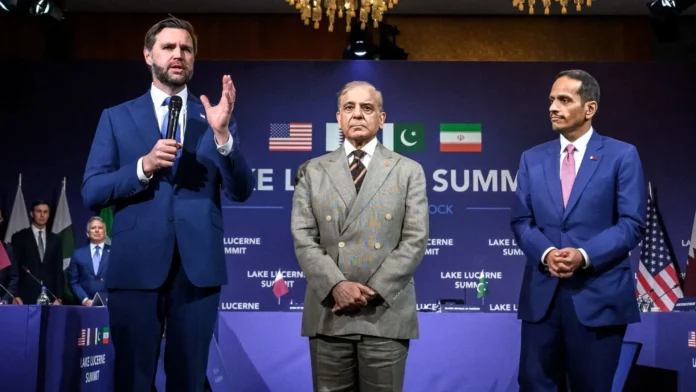
President Donald Trump’s hard-line warnings over the Strait of Hormuz briefly shook U.S.-Iran negotiations before talks restarted in Switzerland.
The negotiations took place at the Bürgenstock resort, where Vice President JD Vance led the U.S. side alongside Steve Witkoff and Jared Kushner.
Qatar and Pakistan served as mediators, helping keep the talks alive after Iran objected to Trump’s public threats.
- Trump warned Iran against closing the Strait of Hormuz.
- Iran’s delegation protested the remarks through state media.
- The talks later resumed and continued into the night.
Trump told Fox News that the United States would respond forcefully if Iran tried to shut down Hormuz.
He also warned that Washington could impose its own tolls if a final deal is not reached within the 60-day negotiating window.
Iranian officials said the remarks violated the spirit of the interim agreement.
Despite that protest, mediators kept both sides engaged.
By the end of the session, Qatar and Pakistan described the atmosphere as positive and constructive.
The parties agreed to create a high-level committee and a dedicated communication channel to manage disputes around the Strait of Hormuz.
Why It Matters
The talks matter because they show both the danger and the durability of Trump’s current Iran strategy.
The danger is that public threats can push Tehran toward walking away.
The durability is that, even after the protest, the talks resumed and produced mechanisms for further negotiation.
- Trump is using pressure to keep Iran from testing the ceasefire.
- Iran is using Hormuz as leverage in talks over sanctions and nuclear limits.
- Mediators are trying to prevent rhetoric from becoming military escalation.
Supporters of Trump’s approach will argue that tough language forced Iran to stay serious at the table.
They will say the president’s threats made clear that Washington will not tolerate another closure of a critical energy waterway.
Critics will argue that threatening military action in the middle of negotiations risks destabilizing the very deal the administration is trying to finalize.
The neutral point is that both sides still returned to negotiations.
That suggests the agreement is fragile, but not broken.
Political and Public Context
Trump is trying to sell the Iran framework as a peace-through-strength achievement.
He wants to show that the United States can end the war, reopen Hormuz, restrain Iran’s nuclear program and keep pressure on Tehran at the same time.
That is a difficult balance.
- Republican hawks want Trump to keep military pressure on Iran.
- Markets want calm shipping conditions in the Gulf.
- Congress wants more clarity on the terms of the Iran framework.
The Switzerland talks gave the White House some positive movement.
Reuters reported that Vance said Iran had agreed to allow nuclear inspectors back into the country and that progress was made on frozen assets and ceasefire maintenance.
That gives Trump an argument that his pressure is producing results.
But Axios reported that Iran nearly walked away after provocative Trump posts, showing how quickly the process can wobble.
The political risk for Trump is that voters may support toughness but still blame the White House if energy prices rise again.
A working Hormuz channel could help reduce that risk if it keeps ships moving and markets calm.
What Happens Next
Technical talks are expected to continue as negotiators work through the hardest details of the 60-day roadmap.
Those details include nuclear inspections, sanctions waivers, frozen-asset controls, Lebanon ceasefire enforcement and shipping access through Hormuz.
Oil markets are likely to respond quickly to any sign of progress or breakdown.
- Watch whether the Hormuz communication channel prevents new maritime incidents.
- Monitor whether Iran follows through on nuclear inspector access.
- Follow whether Lebanon ceasefire violations disrupt the talks again.
- Track whether oil prices continue falling after the Switzerland progress.
Reuters reported that the United States issued temporary sanctions waivers for Iranian oil sales after the talks, while technical meetings are set to continue.
That gives the negotiations momentum, but also raises pressure on Iran to keep Hormuz open and cooperate on inspections.
For Trump, the strongest outcome is a final deal within 60 days that keeps the strait open, stabilizes energy prices and shows voters that military pressure produced diplomatic results.
For Iran, the challenge is securing economic relief without appearing to surrender sovereignty over Hormuz or its nuclear program.
For Qatar and Pakistan, the coming days will test whether their mediation can keep both sides focused when public rhetoric threatens to derail private progress.
The talks restarted after a near-breakdown.
Now the question is whether Trump’s pressure campaign can produce a durable deal rather than another cycle of threats, protests and emergency diplomacy.
