

Story Highlights
- Immigration enforcement operations in southwestern Kansas sparked significant voter mobilization in traditionally Republican strongholds
- Communities with substantial immigrant populations shifted voting patterns in recent electoral cycles
- Local resistance emerged across demographic lines, including from Republican officials concerned about operational approaches
- The enforcement actions demonstrated the complex political dynamics surrounding immigration policy implementation
What Happened
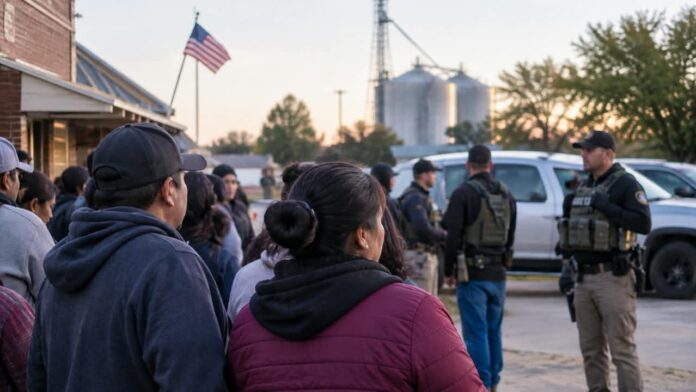
Southwestern Kansas, home to significant meatpacking and feedlot operations, experienced intensive immigration enforcement activities in late September that fundamentally altered local political engagement. The operations featured tactical enforcement teams conducting early-morning residential operations and traffic stops in communities where immigrant populations have become increasingly central to the regional economy and social fabric. These actions sparked widespread community mobilization efforts and transformed previously disengaged residents into active voters.
José Del Real, an Army veteran who had not participated in elections for a decade, became a focal point of this voter engagement movement. Del Real organized community gatherings that drew hundreds of neighbors expressing concerns about the enforcement tactics and their impact on families and local stability. His messaging emphasized the importance of electoral participation, drawing connections between community voice and the voting process. The mobilization efforts extended across multiple counties in southwestern Kansas, regions that had maintained Republican voting patterns for generations.
- ICE enforcement operations conducted in late September across southwestern Kansas counties
- José Del Real, Army veteran with two Iraq tours, transitioned from non-voter to community organizer
- Multiple counties with historically Republican voting records shifted electoral outcomes
- Local Republican officials, including Senator Roger Marshall, raised concerns about enforcement coordination with municipal authorities
Why It Matters
The events in Kansas illuminate critical tensions within the conservative coalition regarding immigration enforcement strategy and implementation. While immigration policy remains a significant policy priority across Republican circles, the practical execution of enforcement operations generated unexpected political consequences. Communities that had supported Republican candidates faced visible disruptions to local economic activity, family structures, and social stability, prompting reassessment of electoral preferences among voters who had previously maintained consistent political alignments.
The electoral shifts in these traditionally Republican regions carried implications for statewide outcomes and demonstrated that enforcement-focused immigration policy can generate mobilization among affected populations. The transformation of apathetic voters into engaged participants reflected both the intensity of community concerns and the salience of immigration policy as a voting issue. Local Republican leadership expressed reservations about coordination and consultation procedures, suggesting that internal party discussions regarding enforcement strategy remained active and contested.
- Voter mobilization among previously disengaged community members altered electoral outcomes in Republican strongholds
- Statewide electoral results reflected shifting voter preferences in counties with substantial immigrant populations
- Local economic disruptions affected community stability in regions dependent on meatpacking and agricultural sectors
- Republican officials acknowledged concerns about consultation processes and operational coordination with local authorities
Political and Public Context
Immigration enforcement policy has remained a defining issue within Republican political platforms and conservative governance priorities. The administration’s focus on deportation enforcement represented a central campaign commitment and policy objective. However, the implementation of enforcement activities in specific communities created measurable political consequences that extended beyond immigration policy discussions into broader questions about the relationship between federal enforcement operations and local political preferences.
Southwestern Kansas represents a microcosm of demographic and economic changes affecting rural American communities. Meatpacking operations and agricultural enterprises in the region have increasingly relied on immigrant labor, creating communities where immigrant populations comprise substantial portions of the resident population. This economic integration, however, occurred within political structures that had maintained Republican voting patterns. The tension between these economic realities and electoral preferences became acute when enforcement operations directly affected community functioning.
The timing of enforcement activities relative to electoral cycles, and the intensity of community response, prompted both Democratic and Republican observers to reassess assumptions about voter behavior and immigration policy preferences. Communications from administration officials reflected ongoing internal discussions about enforcement strategy calibration, with some suggesting that implementation approaches warranted reconsideration while others maintained commitment to aggressive enforcement priorities.
- Immigration enforcement represents core policy priority within conservative governance framework
- Southwestern Kansas economy substantially dependent on immigrant labor in agricultural and meatpacking sectors
- Administration officials communicated differing perspectives regarding enforcement strategy and intensity
- Local Republican leadership raised questions about federal-local coordination procedures and consultation protocols
What Happens Next
The political landscape in southwestern Kansas will likely continue reflecting tensions between immigration enforcement priorities and community preferences. Electoral patterns established during the recent cycle will provide data points for political parties assessing strategy in similar communities nationwide. Republican leadership will face ongoing questions regarding how to maintain immigration enforcement commitments while addressing concerns about community disruption and local political consequences.
The administration’s approach to future enforcement operations will potentially incorporate lessons regarding community impact and political consequences. Both major parties will likely analyze the Kansas experience as a case study for understanding voter behavior in communities affected by federal enforcement activities. Discussions within conservative circles will continue regarding the balance between enforcement intensity and political sustainability in regions with significant immigrant populations employed in essential economic sectors.
National political figures across the ideological spectrum will reference Kansas developments when discussing immigration policy, electoral strategy, and federal enforcement coordination with local authorities. The experience suggests that future immigration policy implementation will warrant consideration of not only policy effectiveness but also political and community consequences in affected regions.
- Electoral patterns in southwestern Kansas likely to influence Republican strategy in similar communities nationwide
- Administration approach to future enforcement operations potentially modified based on community impact assessments
- Ongoing discussions within conservative policy circles regarding enforcement strategy calibration
- Bilateral engagement between federal and local officials on coordination and consultation procedures during enforcement activities