

Story Highlights
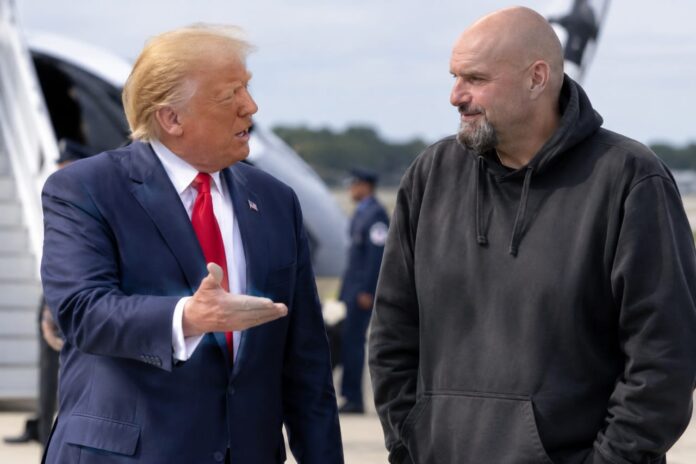
- President Trump expressed enthusiasm about welcoming Pennsylvania Senator John Fetterman into the Republican Party, describing him as a “great guy” with strong common sense
- The Pennsylvania Democrat has increasingly broken ranks with his party on key issues including Iran policy and immigration matters
- Fetterman’s voting record with Senate Democrats has declined from approximately 90% alignment since joining the Senate in 2023 to just under 81% during the current congressional session
- The president suggested that party realignment could enhance Fetterman’s political prospects and polling performance
What Happened
During remarks made after departing Air Force One at Joint Base Andrews on Saturday, the president responded affirmatively when asked whether he would welcome Fetterman into Republican ranks. His administration expressed genuine interest in seeing the Pennsylvania senator make such a transition, with the president characterizing Fetterman as possessing practical judgment and sound instincts that align well with conservative principles. The president also noted that he had previously spoken with Fetterman’s parents and held them in high regard, describing them as magnificent individuals.
The president’s comments reflect broader observations about Fetterman’s increasingly independent voting pattern. Over recent months, the senator has demonstrated willingness to depart from Democratic Party positions on significant matters of national importance. His recent appearances and statements have fueled persistent speculation about his political future and possible party affiliation changes.
- President made remarks at Joint Base Andrews on Saturday praising Fetterman as a solid person with great common sense
- Senator Fetterman has voted with Senate Democrats 81% of the time during the current congressional session, down from approximately 90% historical average
- The Pennsylvania lawmaker has broken with his party on Iran policy and immigration issues in recent months
- President suggested that Republican affiliation could improve Fetterman’s electoral prospects and polling numbers
Why It Matters
Fetterman’s potential political realignment represents a significant development in the Senate’s ideological composition. Should the Pennsylvania senator formally transition to the Republican Party, it would strengthen conservative representation in a chamber where every vote carries substantial weight on consequential legislative matters. The president’s public encouragement of such a move demonstrates a strategic approach to expanding the Republican coalition by attracting independent-minded Democrats whose values increasingly diverge from their party’s positions.
The expanding gap between Fetterman’s voting record and Democratic Party orthodoxy suggests genuine philosophical differences rather than tactical positioning. His willingness to break ranks on major foreign policy and domestic security issues indicates substantive disagreement with progressive Democratic leadership. The president’s endorsement provides political cover and encouragement to senators considering whether their long-term interests align better with Republican principles and a party that appears more receptive to diverse perspectives within its caucus.
- A party switch would strengthen Republican Senate numbers and influence on key legislative votes
- Fetterman’s growing independence from Democratic positions reflects authentic policy disagreements, particularly on foreign affairs and border security
- The president’s public support could encourage other Democrat-affiliated lawmakers to reconsider party loyalty
- Such realignment would demonstrate Republican capacity to appeal to pragmatic, moderate voices skeptical of progressive orthodoxy
Political and Public Context
Fetterman’s potential party realignment arrives amid broader Republican efforts to expand Senate representation. The GOP has identified opportunities to grow its majority by appealing to Democrats whose positions on key issues have diverged from progressive party leadership. This strategy acknowledges that Democratic voters span a wide ideological spectrum, and some elected Democrats represent constituencies with fundamentally conservative orientations on fiscal matters, national security, and border policy.
The senator’s recent activities have intensified speculation about his political trajectory. He has reportedly accessed Republican fundraising platforms to solicit donations and maintains a notably close friendship with Senator Katie Britt of Alabama. Additionally, Fetterman recorded a video introduction for Senator Dave McCormick at the Republican Midterm Convention, signaling comfort with prominent Republican figures and events. These actions, combined with his increasingly independent voting record, paint a picture of a lawmaker whose political home may no longer align with Democratic Party affiliation.
- Fetterman has used Republican fundraising platforms and maintains close relationship with Senator Katie Britt, R-Ala.
- The senator introduced Senator Dave McCormick at the Republican Midterm Convention in a recorded video appearance
- Republican leadership has signaled openness to welcoming Democrats whose values align with conservative principles
- Fetterman’s voting divergence from Democratic colleagues follows pattern of ideological realignment seen with other moderate Democrats in recent years
Trump says he'd 'love' to have Sen. John Fetterman as a Republican amid growing speculation https://t.co/mqGnX0xL4i
— New York Post (@nypost) October 11, 2026
What Happens Next
The political environment appears positioned to encourage further exploration of party realignment possibilities. The president has publicly stated his enthusiasm for such a transition, removing any ambiguity about Republican receptiveness. Should Fetterman ultimately decide to switch party affiliation, he would likely encounter strong bipartisan support from his new Republican colleagues, positioning him favorably within GOP leadership structures and committee assignments.
Whether Fetterman formally transitions to Republican ranks remains uncertain, but the trajectory of recent developments suggests the possibility remains genuinely open. His continued independence on major votes, public interactions with Republican figures, and apparent comfort within conservative circles indicate ongoing deliberation about his political future. The president’s encouragement and positive public framing creates political space for such a decision without requiring Fetterman to justify a dramatic shift in ideology, instead framing it as recognition that his actual positions already align more closely with Republican principles.
- Fetterman faces decision point regarding formal party affiliation, with Republican leadership signaling strong support
- Further voting divergences from Democratic positions could accelerate speculation and internal pressure regarding party switch
- Senate Republican leadership likely to offer prominent committee assignments and leadership opportunities should transition occur
- Timeline for any potential party realignment remains unclear, though recent developments suggest active consideration within political circles
