

Story Highlights
- Federal agents, railroad police, and law enforcement across more than two dozen states conducted a coordinated national operation targeting cargo theft on trains
- Advanced infrared drone technology was deployed to track thieves, detecting heat signatures and providing real-time intelligence to officers on the ground
- Cargo theft costs the U.S. economy between $15 billion and $35 billion annually, with reported losses reaching nearly $725 million in 2025, up 60 percent from the previous year
- Stolen goods including electronics, designer sneakers, and consumer products ultimately result in higher prices for American consumers when manufacturers recover losses
What Happened
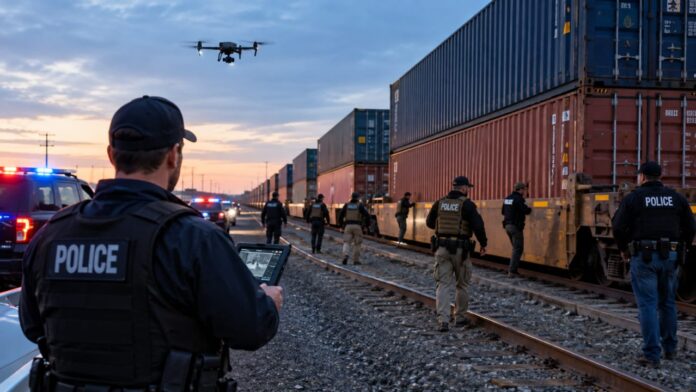
Law enforcement agencies coordinated an unprecedented national operation to combat the rising tide of cargo theft targeting trains across America. In what was described as a first-of-its-kind national blitz, federal agents, railroad police, and local law enforcement personnel from more than two dozen states executed simultaneous operations on the same night, focusing on train tracks and highways where cargo thieves typically operate. The coordinated effort utilized cutting-edge infrared drone technology to identify and apprehend individuals engaged in cargo theft activities.
During the operation, officers deployed unmanned infrared camera systems that could detect heat signatures along railroad tracks and within rail yards. The drone operators communicated real-time information to ground-based enforcement teams, allowing officers to move in strategically without alerting suspects. The infrared technology proved particularly effective because it could detect individuals attempting to hide, as their body heat would remain visible to the cameras even when they attempted to conceal themselves within cargo containers or surrounding areas.
- Operation coordinated across more than two dozen states with federal agents, railroad police, and local law enforcement participating simultaneously
- Infrared drone cameras tracked heat signatures along train tracks and in rail yards to identify and locate cargo thieves in real time
- Officers apprehended individuals caught on drone footage breaking seals on cargo containers worth thousands of dollars in merchandise
- Goods targeted included electronics, designer sneakers, gaming consoles, and other high-value consumer products
Why It Matters
The intensification of cargo theft represents a significant economic challenge for American consumers and businesses. The Department of Homeland Security estimates that cargo theft costs the United States economy between $15 billion and $35 billion annually. Recent data indicates the severity of the problem continues to worsen, with reported cargo theft losses in the U.S. and Canada reaching nearly $725 million in 2025 alone, representing a 60 percent increase from the previous year. This upward trajectory demonstrates that cargo theft has become an increasingly organized and profitable criminal enterprise.
The direct impact on consumer prices cannot be overstated. When manufacturers and shipping companies experience substantial losses to theft, they typically raise prices on their products to offset these losses. This practice effectively passes the burden of theft directly to American consumers who must pay higher prices for everyday goods. Law enforcement officials have emphasized that the items being stolen from trains—including electronics, consumer goods, and seasonal products—typically see price increases following significant theft incidents, particularly during high-demand periods like the holiday shopping season.
- Cargo theft costs the U.S. economy between $15 billion and $35 billion annually according to Department of Homeland Security estimates
- Reported cargo theft losses reached nearly $725 million in 2025, representing a 60 percent increase from 2024
- Manufacturer price increases resulting from theft losses are passed directly to consumers purchasing affected products
- Illinois ranks third nationally for cargo theft incidents, behind only California and Texas
Political and Public Context
Cargo theft has long been recognized as a significant law enforcement challenge, but the scale and organization of modern cargo theft operations distinguish contemporary criminal enterprises from traditional theft rings. Law enforcement officials have increasingly documented the highly organized nature of cargo theft networks, which operate with sophisticated coordination, targeting specific high-value goods and utilizing established distribution channels for stolen merchandise. This level of organization has prompted federal agencies to classify cargo theft as a major criminal priority requiring coordinated national responses.
The deployment of advanced drone technology in this coordinated national operation reflects a broader shift toward utilizing surveillance and reconnaissance capabilities to combat organized cargo theft. The infrared drone systems represent a significant advancement in law enforcement’s ability to detect and apprehend suspects, providing officers with what has been characterized as a decisive tactical advantage. The success of this first-of-its-kind national blitz demonstrates the effectiveness of coordinated, multi-agency operations that share real-time intelligence and execute simultaneous enforcement actions across geographic regions. Cook County Sheriff’s office leadership has noted that the scale of cargo theft represents a critical public safety issue that cannot be effectively addressed through isolated local enforcement efforts alone.
- Cargo theft networks operate with sophisticated coordination and targeted strategies focused on high-value merchandise
- Law enforcement across multiple states including California, Texas, and Illinois have identified cargo theft as a priority requiring coordinated responses
- Infrared drone technology represents a significant tactical advancement providing real-time intelligence to ground-based enforcement teams
- Federal agencies including the Department of Homeland Security and FBI have designated cargo theft as a major criminal enterprise requiring national-level coordination
Train robberies may be a relic of the Old West, but cargo theft is still a big business — and consumers end up paying the price. The Department of Homeland Security estimates cargo theft costs the U.S. between $15 billion to $35 billion a year. In 2025, the FBI says, reported…
— CBS News (@CBSNews) October 9, 2026
What Happens Next
Law enforcement agencies have indicated that the national operation targeting cargo theft represents an ongoing commitment rather than an isolated enforcement action. The success demonstrated through the coordinated use of infrared drone technology and multi-state cooperation suggests that similar operations will likely be replicated and expanded. Agencies have suggested that the technological approach and coordination methodology employed in this operation may become standard practice for future cargo theft enforcement initiatives.
The continued rise in cargo theft losses and the organized nature of these criminal enterprises indicate that law enforcement will need to maintain elevated enforcement pressure and potentially deploy additional technological resources. Officials have noted that upcoming holiday shopping seasons will likely see increased cargo theft activity as criminals target seasonal goods, making continued vigilance and enforcement efforts essential. The coordination demonstrated in this national blitz may serve as a template for future federal, state, and local law enforcement cooperation on complex, multi-jurisdictional criminal enterprises that require simultaneous enforcement action across multiple states.
- Future coordinated enforcement operations will likely employ similar infrared drone technology and multi-state coordination strategies
- Continued monitoring of cargo theft activity during high-demand seasonal periods, particularly the holiday shopping season
- Potential expansion of real-time intelligence sharing among law enforcement agencies across state lines
- Ongoing evaluation of how apprehensions and successful enforcement actions impact cargo theft trends and consumer price pressures
