

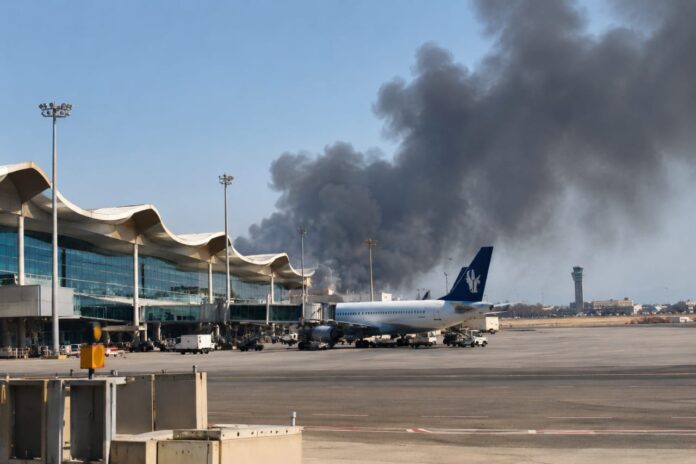
Story Highlights
- Houthi forces conducted attacks targeting Saudi Arabian airport facilities, resulting in three confirmed fatalities
- The incident represents an escalation in the ongoing conflict in Yemen and cross-border military operations
- Civilian infrastructure and personnel have become increasingly vulnerable as regional tensions intensify
- The attacks underscore the broader destabilization affecting the Arabian Peninsula and surrounding areas
What Happened
Recent military operations by Houthi forces have targeted Saudi Arabian airport infrastructure, resulting in a significant loss of life. The attacks on airport facilities resulted in three confirmed deaths, marking another instance of cross-border military activity in the region. The incident highlights the direct impact of the Yemen conflict on neighboring nations and their critical infrastructure, as Houthi capabilities continue to extend beyond traditional battle lines into civilian and commercial zones.
The attacks occurred amid an intensifying pattern of regional hostilities that have characterized the broader conflict affecting Yemen and surrounding areas. Airport facilities in Saudi Arabia serve as crucial economic and transportation hubs, making them significant strategic targets. The successful penetration of these security perimeters and resulting casualties demonstrate both the sophistication of attack capabilities and the vulnerability of infrastructure in the region.
- Three fatalities reported from airport facility attacks by Houthi forces
- Saudi Arabian airport infrastructure targeted and damaged
- Incident represents escalation of cross-border military operations in the region
- October 2026 timeframe marks period of heightened regional tensions
Why It Matters
The attacks carry substantial implications for regional stability and international commerce. Saudi Arabia serves as a central economic and geopolitical player in the Middle East, and successful attacks on its critical infrastructure signal a shift in conflict dynamics. The ability of non-state actors to reach and damage civilian infrastructure indicates an expansion of operational capacity that extends traditional conflict zones into territories previously considered safer and more stable.
These incidents directly impact civilian populations and economic activity throughout the region. Airport closures or security restrictions disrupt business operations, trade routes, and essential services. The loss of civilian life in such attacks underscores how regional conflicts increasingly affect non-combatants and fundamental infrastructure that societies depend upon for functioning. Furthermore, successful strikes on major facilities can trigger security responses that may lead to broader regional escalation and military countermeasures.
The attacks also demonstrate the connectivity between conflict zones and regional security concerns. When military operations in one nation result in strikes against neighboring countries, it illustrates how internal conflicts can become regionalized threats affecting multiple populations and economies. This expansion of conflict scope complicates diplomatic solutions and increases the humanitarian cost of ongoing hostilities.
- Critical infrastructure vulnerability affects regional economic stability and commerce
- Civilian casualties underscore humanitarian dimensions of the conflict
- Successful strikes demonstrate expanded operational capabilities of non-state actors
- Airport attacks disrupt essential services and international connectivity for the region
Political and Public Context
The Yemen conflict has evolved into a complex regional struggle involving multiple international actors and competing geopolitical interests. The war has resulted in significant humanitarian consequences, displacement of populations, and ongoing political fragmentation within Yemen itself. Houthi forces have consistently demonstrated ability to conduct operations that reach beyond traditional conflict zones, challenging conventional security assessments and forcing regional powers to reassess defensive strategies.
Saudi Arabia has engaged in military operations in Yemen for several years, supporting various governmental and coalition forces against Houthi-aligned elements. The conflict has drawn international attention and involvement from multiple nations, each with distinct interests in regional outcomes. The escalating nature of attacks, particularly those reaching critical infrastructure in Saudi Arabia, reflects the inability of existing conflict management mechanisms to contain the scope and intensity of hostilities.
Public and political attention to the Yemen conflict has fluctuated internationally, though the humanitarian dimensions have consistently drawn humanitarian organization concerns and international diplomatic efforts. The broader geopolitical context includes questions about regional power balance, influence of external actors, and the role of various international organizations in conflict resolution and peacekeeping efforts.
- Yemen conflict involves multiple international actors and competing strategic interests
- Saudi-led coalition operations have engaged regional forces for extended period
- Humanitarian organizations document significant civilian impact and displacement
- International diplomatic efforts continue with limited success in achieving sustainable resolution
Pilot killed in attacks by Iran-backed Houthis on Riyadh airport; Saudi-led coalition vows 'firm' response – Two attacks were launched on Saudi Arabia's King Khalid International Airport Thursday, officials said. Via @CNBC:https://t.co/4kCbRipRRH
— 🌊💙 Viking Resistance 💙🌊 (@BlueCrewViking) October 9, 2026
What Happens Next
The airport attacks will likely trigger Saudi Arabian security reassessments and potential military responses. Enhanced defensive measures around critical infrastructure may be implemented, including increased security protocols at airports and other strategic facilities. International partners and allies may increase support for Saudi defense capabilities and security arrangements, particularly regarding air defense and infrastructure protection systems.
Regional diplomatic channels may face pressure to address escalating tensions, though historical patterns suggest limited near-term breakthrough potential. The attacks may influence international discussions regarding Yemen conflict resolution, humanitarian access, and the role of external military support. Additional regional actors may feel compelled to adjust their military postures or strategic positioning in response to demonstrated capabilities.
The humanitarian situation in Yemen itself may worsen as military escalation continues and resources devoted to conflict increase. Internal political factions within Yemen may face shifting circumstances that affect power balances and territorial control. Longer-term implications include questions about whether military solutions can achieve political objectives or whether sustained conflict becomes the default state of regional relations.
- Saudi Arabia expected to enhance airport security and critical infrastructure defenses
- International military support and cooperation likely to increase for regional allies
- Diplomatic efforts may intensify despite historical challenges in achieving breakthroughs
- Humanitarian conditions anticipated to deteriorate further absent major conflict de-escalation
