

Story Highlights
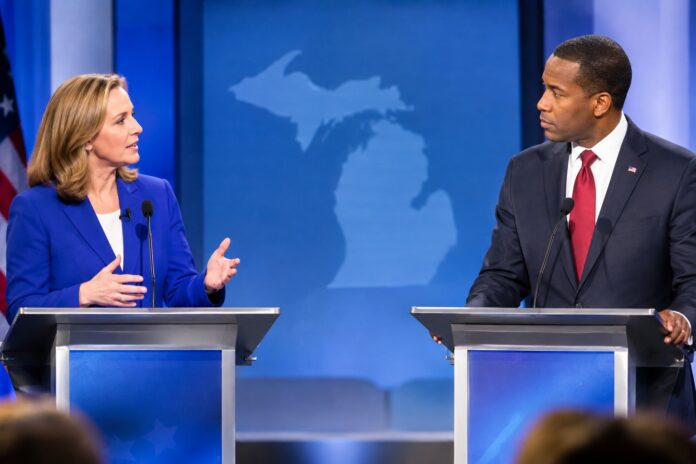
- Michigan Secretary of State Jocelyn Benson and Representative John James engaged in their first gubernatorial debate Tuesday evening as the general election approaches
- The race to succeed term-limited Governor Gretchen Whitmer has drawn significant national attention with Election Day weeks away
- Nonpartisan election analysts have assessed the contest with varying confidence levels regarding each candidate’s prospects
- The debate was hosted by Nexstar’s WOOD-TV and began at 7 p.m. EDT
What Happened
Michigan’s gubernatorial race reached a critical juncture as Secretary of State Jocelyn Benson, the Democratic candidate, and Representative John James, the Republican nominee, faced off in their first general election debate. The two candidates engaged in direct discussion of key issues facing the state as voters prepare to make their decision in the upcoming election. The debate format provided both candidates with an opportunity to present their platforms, respond to direct challenges, and articulate their vision for Michigan’s future leadership.
The encounter marked a significant moment in the campaign cycle, occurring during the final weeks before Election Day. The debate covered various policy areas relevant to Michigan voters and the state’s continued development. Both candidates utilized the platform to distinguish their approaches and appeal to the electorate across the state.
- Secretary of State Jocelyn Benson represented the Democratic Party in the race
- Representative John James represented the Republican Party in the contest
- The debate occurred on Tuesday evening with a 7 p.m. EDT start time
- WOOD-TV, a Nexstar-owned outlet, hosted the forum
Why It Matters
The gubernatorial debate carries substantial weight in determining voter sentiment ahead of the election. Michigan is a significant state in national political calculations, and the race to succeed Whitmer has attracted considerable attention from political observers and analysts. The debate provided both candidates with a prime opportunity to communicate directly with voters and shape the final narrative before ballots are cast. For many Michigan voters who remain undecided or seek to learn more about each candidate’s positions, the debate offered crucial information to inform their voting decisions.
The contest represents a pivotal moment in Michigan’s political landscape. Control of the governor’s office has implications for state policy on economics, education, healthcare, and numerous other areas affecting residents’ daily lives. The debate allowed both candidates to address voter concerns directly and demonstrate their capability to lead the state through various challenges and opportunities ahead.
- Michigan voters received direct information about each candidate’s policy positions and leadership approach
- The debate influenced potential shifts in voter preference during the final weeks of the campaign
- The outcome of the gubernatorial race will determine direction of state policy across multiple sectors for the next four years
- Media coverage of the debate shaped broader campaign narratives and public perception of both candidates
Political and Public Context
The race to succeed Governor Gretchen Whitmer represents a significant test of voter preferences in Michigan. Whitmer, who has served as governor during a period of considerable national political change, is term-limited and unable to seek another term. Her departure from the governor’s office opens the position to new candidates and represents an opportunity for either party to maintain or shift control of the state’s executive branch.
Nonpartisan election analysts have provided assessments of the race dynamics. The Cook Political Report, a respected nonpartisan election handicapper, has characterized the 2026 race with specific leanings regarding candidate prospects. Additionally, Decision Desk HQ, another independent elections analysis organization, has calculated probabilistic assessments of each candidate’s likelihood of victory based on available polling and demographic data. These analyses provide context for understanding the competitive landscape and how various observers view the race’s trajectory.
The debate format itself reflects standard practice in major gubernatorial campaigns, where candidates engage in direct public discussions of issues and policy differences. Such forums have historically served as important moments in election cycles, sometimes shifting voter sentiment and establishing key themes that dominate final weeks of campaigning.
- Governor Gretchen Whitmer’s term-limited status opened the gubernatorial office to new candidates
- The Cook Political Report provided nonpartisan assessment of the race dynamics and competitive balance
- Decision Desk HQ generated probabilistic analyses of candidate victory prospects based on campaign data
- Gubernatorial debates serve as traditional venues for direct candidate engagement with Michigan voters
Michigan governor candidates Jocelyn Benson and John James clashed Tuesday night over data centers, tariffs, the gas tax and Medicaid. pic.twitter.com/ym9NXE0xpH
— FOX 17 (@FOX17) October 7, 2026
What Happens Next
Following the debate, both campaigns will likely continue their efforts to reach voters and build support through the remaining weeks before Election Day. Media analysis of the debate performance will provide commentary on candidate strengths, weaknesses, and memorable moments that may resonate with voters. Campaign teams will assess the debate’s impact on polling and adjust their strategies accordingly.
Additional campaign activities will continue as candidates engage in further public appearances, advertising, and outreach to key voter populations across Michigan. The period between this debate and Election Day represents the final opportunity for both candidates to persuade undecided voters and mobilize their respective bases. Campaign organizations will focus on voter turnout efforts and last-minute messaging designed to influence final voting decisions.
- Media outlets will analyze debate performance and provide commentary on candidate effectiveness
- Both campaigns will assess debate impact on polling and voter sentiment throughout Michigan
- Additional campaign events and advertising will occur during the remaining weeks before Election Day
- Voter turnout efforts and final campaign messaging will intensify as the election approaches
