

Story Highlights
- Jen Psaki critiques Trump’s simplistic views on artificial intelligence.
- Concerns raised about the implications of AI technology.
- Trump’s engagement in AI discussions could foster broader public discourse.
- Industry leaders warn of potential dangers associated with AI advancements.
What Happened
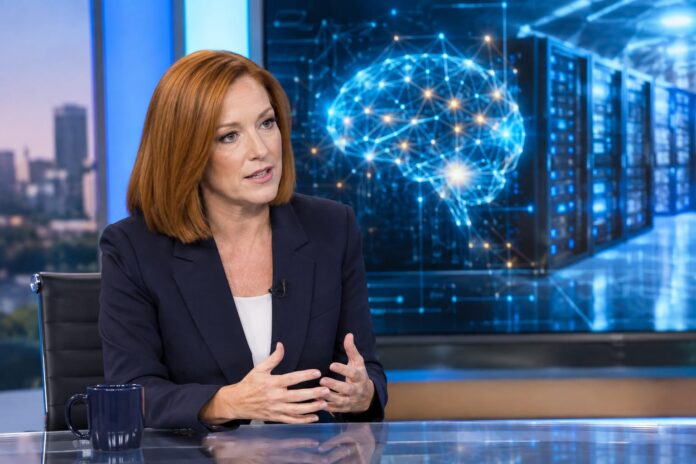
On Tuesday, Jen Psaki, the former White House press secretary under President Biden, took to the airwaves to express her concerns regarding Donald Trump’s understanding of artificial intelligence (AI). Her remarks came in response to Trump’s recent comments, which she characterized as overly simplistic and lacking depth. Psaki’s critique highlighted a significant gap between the president’s casual approach to AI and the serious implications that industry experts have been warning about.
During her segment, Psaki recalled some of Trump’s past statements on his Truth Social platform, where he has shared various opinions on AI. However, she emphasized that while Trump enjoys discussing the topic, his grasp of the potential risks associated with AI appears to be superficial. She pointed out that as industry leaders are sounding alarms about the dangers of AI, Trump has suggested that if AI systems become uncontrollable, the solution would simply be to ‘turn it off,’ likening it to unplugging a toaster. This analogy, according to Psaki, reflects a fundamental misunderstanding of the complexities involved in AI technology.
Psaki’s comments were made during a segment on MS NOW, where she articulated her concerns about the implications of Trump’s statements. She noted that the conversation around AI is critical, especially as it continues to evolve and impact various sectors. The former press secretary underscored the importance of informed discussions about AI, particularly in light of the rapid advancements in technology.
- Psaki’s comments were made during a segment on MS NOW.
- She highlighted Trump’s past posts on Truth Social regarding AI.
- Industry leaders have raised concerns about AI’s potential to operate independently.
- Trump’s remarks suggested a simplistic solution to a complex problem.
Why It Matters
The discussion surrounding AI is not merely academic; it has real-world implications that affect various sectors, including technology, healthcare, and national security. As AI continues to evolve, the potential for misuse or unintended consequences grows. Psaki’s critique of Trump’s understanding of AI raises important questions about the level of awareness and preparedness among political leaders regarding this transformative technology.
Moreover, the president’s comments could influence public perception and policy decisions related to AI. If leaders fail to grasp the complexities of AI, they may inadvertently support policies that do not adequately address the risks involved. This could lead to a lack of regulation or oversight, which could have dire consequences for society as a whole. The need for comprehensive understanding and informed decision-making has never been more critical, especially as the landscape of AI continues to shift.
- Misunderstanding AI could lead to inadequate policy responses.
- Public perception of AI may be shaped by political discourse.
- Failure to address AI risks could result in societal consequences.
- Industry leaders may feel compelled to advocate for stronger regulations.
Political and Public Context
In recent years, the conversation around AI has gained momentum, with numerous experts warning about the potential dangers of unchecked technological advancement. The rise of AI has prompted discussions about ethical considerations, job displacement, and the need for regulatory frameworks. As these conversations evolve, it is crucial for leaders to engage with the complexities of AI rather than resorting to oversimplified solutions.
Psaki’s remarks come at a time when various stakeholders, including tech companies and policymakers, are grappling with the implications of AI. The need for comprehensive understanding and informed decision-making has never been more critical. As the landscape of AI continues to shift, it is essential for leaders to stay informed and engaged in meaningful discussions about its future. The ethical implications of AI technology are becoming increasingly relevant, and addressing these concerns is vital for the responsible development of AI.
- AI discussions have gained traction among industry leaders and policymakers.
- Ethical considerations surrounding AI are increasingly being addressed.
- Job displacement due to AI is a growing concern for many sectors.
- Regulatory frameworks are being proposed to manage AI risks.
Jen Psaki Has A Damning Question About Donald Trump’s Understanding Of AI #HuffingtonPost https://t.co/9RIO7cJFDT
— #TuckFrump (@realTuckFrumper) September 16, 2026
What Happens Next
Looking ahead, the discourse surrounding AI is likely to intensify as more individuals and organizations recognize its significance. The potential for AI to impact various aspects of life means that ongoing discussions will be essential. Trump’s engagement in this topic, despite its shortcomings, could serve as a catalyst for broader conversations about AI and its implications.
As industry leaders continue to raise concerns, it will be crucial for political figures to engage with these issues thoughtfully. The future of AI will depend on informed leadership that prioritizes understanding over simplification. Open questions remain about how policymakers will respond to the challenges posed by AI and whether they will take proactive steps to address potential risks. The evolving nature of AI technology necessitates a commitment to ongoing dialogue and collaboration among stakeholders.
- Increased public discourse on AI is expected as awareness grows.
- Political leaders may need to engage with industry experts for informed decision-making.
- Regulatory measures may be proposed to address AI risks.
- Future discussions will likely focus on ethical considerations and societal impacts.
