
Story Highlights
- President Trump criticizes the Federal Reserve Board for recent interest rate hikes.
- He praises Federal Reserve Chair Kevin Warsh while expressing concern over the board’s decisions.
- The Fed’s recent rate increase marks the first hike in three years, raising rates to a range of 3.75 to 4 percent.
- Trump advocates for lower interest rates to bolster economic growth and stability.
What Happened
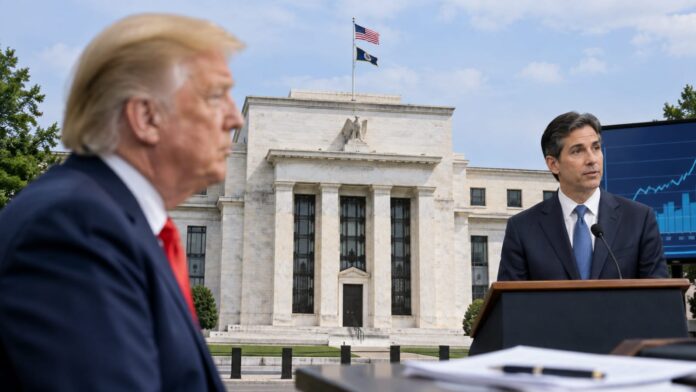
On Wednesday, President Trump took a firm stance against the Federal Reserve Board, attributing the recent interest rate hikes to the board’s decisions rather than to Federal Reserve Chair Kevin Warsh, whom he praised. After landing in North Carolina, Trump expressed his reliance on Warsh but noted the challenges posed by the board, which he described as ‘very hostile’ and ‘political.’ This criticism comes in light of the Federal Reserve’s announcement that it would raise interest rates to a range of 3.75 to 4 percent, marking the first increase in three years. The president’s remarks reflect a broader concern about the impact of high interest rates on the economy, particularly as the nation continues to recover from the challenges posed by the pandemic and other economic pressures.
Trump’s comments underscore his belief that the Federal Reserve’s actions could hinder economic recovery. He emphasized the need for lower interest rates to stimulate growth and support American businesses. The president’s remarks were made during a time when many economists are closely monitoring the effects of monetary policy on the economy.
- Trump praised Federal Reserve Chair Kevin Warsh.
- The Federal Reserve announced a rate hike to 3.75 to 4 percent.
- This marks the first interest rate increase in three years.
- The board voted unanimously for the rate hike.
Why It Matters
The implications of the Federal Reserve’s decision to raise interest rates are significant, particularly in the context of the current economic climate. President Trump’s call for lower interest rates is rooted in the belief that such measures are essential for fostering economic growth and stability. High interest rates can stifle borrowing and investment, which are critical components of a thriving economy. By advocating for a reduction in rates, Trump is positioning himself as a champion for the American worker and business owner, emphasizing the need for policies that support economic expansion rather than contraction.
The president’s comments also highlight a growing concern among many economists and business leaders about the potential negative effects of high interest rates on consumer spending and business investment. As the economy continues to recover, the balance between controlling inflation and supporting growth becomes increasingly important.
- High interest rates can hinder economic growth by discouraging borrowing.
- Trump’s advocacy for lower rates aims to support American businesses and workers.
- The decision to raise rates may lead to increased costs for consumers and businesses alike.
- Many economists share concerns about the potential negative impact of high rates on the economy.
Political and Public Context
Understanding the context of the Federal Reserve’s decision to raise interest rates is crucial for grasping the broader economic landscape. The rate hike comes after a prolonged period of low interest rates, which were implemented to stimulate the economy during the pandemic. However, as the economy shows signs of recovery, the Federal Reserve has signaled a shift in its monetary policy to combat inflation. This shift has sparked debate among economists and policymakers about the appropriate balance between controlling inflation and supporting economic growth.
Trump’s criticism of the board reflects a broader sentiment among some conservatives who believe that the Federal Reserve’s actions may be overly cautious and detrimental to economic recovery. The ongoing discussions about monetary policy are likely to influence public opinion and political discourse as the nation approaches future elections.
- The rate hike follows a prolonged period of low interest rates during the pandemic.
- There is ongoing debate about the balance between controlling inflation and supporting growth.
- Trump’s criticism aligns with concerns among conservatives about the Fed’s cautious approach.
- The economic recovery is still fragile, making the timing of rate hikes critical.
PRESIDENT TRUMP SAYS HE TOLD FED CHAIR KEVIN WARSH TO "VOTE WITH THE BOARD" ON TODAY'S RATE HIKE BECAUSE "IT'S NOT GOING TO MATTER" 🇺🇸
Asked if he still has confidence in Warsh, Trump said yes, then went after the rest of the Fed.
"He's got a very tough board. He's got a board… pic.twitter.com/VdLmgxTjzZ
— WOLF (@WOLF_Financial) September 17, 2026
What Happens Next
Looking ahead, the future of interest rates and the Federal Reserve’s monetary policy will be closely watched by economists, investors, and policymakers alike. The president’s call for lower interest rates may resonate with many who are concerned about the potential impact of high rates on economic growth. As the Federal Reserve navigates the complexities of inflation and economic recovery, questions remain about how it will balance these competing priorities.
The potential for further rate hikes in the coming months could have significant implications for the economy, particularly if inflation continues to rise. Trump’s advocacy for lower rates may also influence public sentiment and political discourse as the nation approaches the next election cycle. The decisions made by the Federal Reserve in the near future will be critical in shaping the economic landscape.
- Future Federal Reserve meetings will be critical in determining the trajectory of interest rates.
- Trump’s advocacy may shape public opinion on economic policy leading up to elections.
- Investors will closely monitor inflation trends and their impact on monetary policy.
- Questions remain about the long-term effects of rate hikes on economic recovery.