

Story Highlights
- President Trump advocates for minimal regulation of artificial intelligence.
- Critics argue that his personalist approach undermines necessary safeguards.
- Concerns arise over potential conflicts of interest involving AI advisors.
- The debate highlights the balance between innovation and safety in technology.
What Happened
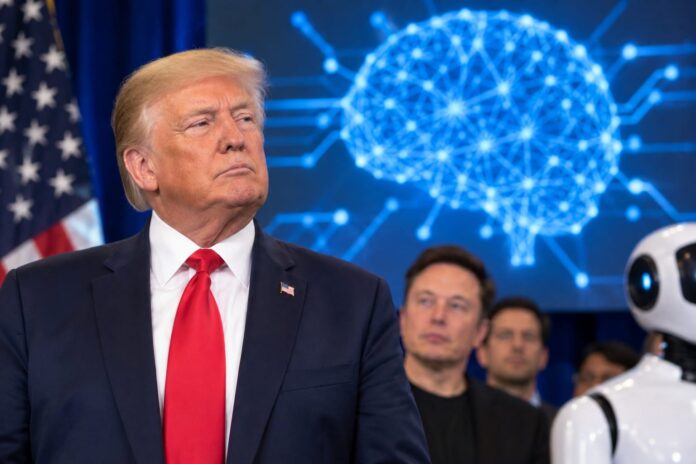
The recent comments made by President Trump regarding artificial intelligence (AI) regulation have ignited a heated debate across the political spectrum. In a post on Truth Social, he boldly declared that the only control AI requires is a ‘strong and smart’ president, implying that his leadership alone is sufficient to manage the complexities of this rapidly evolving technology. This statement has drawn both support and criticism, with many questioning the implications of such a personalist approach to governance. Critics argue that relying on the whims of a single leader, rather than established legal frameworks, poses significant risks to society. The president’s stance raises concerns about the potential for conflicts of interest, particularly given his close ties to influential figures in the AI industry.
Trump’s comments have sparked discussions about the future of AI regulation and the role of government in overseeing technological advancements. As AI technologies continue to evolve, the need for a structured regulatory framework becomes increasingly apparent. The debate has intensified as stakeholders from various sectors weigh in on the implications of Trump’s approach.
- Trump’s post on Truth Social emphasized his belief in personal leadership over regulatory frameworks.
- Critics have highlighted the risks associated with a lack of formal regulations.
- David Sacks, a key AI advisor to Trump, has been scrutinized for potential conflicts of interest.
- The debate has intensified as AI technologies continue to advance rapidly.
Why It Matters
The implications of Trump’s stance on AI regulation extend far beyond the realm of technology; they touch on fundamental questions about governance, accountability, and the role of leadership in a democratic society. By advocating for minimal regulation, the president positions himself as the ultimate arbiter of AI development, which raises concerns about the potential for abuse of power. Critics argue that this approach undermines the necessary safeguards that protect the public from the risks associated with AI technologies.
The rapid advancement of AI has the potential to create significant externalities—costs imposed on individuals and society that are not accounted for in the market. For instance, the fear that AI could lead to job displacement, privacy violations, or even existential threats to humanity underscores the need for thoughtful regulation. Without proper oversight, the risks associated with AI could escalate, affecting millions.
- Without proper oversight, the risks associated with AI could escalate, affecting millions.
- Trump’s personalist approach may lead to decisions that prioritize short-term gains over long-term safety.
- Stakeholders in the AI industry may benefit from a lack of regulation, potentially at the expense of public welfare.
- The debate highlights the tension between innovation and the need for responsible governance.
Political and Public Context
The discussion surrounding AI regulation is not new; it has been a topic of concern among policymakers, technologists, and ethicists for years. As AI technologies have advanced, so too have the calls for regulation to ensure that these innovations are developed and deployed responsibly. The Trump administration’s approach to regulation has often been characterized by a preference for deregulation, which aligns with the president’s broader economic philosophy. However, the unique challenges posed by AI necessitate a more nuanced approach.
The potential for AI to disrupt various sectors, from healthcare to finance, raises questions about how best to balance innovation with safety. Furthermore, the involvement of influential figures like David Sacks, who has both advisory and investment roles in the AI sector, complicates the landscape. The ongoing debate over AI regulation reflects broader tensions in American governance.
- The ongoing debate over AI regulation reflects broader tensions in American governance.
- Previous administrations have grappled with similar issues, but Trump’s approach is distinct.
- Concerns about conflicts of interest are not new, but they are particularly pronounced in this context.
- The rapid pace of AI development necessitates urgent discussions about ethical considerations.
Despite echoing calls for regulation from AI industry leaders, Trump has said the U.S. must prioritize winning the global AI race. https://t.co/IPy4Rk9fEQ
— Newsweek (@Newsweek) September 14, 2026
What Happens Next
As the debate over AI regulation continues, several key questions remain unanswered. Will the Trump administration take steps to formalize its stance on AI, or will it continue to rely on personal judgment? The future of AI regulation in the United States may hinge on the outcomes of upcoming elections and the political landscape that emerges. Additionally, the role of Congress in shaping AI policy will be critical. Lawmakers will need to grapple with the complexities of AI and consider how best to protect the public while fostering innovation.
The potential for bipartisan cooperation on this issue exists, but it will require a willingness to engage in constructive dialogue. Future legislative efforts may seek to establish a framework for AI regulation, and public opinion will likely play a significant role in shaping the direction of AI policy.
- Future legislative efforts may seek to establish a framework for AI regulation.
- Public opinion will likely play a significant role in shaping the direction of AI policy.
- Stakeholders from various sectors will need to collaborate to address the challenges posed by AI.
- The outcomes of the 2024 elections could significantly impact the regulatory landscape.
